External Debt: Definitions, Sustainability, and Economic Indicators
When discussing a nation's financial health, it is crucial to distinguish between government debt—the total amount owed by a state—and external debt. External debt, also known as foreign debt, represents the liabilities that residents of a country owe to nonresidents. These debtors can include national governments, private corporations, or individual citizens.
External debt may be denominated in either domestic or foreign currency. Lenders typically include private commercial banks, foreign governments, and international financial institutions such as the World Bank and the International Monetary Fund (IMF). Because it measures an economy's future payment obligations, external debt serves as a primary indicator of a country's vulnerability to liquidity and solvency problems.
To gain a more complete picture, economists often look at the net external debt position, which is the gross external debt minus external assets held in the form of debt instruments. A closely related concept is the net international investment position (net IIP). When debt securities are measured at market value, the net external debt position is essentially the net IIP, excluding financial derivatives, employee stock options, and equity or investment fund shares.
Key Facts
- Definition: Gross external debt consists of actual, current liabilities owed to nonresidents that require future principal and/or interest payments.
- Scope: It includes arrears of both principal and interest but excludes contingent liabilities (transactions dependent on specific conditions).
- Residence: Debt is classified as external based on the center of economic interest (location) of the debtor and creditor, not their nationality.
- Sustainability: Debt is sustainable if a country can meet all obligations without needing debt relief, rescheduling, or compromising economic growth.
- Critical Thresholds: The IMF and World Bank suggest that bringing the net present value (NPV) of public external debt to 150% of exports or 250% of revenues helps ensure long-term sustainability.
Defining External Debt
According to the IMF's External Debt Statistics: Guide for Compilers and Users, gross external debt refers to outstanding, actual current liabilities. To be classified as such, the debt must meet specific criteria regarding its nature and the relationship between the parties involved.
Principal and Interest
The definition encompasses both interest payments (the periodic cost of borrowing) and principal payments (payments that reduce the outstanding balance). The classification of external debt does not require the exact timing of these payments to be known, nor does it distinguish between the two types of payments.
Residence and Contingency
The distinction between resident and nonresident is based on where the parties are ordinarily located—their center of economic interest—rather than their legal nationality. Furthermore, contingent liabilities—arrangements that only trigger a financial transaction if certain conditions are met—are excluded from the definition of external debt, though they remain analytically important for assessing economic risk.
Classification Systems
Countries categorize external debt differently. A common four-head classification includes:
- Public and publicly guaranteed debt
- Private non-guaranteed credits
- Central bank deposits
- Loans due to the IMF
Some nations use more granular systems. For example, India utilizes a seven-head classification that includes multilateral and bilateral debt, trade credit, commercial borrowings, Rupee debt, NPR debt, and deposits from Non-resident Indians and persons of Indian origin.
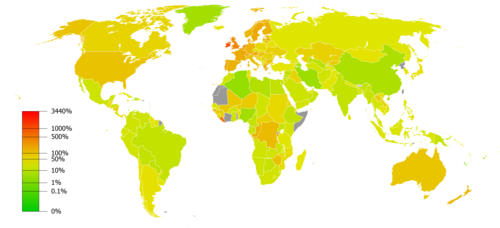
![Total debt service as % of exports of goods, services and primary income in 2017[3]](/images/1d/95/1d959d8688224c26b675968e303b6807cc762e11426ba42e7ad536c07559c8c6.webp)
External Debt Sustainability
Debt sustainability is the level of debt that allows a country to fulfill its current and future debt service obligations in full. A sustainable position avoids the accumulation of arrears and the need for rescheduling or debt relief, all while maintaining an acceptable level of economic growth.
Sustainability is typically analyzed through medium-term scenarios. These numerical evaluations account for economic variables and policy uncertainties—such as fiscal policy and current account outlooks—to determine if debt will stabilize at reasonable levels. High levels of external debt are generally viewed as harmful to an economy's overall health.
![Share of U.S. gross external debt by debtors[4]](/images/ab/34/ab34ef6722cd45085fc06a256f7f1c2b83f5e295798232785abaede1b42598c4.png)
Measuring Debt Through Indicators
Economists use various ratios to determine if a country's debt is sustainable. These indicators measure solvency (the ability to generate resources to repay the total balance) and liquidity (the ability to meet short-term payment obligations).
Debt Burden and Solvency Indicators
These ratios compare the stock of debt to the country's overall economic capacity:
- Debt-to-GDP ratio
- Foreign debt to exports ratio
- Government debt to current fiscal revenue ratio
- Share of foreign debt, short-term debt, and concessional debt (loans with an original grant element of 25% or more) within the total debt stock.
Liquidity Monitoring Indicators
These serve as early-warning signs for potential debt service problems:
- Debt service to GDP ratio
- Foreign debt service to exports ratio
- Government debt service to current fiscal revenue ratio
Dynamic Ratios
Forward-looking indicators, such as the ratio of the average interest rate on outstanding debt to the growth rate of nominal GDP, show how the debt burden will evolve over time without new disbursements or repayments.
| Indicator Category | Focus | Examples |
|---|---|---|
| Solvency | Long-term ability to repay total debt stock | Debt-to-GDP, Foreign debt to exports |
| Liquidity | Short-term ability to meet payment obligations | Debt service to GDP, Debt service to exports |
| Dynamic | Future evolution of the debt burden | Average interest rate vs. nominal GDP growth |
Frequently Asked Questions
What is the difference between government debt and external debt?
Government debt (or public debt) is the total amount owed by a government or state. External debt specifically refers to liabilities owed by residents of a country (which can include the government, corporations, or citizens) to nonresidents.
What are contingent liabilities?
Contingent liabilities are financial arrangements where a transaction only takes place if certain conditions are fulfilled. Unlike gross external debt, these are not included in the official external debt totals, although they are monitored for economic vulnerability.
How is "residence" determined for external debt?
Residence is determined by the center of economic interest—typically where the debtor and creditor are ordinarily located—rather than by their legal nationality.
What is considered "concessional debt"?
Concessional debt refers to loans that have an original grant element of 25 percent or more, making them more favorable to the borrower than standard commercial loans.
When is external debt considered sustainable?
Debt is sustainable when a country can meet its current and future payment obligations in full without needing to reschedule debt, accumulate arrears, or sacrifice economic growth.