Gross National Income per Capita: 2025 World Bank Atlas Method Analysis
Measuring the economic health of a nation requires precise metrics that can be compared across borders. One of the most widely recognized indicators is the Gross National Income (GNI) per capita. Developed by the World Bank, this metric provides a snapshot of a country's economic strength by calculating the total income earned by a nation's residents and dividing it by the midyear population.
To ensure consistency, the World Bank utilizes the Atlas method, a specific valuation technique used to classify economies. While GNI per capita is a powerful tool for identifying economic needs and strengths, it is important to note that it does not account for income distribution within a population.
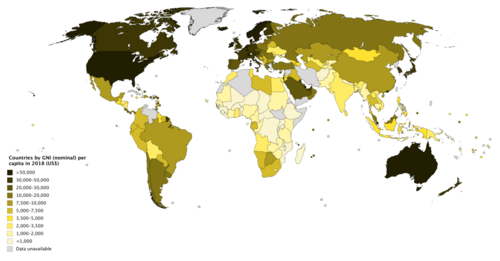
How GNI per Capita is Calculated
Gross National Income is more than just a measure of domestic production. It is a comprehensive sum that includes several key financial components:
- Value Added: The total value added by all resident producers.
- Product Taxes: Any product taxes minus subsidies that were not already included in the output valuation.
- Net Primary Income: Net receipts from abroad, which include property income and compensation for employees.
By dividing this total GNI by the midyear population, economists arrive at the GNI per capita, expressed in nominal U.S. dollars.
Key Facts
- High-Income Threshold: For 2025, the World Bank's threshold for high-income economies is set at US$14,375.
- Inflation Impact: Countries experiencing persistent high inflation may be classified lower than their nominal GNI suggests.
- Atlas Method: This specific indicator is used by the World Bank to standardize income measurements across different currencies.
- Correlation: GNI per capita is typically closely linked to other social, environmental, and economic well-being indicators.
Income Classifications and Exceptions
While the nominal GNI per capita usually determines a country's classification, certain economic conditions can lead to exceptions. The World Bank maintains flexibility to ensure classifications reflect economic reality rather than just numerical data.
The Case of Turkey and Argentina
Both Turkey and Argentina have GNI per capita figures that exceed the 2025 high-income threshold of US$14,375. However, the World Bank continues to classify them as upper-middle-income economies. This decision is based on the limitations of the Atlas method when dealing with countries facing persistent high inflation, which can distort nominal values.
Data Availability and Groupings
Not all entities are classified in the same manner. Some territories and dependencies are grouped based on their administrative ties. For example, American Samoa, Guam, and the U.S. Virgin Islands are associated with the United States, while Gibraltar and the British Virgin Islands are associated with the United Kingdom.
| Category | Criteria/Details | Notes |
|---|---|---|
| High-Income Threshold | > US$14,375 | Standard 2025 benchmark |
| Atlas Method | Nominal USD | Used for World Bank classifications |
| Special Classifications | Upper-Middle-Income | Applied to Turkey and Argentina despite high GNI |
| Calculation Basis | GNI / Midyear Population | Excludes income distribution data |
Frequently Asked Questions
What is the difference between GNI and GDP?
While GDP measures the value of goods and services produced within a country's borders, GNI includes net receipts of primary income from abroad, focusing on the income earned by the residents of a country regardless of where the production occurred.
Why are Turkey and Argentina not classified as high-income?
Despite exceeding the US$14,375 threshold, these countries are kept in the upper-middle-income category because persistent high inflation limits the accuracy of the Atlas method's nominal classifications.
Does GNI per capita show how wealth is distributed?
No, GNI per capita is an average. It does not take into account income distribution or inequality within a country.
What is the Atlas method?
The Atlas method is an income indicator developed by the World Bank to provide a standardized way of measuring GNI per capita across different nations using U.S. dollars.
What is the 2025 high-income threshold?
The World Bank has set the high-income economy threshold at US$14,375 for the year 2025.