Strong Interaction: The Force Binding the Atomic Nucleus
In the realm of particle physics, the strong interaction (also known as the strong force or strong nuclear force) is one of the four fundamental interactions of nature. It is the most powerful of these forces, acting as the cosmic glue that confines quarks into protons and neutrons, and subsequently binds those nucleons together to form the heart of every atom: the nucleus.
The influence of the strong interaction is profound. While we often think of the mass of a proton or neutron as coming from its constituent quarks, those quarks actually provide only about 1% of the total mass. The remaining 99% is the result of the immense energy generated by the strong interaction. At a range of 1 femtometer (10-15 meters), this force is approximately 100 times stronger than electromagnetism and 10 times stronger than both the weak interaction and gravitation.
Key Facts
- Primary Role: Confines quarks into hadrons (like protons and neutrons) and binds nucleons into atomic nuclei.
- Force Carriers: Mediated by gluons within hadrons and mesons between nucleons.
- Color Charge: Unlike electric charge, the strong force operates on a property called color charge (red, green, and blue).
- Color Confinement: Quarks can never be isolated; attempting to pull them apart creates new quark-antiquark pairs.
- Mass Contribution: Most of the mass of nucleons is derived from strong interaction energy, not the quarks themselves.
The Evolution of Nuclear Theory
Before 1971, physicists faced a paradox: the atomic nucleus contains multiple positively charged protons. According to the laws of electromagnetism, these protons should repel each other violently, causing the nucleus to fly apart. Since nuclei remain stable, scientists postulated the existence of a powerful attractive force—the strong force—to counteract this repulsion.
In 1964, Murray Gell-Mann and George Zweig independently proposed the quark model, suggesting that baryons (such as protons and neutrons) and mesons are composed of smaller elementary particles. Gell-Mann named these particles "quarks." This discovery revealed that the attraction between nucleons is actually a secondary effect of a more fundamental force binding quarks together.
Quantum Chromodynamics and the Color Force
The theory describing the interaction between quarks and gluons is called Quantum Chromodynamics (QCD). In QCD, quarks carry a property known as color charge. This has no relation to visual color but comes in three types: red, green, and blue (along with their corresponding anti-colors). Quarks with unlike color charges attract one another.
The force is mediated by the gluon, a massless gauge boson. Unlike the photon in electromagnetism, which is electrically neutral, the gluon itself carries a color charge. This allows gluons to interact not only with quarks but also with other gluons.

Color Confinement
One of the most unique aspects of the strong interaction is color confinement. Unlike gravity or electromagnetism, the strong force does not diminish as quarks move apart. Once a certain distance is reached, the force remains constant at approximately 10,000 Newtons. If enough energy is supplied to pull two quarks apart, the energy in the "gluon tube" becomes so great that it "snaps," converting that energy into mass to create a new quark-antiquark pair.
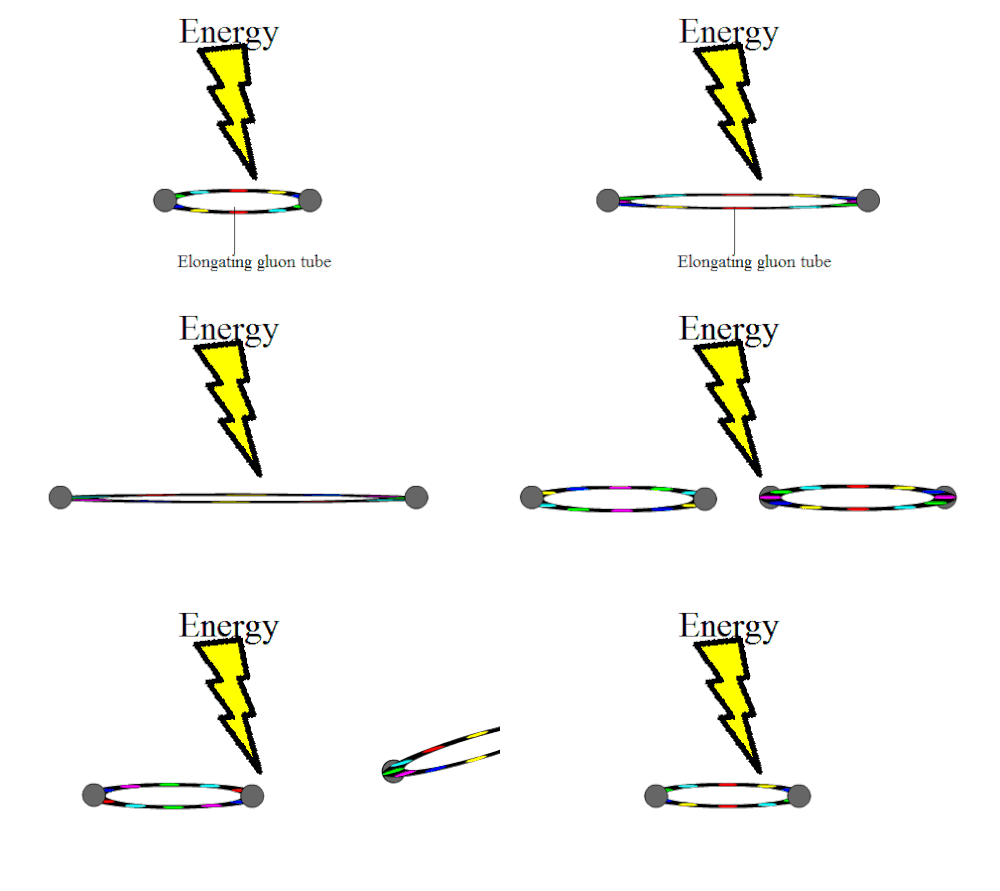
Because of this phenomenon, quarks are never seen in isolation; they are always bound within hadrons. In high-energy collisions, such as those in particle accelerators, this results in "jets" of newly created hadrons rather than individual free quarks.
The Residual Strong Force: Binding the Nucleus
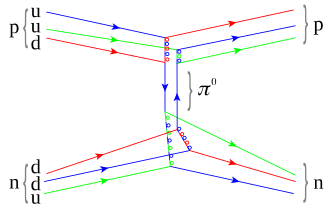
While the primary strong force binds quarks inside a proton, a "leakage" of this force extends beyond the boundaries of the nucleon. This is known as the nuclear force or residual strong force. It is analogous to van der Waals forces in chemistry, which are weaker versions of the electromagnetic forces holding atoms together.
On this larger scale (up to about 3 femtometers), the force is mediated by mesons (such as pions) rather than gluons. This residual force is what binds protons and neutrons together to form the nucleus.
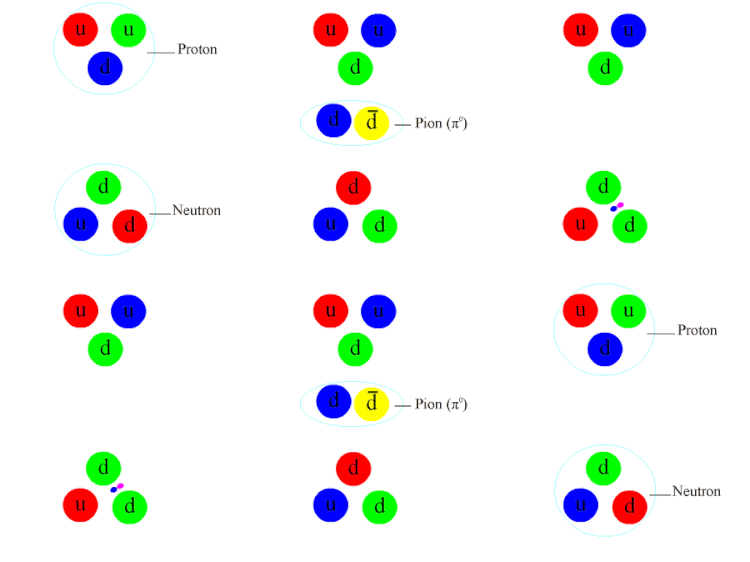
Unlike the fundamental strong force, the residual strong force diminishes rapidly with distance. This rapid decay, combined with the persistent repulsion of protons, explains why very large nuclei (those with atomic numbers greater than 82, like lead) become unstable and radioactive.
Energy and Mass Defect
The nuclear force is so energetic that the mass of a nucleus is actually less than the sum of its individual protons and neutrons. This difference is called the mass defect. The energy associated with this defect powers the universe's most energetic processes:
- Nuclear Fusion: The process of combining light nuclei, which powers the Sun and other stars.
- Nuclear Fission: The splitting of heavy nuclei, which allows for the decay of radioactive isotopes and is utilized in nuclear power plants and fission weapons.
Summary of Strong Interaction Ranges
| Interaction Type | Range | Particles Held | Force Carrier | Resulting Structure |
|---|---|---|---|---|
| Strong (Color Force) | < 0.8 fm | Quarks | Gluons | Hadrons (Protons/Neutrons) |
| Residual Strong (Nuclear Force) | 1–3 fm | Hadrons | Mesons | Atomic Nucleus |
Grand Unification
Physicists are currently working on Grand Unified Theories (GUT), which aim to merge the strong interaction with the electroweak interaction into a single fundamental force. A key property aiding this research is asymptotic freedom, where the strong force actually becomes weaker at extremely high energies or temperatures. While the "grand unification energy" is theorized, a complete, successful GUT remains one of the great unsolved problems in modern physics.
Frequently Asked Questions
Why can't we find a single quark on its own?
Due to a property called color confinement, the energy required to separate two quarks is so immense that it spontaneously creates a new quark-antiquark pair. This ensures quarks always remain bound within hadrons.
What is the difference between the strong force and the nuclear force?
The strong force (or color force) is the fundamental interaction that binds quarks together using gluons. The nuclear force is a residual effect of that interaction that binds protons and neutrons together using mesons.
How does the strong force contribute to the mass of a proton?
The actual mass of the quarks is minimal. Most of a proton's mass comes from the binding energy of the strong interaction, following Einstein's mass-energy equivalence principle.
What happens when the residual strong force is too weak to hold a nucleus?
When a nucleus becomes too large (typically beyond lead, atomic number 82), the repulsive electromagnetic force between protons begins to overcome the short-range residual strong force, leading to nuclear instability and radioactive decay.
What is color charge?
Color charge is a property of quarks and gluons, similar to electric charge but with three types: red, green, and blue. It is the source of the strong interaction and is described by the theory of Quantum Chromodynamics.