Strategos: The Evolution of the Greek Military General
The term Strategos (plural: strategoi) is a cornerstone of military terminology, originating from Ancient Greece to describe a military general. Over millennia, the role has evolved from a democratic office in Athens to a gubernatorial position in the Hellenistic world, a territorial governor in the Byzantine Empire, and finally, the highest officer rank in the modern Hellenic Army.
Etymology of the Term
The word strategos is a compound of two Greek words: stratos (στρατός), meaning "army" (literally "that which is spread out"), and agos (ἀγός), meaning "leader" (from agein, "to lead"). Together, they define the role as an army leader.
The Strategos in Classical Athens
In Classical Athens, the office of the strategos became a central pillar of the city-state's defense. Following the reforms of Cleisthenes in 501 BC, Athens established a board of ten strategoi, elected annually with one representative from each tribe (phyle). This system replaced the polemarchos as the senior military command.
During the Battle of Marathon in 490 BC, these generals made strategic decisions by majority vote, rotating the presidency daily. While early strategoi like Pericles, Themistocles, and Cimon leveraged their military office to gain political influence, the role eventually shifted. By the late 5th century BC, political power moved toward civilian rhetores, and strategoi were restricted to military duties.
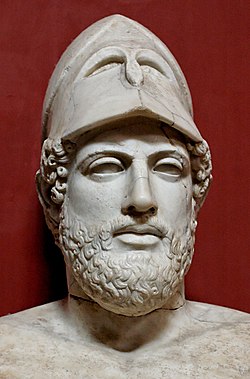
Unlike other Greek states that separated land and sea command, Athenian strategoi held authority over both. By the 4th century BC, the roles became more specialized, with specific generals assigned to the defense of Attica, expeditions abroad, or the management of the Piraeus war harbor.
Accountability was strict. At the end of their terms, strategoi underwent euthyna (a formal audit). The Athenian assembly (ekklesia) also voted regularly on their performance; failure could lead to deposition, fines, or even death, as seen after the Battle of Arginusae in 406 BC.
Hellenistic and Roman Adaptations
As Greek influence expanded, the title evolved. Philip II of Macedon and Alexander the Great used the title strategos autokrator to denote a commander-in-chief with full, broad powers.
In the Achaean and Aetolian Leagues, the strategos served as both the supreme military commander and the head of civil government. Meanwhile, in Ptolemaic Egypt, the role shifted toward administration. Originally responsible for military colonists (klerouchoi), the strategoi eventually became civilian governors. To maintain military oversight, Ptolemy V Epiphanes introduced the epistrategos ("over-general") to supervise them.

During the Roman period, Greek historians often used strategos to translate the Roman office of praetor. This usage is preserved in the New Testament, specifically in the Acts of the Apostles.
The Byzantine Empire and the Theme System
In the Byzantine Empire, the role of the strategos was transformed by the 7th-century Theme system. Themes were territorial districts where the strategos combined military command with civil governance.
Because these provincial governors held significant power, they occasionally rebelled against the emperor in Constantinople. To prevent this, the empire progressively split the themes into smaller units, increasing the number of strategoi but diluting their individual power. By the 11th century, their administrative duties were transferred to civil judges (kritai), and supreme command shifted to officers titled doukes or katepano.
The Kingdom of Sicily
The influence of the term extended to the Kingdom of Sicily and the Duchy of Apulia, where the stratigotus served as a royal appointee. These officials acted as governors with command over local militias and functioned as local justiciars.
Modern Use in the Hellenic Army
Today, stratigós remains the highest active officer rank in the modern Hellenic Army. While the rank of stratárchis (Field Marshal) existed under the monarchy, it is not used in the current Third Hellenic Republic.
Current NATO-aligned structures designate the Chief of the General Staff of National Defence as a stratigós. Other general officer ranks are derived from the same root, including antistrátigos (Lieutenant General) and ypostrátigos (Major General).
Key Facts
- Etymology: Derived from stratos (army) and agos (leader).
- Athenian System: Ten strategoi were elected annually, one from each tribe, until the mid-4th century BC.
- Versatility: In Athens, strategoi commanded both land and naval forces.
- Byzantine Shift: The Theme system merged military and civil governance under the strategos.
- Modern Rank: It is currently the highest officer rank in the Hellenic Army.
| Era/Entity | Primary Role | Nature of Power |
|---|---|---|
| Classical Athens | Military General | Elected, accountable to the assembly |
| Ptolemaic Egypt | Gubernatorial Official | Civil administration and fiscal oversight |
| Byzantine Empire | Theme Governor | Combined military and civil authority |
| Modern Greece | Highest Army Rank | Professional military leadership (NATO OF-9) |
Frequently Asked Questions
What was the difference between a strategos and a polemarchos in Athens?
The polemarchos was the senior military commander before the reforms of Cleisthenes. After 501 BC, the board of ten elected strategoi took over primary military leadership, while the polemarchos eventually became an appointed official chosen by lot.
How did the role of strategos change in Ptolemaic Egypt?
It transitioned from a military role overseeing colonists to a purely civilian gubernatorial office. This led to the creation of the epistrategos, who retained the actual military command over the civilian strategoi.
What was the "Theme system" in the Byzantine Empire?
The Theme system was a territorial administrative structure where military forces were settled in specific districts. The strategos of each theme acted as both the military commander and the civil governor of that region.
Is the rank of strategos still used today?
Yes, it is the highest officer rank in the modern Hellenic Army, corresponding to a full General in other NATO armies.
What happened to the strategoi who failed in their duties in Athens?
They were subject to a process called euthyna and could be deposed by a vote in the assembly. Depending on the severity of the failure, they could be fined or condemned to death.