Stimulated Emission: The Quantum Foundation of Lasers
At the heart of modern photonics lies a remarkable quantum process known as stimulated emission. This phenomenon occurs when an incoming photon interacts with an excited atomic electron or molecular state, triggering it to drop to a lower energy level. This transition releases energy into the electromagnetic field, creating a second photon that is an exact replica of the first.
Unlike the random nature of common light sources, stimulated emission produces photons with identical frequency, polarization, and direction of travel. This unique property of coherence is what allows for the creation of highly concentrated beams of light, forming the theoretical and practical basis for the maser and the laser.
Key Facts
- Predicted by Albert Einstein in 1916 and detailed in his 1917 papers.
- Produces Coherent Light: Emitted photons match the incident photon in phase, energy, and polarization.
- Requires an Electromagnetic Field: Unlike spontaneous emission, this process is triggered by an external field.
- Enables Amplification: When a population inversion occurs, the medium amplifies incident radiation.
- Opposite of Absorption: While absorption raises an electron to a higher energy state, stimulated emission lowers it.
The Mechanics of Quantum Radiation
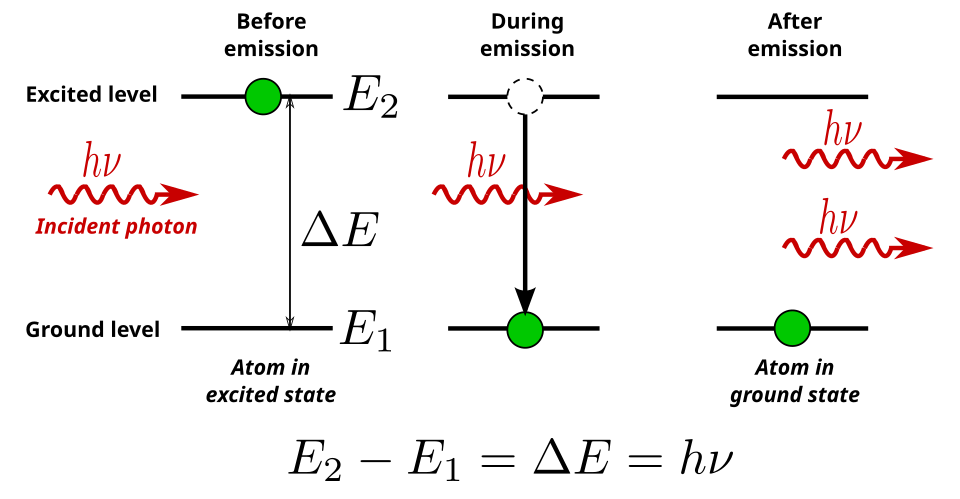
To understand stimulated emission, one must consider an atom with at least two electronic energy states: a lower level (often the ground state, $E_1$) and an excited state ($E_2$).
Spontaneous vs. Stimulated Emission
In the absence of an external field, an atom in an excited state will eventually decay naturally. This is called spontaneous emission, the mechanism responsible for fluorescence and thermal emission. The resulting photon is emitted in a random direction and phase.
However, if the atom is perturbed by an electric field with a frequency ($\nu_0$) that matches the energy difference between the two states, it may undergo stimulated emission. This process adds a photon to the external field that is perfectly in phase with the incident wave.
The Einstein Coefficients
Albert Einstein mathematically modeled these interactions using what are now known as the Einstein Coefficients. He determined that the rate of stimulated emission is proportional to both the number of atoms in the excited state ($N_2$) and the radiation density of the incident field ($\rho(\nu)$). This relationship is defined by the Einstein B coefficient ($B_{21}$).
Einstein also demonstrated that the rate of atomic absorption—where a photon is consumed to raise an electron to a higher state—is the precise negative of the stimulated emission rate, proportional to the number of atoms in the lower state ($N_1$).
Optical Amplification and Population Inversion
For a medium to amplify light rather than absorb it, a condition called population inversion must be achieved. In a standard state, most atoms reside in the lower energy level. Population inversion occurs when an external energy source excites more than 50% of the atoms into the higher energy state.
When light of the correct frequency passes through such a medium, the probability of stimulating an emission outweighs the probability of absorption. This results in an increase in the intensity of the input signal, effectively creating an optical amplifier.
Gain and Saturation
The efficiency of this amplification is described by the small-signal gain coefficient. However, as the intensity of the light increases, the gain begins to drop. This leads to the concept of saturation intensity ($I_S$), defined as the input intensity at which the gain of the optical amplifier drops to exactly half of its small-signal value.
Spectral Line Shape and Broadening
While stimulated emission occurs at the frequency of the stimulating field, the strength of the emission is influenced by the spectral line shape. In a perfectly homogeneous system, this follows a Lorentzian distribution, where the peak strength is at the line center.
In practical applications, inhomogeneous broadening often occurs. A primary example is the Doppler effect, caused by the varying velocities of atoms in a gas, which results in a Gaussian shape. The actual line shape used in calculations is typically a convolution of these individual broadening effects.
| Feature | Spontaneous Emission | Stimulated Emission |
|---|---|---|
| Trigger | Natural decay (no field required) | Incident photon/EM field |
| Phase/Direction | Random | Identical to incident photon |
| Coherence | Incoherent | Mutually Coherent |
| Primary Use | Fluorescence, Thermal light | Lasers, Masers, Amplifiers |
Frequently Asked Questions
What is the difference between stimulated and spontaneous emission?
Spontaneous emission happens randomly when an excited atom decays on its own. Stimulated emission is triggered by an incoming photon, forcing the atom to release a second photon that is identical in frequency, phase, and direction.
Who first predicted stimulated emission?
Albert Einstein predicted the phenomenon in 1916 and published the theoretical framework, including the Einstein B coefficients, in 1917.
What is a population inversion?
A population inversion is a state where more atoms exist in a higher energy excited state than in a lower energy state. This is a necessary condition for optical amplification and laser operation.
Are the photons produced by stimulated emission entangled?
No, the photons produced via stimulated emission are not entangled; they are considered indistinguishable particles or "cloned biphotons" because they share the same quantum properties.
How does the Doppler effect impact stimulated emission?
The Doppler effect causes inhomogeneous broadening of the spectral line shape. Because atoms in a gas move at different velocities, the peak strength of the line shape function is reduced and spread across a Gaussian distribution.