Laser Technology: Principles, History, and Modern Applications
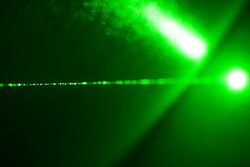
A laser is a sophisticated device that generates a highly concentrated beam of light through a process known as optical amplification. The term itself is an acronym for Light Amplification by Stimulated Emission of Radiation. Unlike conventional light sources, such as light bulbs, lasers produce light that is coherent, meaning the light waves are synchronized in both space and time.
This unique property allows laser beams to be focused into an incredibly tight spot or to remain narrow over vast distances, a characteristic known as collimation. These capabilities have made lasers indispensable in fields ranging from high-precision surgery and industrial cutting to global telecommunications and deep-space exploration.
Key Facts
- First Laser: Built in 1960 by Theodore Maiman at Hughes Research Laboratories.
- Core Process: Based on the stimulated emission of electromagnetic radiation.
- Primary Advantage: Produces coherent light that can be tightly focused or collimated.
- Market Scale: Global industrial laser sales reached $21.85 billion in 2023.
- Power Range: Varies from milliwatts (laser pointers) to petawatts (ELI-NP facility).
The Science of Lasers
How Lasers Work
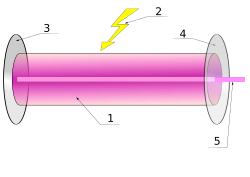
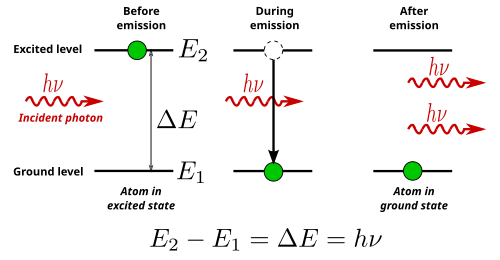
At its core, a laser operates by amplifying light. This is achieved using a gain medium—the material that provides the optical amplification—and a cavity usually consisting of mirrors. When energy is pumped into the gain medium, it triggers stimulated emission, where an incoming photon encourages an excited atom to release a second photon of the same wavelength and direction.
Coherence and Collimation
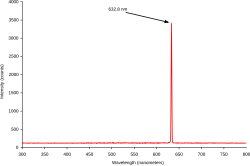
The defining characteristic of laser light is its coherence. Spatial coherence allows the beam to be focused to a microscopic point, which is essential for lithography and laser cutting. Temporal coherence allows the laser to emit light within a very narrow frequency spectrum, enabling the creation of ultrashort pulses measured in attoseconds.
History and Evolution
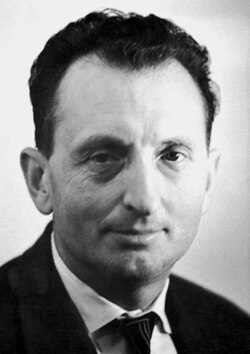
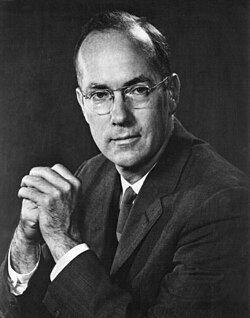
The theoretical foundation for the laser was laid by Charles H. Townes and Arthur Leonard Schawlow, while Gordon Gould patented the optical amplifier. The first working laser was realized in 1960 by Theodore Maiman.
![LASER notebook: First page of the notebook wherein Gordon Gould coined the acronym LASER, and described the elements required to construct one. Manuscript text: "Some rough calculations on the feasibility / of a LASER: Light Amplification by Stimulated / Emission of Radiation. / Conceive a tube terminated by optically flat / [Sketch of a tube] / partially reflecting parallel mirrors..."](/images/ae/a5/aea530f8b107282726459272d289a32b5128d44e67b3519b690c85d07699422a.jpg)
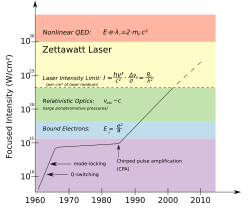
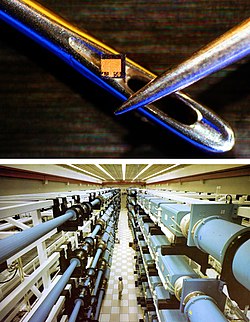
Since its inception, laser technology has evolved rapidly. Early devices were large and cumbersome, but innovations have led to the development of microscopic diode lasers and massive systems used for nuclear weapons research and inertial confinement fusion.
Types of Lasers
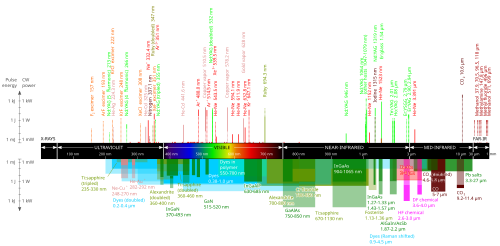
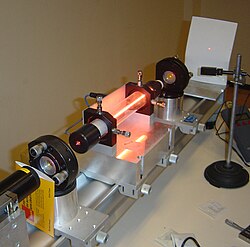
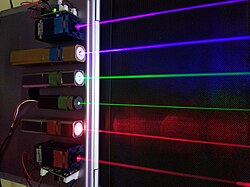
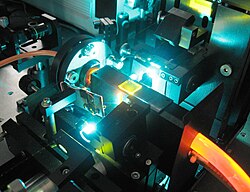
Lasers are categorized primarily by the type of gain medium they use to produce light:
- Gas Lasers: Use gases like helium-neon or carbon dioxide (CO2).
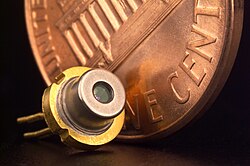
- Semiconductor Lasers: Also known as diode lasers, these are small and efficient, commonly found in CD/DVD players.
- Solid-State Lasers: Use a solid gain medium, such as Nd:YAG crystals.
- Fiber Lasers: A type of solid-state laser where the active medium is an optical fiber.
- Dye Lasers: Use organic dyes to produce tunable wavelengths.
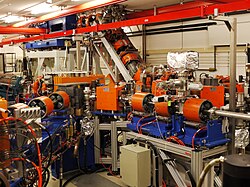
- Free-Electron Lasers: Use a beam of high-energy electrons to generate light.
Practical Applications
Commercial and Industrial Use
Lasers are integrated into countless everyday products, including barcode scanners, laser printers, and thermometers. In industry, high-power CO2 lasers are used for precision cutting and welding of materials.
Medicine and Science
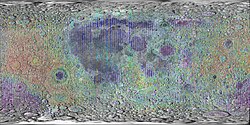
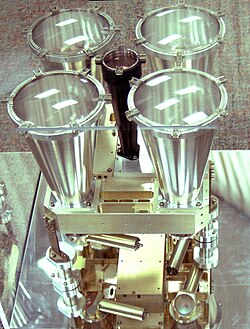
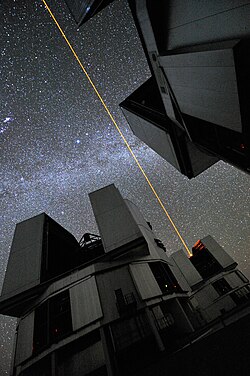
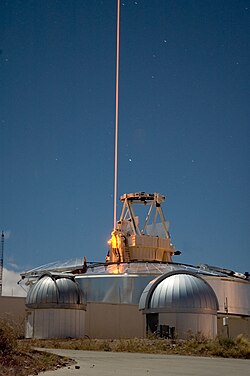
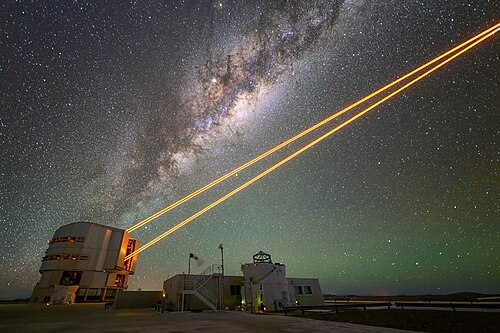
In the medical field, lasers are used for everything from corrective eye surgery to cancer therapy. In science, lasers enable Lidar (Light Detection and Ranging) for mapping lunar topography and adaptive optics to clear atmospheric distortion in astronomy.
Defense and Communication
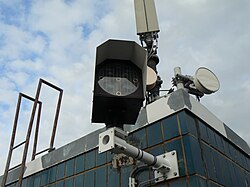
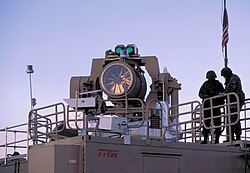
Laser technology is used in point-to-point optical wireless networks for high-speed data transfer. In defense, high-energy lasers have been developed to intercept rockets and artillery shells, though some projects, like the YAL-1 Boeing 747, were eventually canceled.

Laser Power and Safety
Laser power varies wildly depending on the application. While a laser pointer uses only a few milliwatts, the world's most powerful lasers, such as the one at the ELI-NP facility in Romania, reach 10 petawatts (PW).
| Power Level | Typical Application |
|---|---|
| 1–5 mW | Laser pointers |
| 5–10 mW | DVD players / DVD-ROM drives |
| 100 mW | High-speed CD-RW burners |
| 30–100 W | Sealed CO2 surgical lasers |
| 100–3000 W | Industrial laser cutting |
| 700 TW | National Ignition Facility (NIF) |
| 10 PW | ELI-NP facility (Romania) |
Due to their intensity, lasers are categorized by safety classes. Class 1 lasers are inherently safe because the light is contained within an enclosure, such as in a CD player, preventing accidental eye exposure.
Frequently Asked Questions
What does the word LASER actually stand for?
LASER is an acronym for Light Amplification by Stimulated Emission of Radiation.
How is a laser different from a regular flashlight?
Unlike a flashlight, which emits divergent light of many wavelengths, a laser emits coherent light that is monochromatic (single wavelength) and collimated, meaning it stays in a narrow beam over long distances.
Who invented the first working laser?
The first working laser was built in 1960 by Theodore Maiman at Hughes Research Laboratories, based on theoretical work by Charles H. Townes and Arthur Leonard Schawlow.
Are all lasers dangerous?
Not all lasers are dangerous. They are categorized into safety classes; for example, Class 1 lasers are designed to be inherently safe for the user because the beam is fully enclosed.
What is a diode laser?
A diode laser is a semiconductor laser that converts electrical energy directly into light. They are highly efficient and are commonly used in consumer electronics like DVD players and barcode scanners.