Maser Technology: The Science of Microwave Amplification
A maser is a sophisticated device capable of producing coherent electromagnetic waves, specifically in the microwave spectrum. The name is an acronym for microwave amplification by stimulated emission of radiation. By utilizing the principles of quantum mechanics, masers amplify radiation to create highly stable and precise signals, serving as the foundational technology for some of the world's most accurate timekeeping and communication systems.
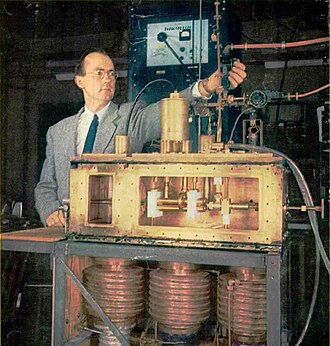
The concept was introduced in 1952 by Nikolay Basov, Alexander Prokhorov, and Joseph Weber. Shortly thereafter, in 1953, Charles H. Townes, James P. Gordon, and Herbert J. Zeiger constructed the first working maser at Columbia University. The theoretical breakthroughs leading to this invention were so significant that Townes, Basov, and Prokhorov were awarded the Nobel Prize in Physics in 1964.
Key Facts
- Core Principle: Operates via stimulated emission, where excited atoms amplify radiation at a specific frequency.
- Precursor to Laser: The maser provided the theoretical basis for the laser (light amplification by stimulated emission of radiation).
- Primary Uses: High-precision atomic clocks, radio telescopes, and deep-space communication.
- Natural Occurrence: Maser-like emissions occur naturally in interstellar space (astrophysical masers).
- Frequency Range: While originally focused on microwaves, modern versions can operate at radio and infrared frequencies.
How a Maser Works
The operation of a maser is based on stimulated emission, a concept proposed by Albert Einstein in 1917. In this process, atoms or molecules are induced into an excited energy state. When these excited particles interact with radiation of a specific frequency, they are stimulated to release their energy as photons, amplifying the original signal.
To achieve this, the amplifying medium is placed inside a resonant cavity. This cavity creates feedback, allowing the radiation to bounce back and forth through the medium, further amplifying the signal and producing a coherent beam of radiation.
The Evolution of Maser Technology
From Microwaves to Light
The maser was the direct inspiration for the laser. In 1957, the concept of an "optical maser" was imagined, which Theodore Maiman eventually realized as the first working laser in 1960. While the maser focuses on lower-frequency microwaves, the laser produces higher-frequency coherent radiation at visible wavelengths. Gordon Gould is credited with coining the term "laser" in 1957.
Modern Developments
Recent scientific advancements have pushed masers beyond the need for extreme cooling. In 2012, researchers from the National Physical Laboratory and Imperial College London created a solid-state maser operating at room temperature using pentacene-doped p-Terphenyl. In 2018, continuous-wave oscillation was demonstrated using synthetic diamonds with nitrogen-vacancy defects. Most recently, in 2025, Northumbria University developed a low-cost, energy-efficient room-temperature unit powered by an LED.
Types and Applications of Masers
Masers are categorized by their medium and application. Common types include atomic beam masers (such as ammonia and rubidium masers), gas masers, and solid-state masers (such as ruby masers).
| Application | Specific Technology | Key Feature/Benefit |
|---|---|---|
| Timekeeping | Hydrogen Maser | Extreme frequency stability for atomic clocks |
| Deep Space Communication | Ruby Comb Maser | Ultra-low-noise amplification (e.g., Mariner IV) |
| Astronomy | Radio Telescope Amplifiers | Detection of weak cosmic microwave signals |
| Astrophysics | Natural Interstellar Masers | Observation of star-forming regions (H2O, OH) |
The Hydrogen Maser
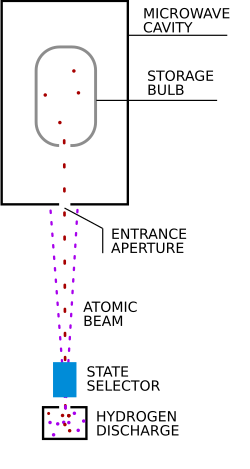
The hydrogen maser is a critical component of the International Atomic Time (TAI) standard. It works by producing a beam of atomic hydrogen via a high-frequency radio wave discharge.
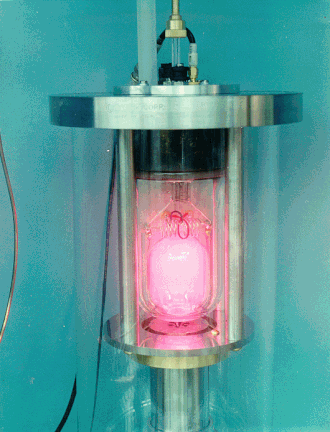
Through a process called "state selection," a population inversion is created, ensuring more atoms are in the upper energy level. These atoms then enter a high-quality (high Q factor) microwave cavity tuned to 1,420,405,752 hertz. The resulting signal, though weak (a few picowatts), is incredibly stable and is amplified using phase-locked loops and quartz oscillators.
Deep Space and Radio Astronomy
In the 1960s, the Jet Propulsion Laboratory used ruby masers chilled to 4 kelvin with liquid helium to amplify S-band signals from deep space. This technology allowed the Mariner IV probe to transmit images from Mars despite having a transmitter output of only 15 watts.
Astrophysical Masers
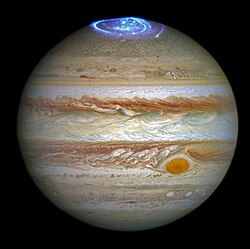
Nature also produces maser effects, often referred to as "superradiant emission." These occur in interstellar space when molecules like water (H2O), hydroxyl radicals (•OH), and methanol (CH3OH) undergo population inversion. Water masers in star-forming regions can emit radiation at 22.0 GHz and 96 GHz, creating some of the brightest spectral lines in the radio universe.
On a larger scale, "megamasers" associated with active galactic nuclei can be a million times more powerful than stellar masers.
Frequently Asked Questions
What is the difference between a maser and a laser?
The primary difference is the frequency of the radiation they produce. A maser amplifies microwaves (lower frequency), while a laser amplifies visible light or infrared radiation (higher frequency).
Who invented the maser?
The concept was introduced by Nikolay Basov, Alexander Prokhorov, and Joseph Weber in 1952. The first physical prototype was built in 1953 by Charles H. Townes, James P. Gordon, and Herbert J. Zeiger.
Why are hydrogen masers used in atomic clocks?
Hydrogen masers are used because they provide an extremely stable and fixed frequency (1,420,405,752 Hz), which is essential for maintaining the high precision required for international time standards.
Can masers occur naturally?
Yes, astrophysical masers occur in space. Molecules such as water and hydroxyl radicals in interstellar clouds can act as natural amplifiers, producing powerful microwave emissions.
Do masers always require extreme cooling?
Historically, many masers required cryogenic cooling (such as liquid helium) to reduce noise. However, 21st-century developments have led to the creation of solid-state masers that operate at room temperature.