Spriggina: The Enigmatic Fossil Emblem of South Australia
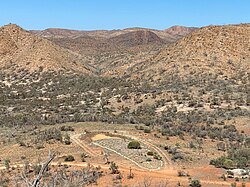
Deep within the geological layers of South Australia lies the record of one of Earth's earliest complex organisms: Spriggina. Dating back to the late Ediacaran period, approximately 555 million years ago, this mysterious creature offers a glimpse into the dawn of animal life. While its exact place on the tree of life remains a subject of scientific debate, its unique morphology and regional significance have made it a symbol of prehistoric discovery.
Spriggina is primarily known through the species Spriggina floundersi, which is found exclusively in South Australia. Because of this rarity and its scientific importance, it was officially adopted as the state's fossil emblem on February 14, 2017, following a public vote by over 3,500 citizens.
Key Facts
- Temporal Range: Late Ediacaran period (approx. 555 million years ago).
- Location: Found exclusively in South Australia.
- Size: Typically reached 3–5 centimeters (1.2–2.0 inches) in length.
- Symmetry: Exhibits glide reflection rather than standard bilateral symmetry.
- Status: Official fossil emblem of South Australia.
Physical Description and Anatomy
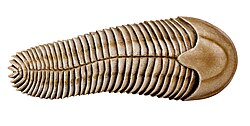
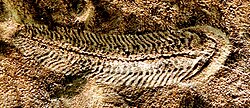
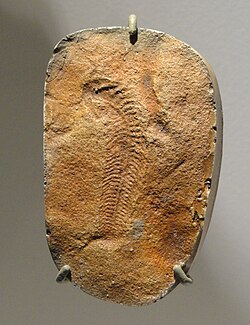
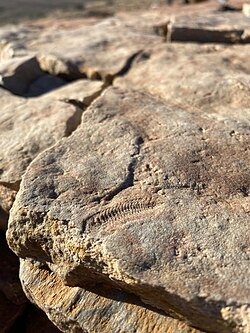
Spriggina was an oblong, segmented organism. Its body was protected by a series of tough, uncalcified cuticular plates: a single row covered the top, while two rows of interlocking plates protected the underside. These fossils are typically preserved as moulds on the lower surface of fossiliferous beds.
The front of the organism featured a specialized "head" formed by the fusion of the first two segments. The leading segment was horseshoe-shaped and contained two depressions that scientists believe may have been eyes. The second segment potentially bore antennae, and some specimens suggest the presence of a circular mouth at the center of the head.
The Mystery of Glide Reflection
One of the most striking features of Spriggina is its glide reflection. Unlike humans or most modern animals that have bilateral symmetry (where left and right sides are mirror images), Spriggina's opposite segments are shifted by half an interval. This distinct structural arrangement is a key piece of evidence used by paleontologists to determine its evolutionary relationships.
Classification and Evolutionary Affinity
Determining where Spriggina fits into the animal kingdom has proven difficult. Because it lacks preserved legs or limbs, its classification has shifted over decades of research. It has been variously described as:
- Annelid worms: Early comparisons were made to polychaete worms like Nereis or Tomopteris, though the lack of chaetae (bristles) makes this unlikely.
- Arthropods: Some researchers suggested a link to trilobites due to its superficial appearance and potential predatory nature. However, the absence of a rigid exoskeleton and jointed limbs suggests this similarity may be a result of convergent evolution—where unrelated species evolve similar traits.
- Rangeomorphs: Some theories link it to frond-like Ediacaran organisms.
- Proarticulata: A group characterized by the glide reflection symmetry seen in Spriggina and Dickinsonia.
Palaeobiology and Behavior
Evidence suggests that Spriggina lived on or very close to the sea floor. Many fossils show missing portions along the margins, suggesting the organism could lift parts of its body off the substrate. This indicates that Spriggina was likely motile (capable of movement) rather than stationary.
Remarkably, Spriggina may provide the earliest evidence of behavioral handedness in the fossil record. A significant majority of specimens are bent to the left (which would be the organism's right side in life), suggesting a consistent behavioral preference in how the creature moved or interacted with its environment.
Summary of Spriggina Characteristics
| Feature | Detail |
|---|---|
| Length | 3–5 cm |
| Period | Late Ediacaran (555 Ma) |
| Symmetry | Glide Reflection |
| Body Structure | Segmented with cuticular plates |
| Distribution | South Australia only |
| Key Behavior | Likely motile; exhibited handedness |
Frequently Asked Questions
What is Spriggina?
Spriggina is a genus of early animals from the late Ediacaran period, known primarily from fossils found in South Australia. It is characterized by a segmented body and a horseshoe-shaped head.
Is Spriggina related to trilobites?
While it superficially resembles trilobites, most modern scientists believe it is not a stem-arthropod because it lacks the jointed limbs and hard exoskeleton characteristic of arthropods.
Why is it the fossil emblem of South Australia?
It was chosen as the official emblem because Spriggina floundersi has been found nowhere else in the world, making it a unique symbol of the region's geological history.
How did Spriggina move?
Although it had no legs, evidence from fossils suggests it was motile and could lift its head and margins off the sea floor to move across the substrate.
What is glide reflection symmetry?
Glide reflection is a type of symmetry where the segments on the left and right sides of the body are not perfectly mirrored but are instead offset or shifted by half a segment.