Ediacaran Period: The Dawn of Complex Life
The Ediacaran Period represents one of the most pivotal chapters in Earth's history, marking the transition from a world dominated by microscopic organisms to one inhabited by complex, multicellular life. Spanning from approximately 635 to 538.8 million years ago (Ma), this period serves as the final act of the Proterozoic Eon before the explosion of diversity seen in the Cambrian.
Named after the Ediacara Hills of South Australia, where geologist Reg Sprigg first discovered a diverse community of unrecognized lifeforms in 1946, the Ediacaran was officially ratified as a geological period in 2004 by the International Union of Geological Sciences (IUGS). This was a landmark decision, as it was the first new geological period declared in 120 years.
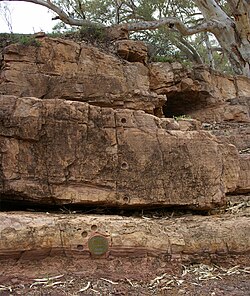
While the period takes its name from the Ediacara Hills, the official type section—the physical reference point for the period's start—is located at Enorama Creek in the Brachina Gorge of the Ikara-Flinders Ranges National Park.
Key Facts
- Time Span: 635 to 538.8 ± 0.6 million years ago.
- Era: Neoproterozoic Era, Proterozoic Eon.
- Defining Life: The Ediacaran biota, the first large-scale complex multicellular organisms.
- Atmosphere: Oxygen levels were roughly 40% of modern levels (c. 8 vol %), while CO2 was 16 times higher than pre-industrial levels.
- Climate: Mean surface temperatures were approximately 17 °C, about 3.5 °C warmer than pre-industrial times.
Defining the Boundaries
Geologists define the Ediacaran Period using a Global Boundary Stratotype Section and Point (GSSP), often referred to as a "golden spike." This is a physical location in the rock strata that marks the precise beginning or end of a time unit.
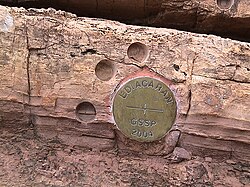
The Lower Boundary
The base of the Ediacaran is defined at the Enorama Creek section in the Flinders Ranges of South Australia. Because this site lacks overlying igneous material for direct dating, scientists rely on correlations from Africa, China, North America, and Tasmania. Using U–Pb (uranium–lead) and Re–Os (rhenium–osmium) dating, the base is estimated at approximately 635 million years ago.
The Upper Boundary
The period ends with the appearance of the ichnofossil (trace fossil) Treptichnus pedum. This boundary is marked at the Fortune Head section in Newfoundland, Canada. This transition marks the beginning of the Cambrian Period.
The Ediacaran Biota and Evolutionary Intervals
The Ediacaran is characterized by four distinct biotic intervals, each defined by unique ecological assemblages:
- 635 to 575 Ma: Dominated by acritarchs, specifically large ornamented Ediacaran microfossils.
- 575 to 560 Ma: The Avalon biota, which contains the earliest recorded trace fossils left by motile (moving) organisms.
- 560 to 550 Ma: The White Sea biota, named for the numerous fossils discovered along the coasts of the White Sea.
- 550 to 539 Ma: The Nama biotic assemblage, representing the final phase of the period.
![Archaeaspinus, a representative of phylum Proarticulata which also includes Dickinsonia, Karakhtia, Spriggina and numerous other organisms. They are members of the Ediacaran biota.[33]](/images/40/88/4088476dc809a72e43901410abc1aef470a257457e6830b5c44fd7254bd4da2d.jpg)
Geological Evidence in the Pyrenees
Beyond Australia and Canada, Ediacaran evidence is found globally. In the eastern Pyrenees of France, outcrops of micaschists and marble from the Groupe de Canaveilles date back to approximately 580 Ma.
![Outcrops of micaschists and marble of the Groupe de Canaveilles [fr] (Ediacaran, c. 580 Ma) in the eastern Pyrenees (commune of Fontpédrouse, France)[25]](/images/fc/46/fc466ad3087eb6cce06b405ab6d4855b6f32c65835243d8149eb54610697dd4f.jpg)
These exposures, such as those at Piton de Castell Vidre, reveal a complex mix of siliceous schist, marble, limestone, and dolomite, including the "Barégiennes"—thin, deformed alternating beds of calcareous and siliceous material.
![Groupe de Canaveilles exposure (Piton de Castell Vidre) in the eastern Pyrenees (commune of Llo, France). 1 - Very silicious schist. 2 - Marble. 3 - Limestone and dolomite. 4 (& inset) - "Barégiennes" (thin, deformed, alternating calcareous/siliceous beds).[26]](/images/70/a6/70a685ddb941043a6a6a3eab20ed7f507f6f4f3c294c09f28afa6b267e374753.jpg)
Comparison: Ediacaran vs. Vendian
In scientific literature, you may encounter the term Vendian Period. Proposed by Russian geologist Boris Sokolov in 1952, the Vendian (650 to 543 Ma) is a longer interval than the Ediacaran. While the Ediacaran is the internationally ratified standard, the Vendian concept was developed using a top-down stratigraphic approach, where the base of the Cambrian served as the upper limit of the Vendian.
| Feature | Details |
|---|---|
| Time Range | 635 – 538.8 Ma |
| Lower GSSP | Enorama Creek, South Australia |
| Upper GSSP | Fortune Head, Newfoundland, Canada |
| Key Fossil Marker | Treptichnus pedum (Upper Boundary) |
| Atmospheric O2 | c. 8 vol % |
| Atmospheric CO2 | c. 4500 ppm |
Frequently Asked Questions
What is the Ediacaran biota?
The Ediacaran biota refers to a diverse community of early multicellular organisms that lived during the Ediacaran Period. These include unique lifeforms like Archaeaspinus and Dickinsonia, many of which represent early experiments in complex body plans.
How do scientists date the Ediacaran Period?
Because the type section in Australia lacks igneous rocks for direct dating, scientists use U–Pb (uranium–lead) and Re–Os (rhenium–osmium) dating from other global sites in China, Africa, North America, and Tasmania to establish the age range.
What is a GSSP?
A Global Boundary Stratotype Section and Point (GSSP) is an internationally agreed-upon reference point in a stratigraphic section of rock that defines the lower boundary of a stage or period. It is colloquially known as a "golden spike."
What happened at the end of the Ediacaran Period?
The period ended approximately 538.8 million years ago, marked by the appearance of the trace fossil Treptichnus pedum, signaling the transition into the Cambrian Period and the subsequent radiation of animal life.