Spanish Inquisition: The History of the Tribunal of the Holy Office
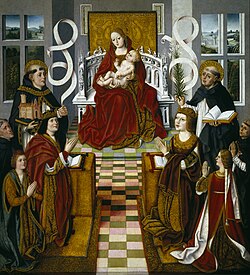
The Tribunal of the Holy Office of the Inquisition was a powerful judicial institution established under the Spanish monarchy to maintain religious orthodoxy. Founded on November 1, 1478, and not disbanded until July 15, 1834, the Inquisition served as a tool for the crown to ensure spiritual uniformity across the Spanish Empire.
Initially, the Tribunal focused on identifying heretics among those who had converted from Judaism and Islam to Catholicism. This scrutiny intensified following royal decrees in 1492 and 1502, which mandated that Jews and Muslims either convert to Catholicism, leave Castile, or face death. These decrees led to mass expulsions—including an estimated 40,000 to 100,000 Jews in 1492—and hundreds of thousands of forced conversions.
Key Facts
- Established: November 1, 1478.
- Disbanded: July 15, 1834.
- Primary Goal: Upholding religious orthodoxy and identifying heresy.
- Key Targets: Conversos (Jewish converts), Moriscos (Muslim converts), and later, Protestants.
- Blood Purity: The limpieza de sangre statutes introduced racially-based discrimination against those of non-Christian descent.
- Global Reach: Tribunals were established not only in Spain but also in the Viceroyalties of Peru and New Spain (Mexico).
The Persecution of Conversos and Moriscos
The Inquisition's early activity peaked between 1480 and 1530, primarily targeting conversos. In some regions, the focus was overwhelming; for example, 99.3% of those judged in Barcelona between 1484 and 1505 were of Jewish origin. Those found to be practicing their original faith in secret, known as crypto-Jews, faced severe penalties.
Beyond spiritual punishment, the Inquisition exerted significant economic pressure. Between 1536 and 1543, eight courts seized 87 million maravedis from their victims. Those who were "reconciled" with the church were barred from holding public office or working as doctors, pharmacists, and tax collectors—restrictions that often extended to their descendants.
![Torquemada is buried in the monastery of Saint Thomas at Ávila, and left his own epitaph Pestem Fugat Haereticam, meaning "drove away the pestilence of heresy".[28]](/images/23/d9/23d9a4049952587dd79c72851a2c9b0a6c56aa99ff4b486d4a778030b133692e.jpg)
Expansion of Scope: Protestantism and Other Offenses

While the early years focused on converts, the Inquisition later targeted other perceived threats to orthodoxy. Under Philip II from 1558 to 1562, the Tribunal prosecuted Protestant communities in Seville and Valladolid. While Spanish Protestantism was a small movement, these efforts nearly eliminated it from the region.
The Tribunal's jurisdiction eventually expanded to include a wide array of offenses, including:
- Blasphemy and superstition.
- Sodomy and bigamy.
- Unnatural marriage.
- Witchcraft.
Organization and Judicial Process
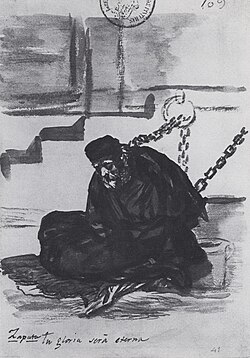
The Inquisition was led by the Grand Inquisitor and the Suprema, both designated by the crown. Permanent tribunals were established across Castile, including major centers in Seville, Córdoba, Toledo, and Valladolid.
The Trial Process
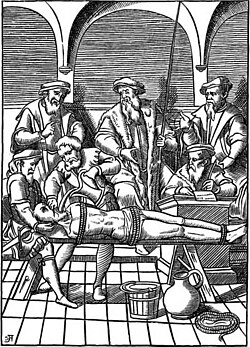
The judicial process typically followed a sequence of accusation, detention, and trial. During interrogations, the accused were often placed on low benches while the Inquisitor sat in an armchair to establish a power imbalance.
![Two priests and a suspected heretic in a Spanish Inquisition interrogation chamber (Bernard Picart's engraving, 1722). In contrast to the Inquisitor's armchair, Eymeric's manual suggests that the accused be sat on a low bench.[129]](/images/a9/1c/a91c19384d922e54689e246f78297202fbd289d25ef8d3399ce82bca6e55c816.jpg)
Torture and Sentencing
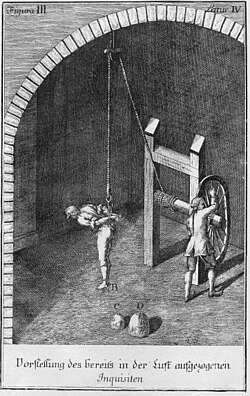
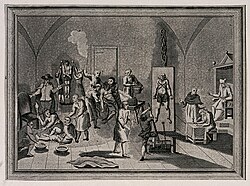
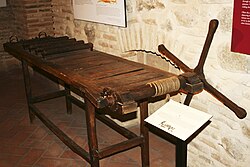
Torture was employed to extract confessions. Common methods included the strappado (suspending the victim by the wrists to dislocate shoulders), the rack, and water torture.
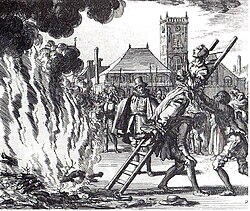
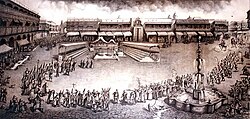
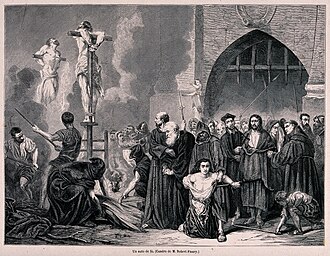
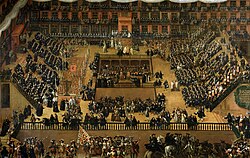
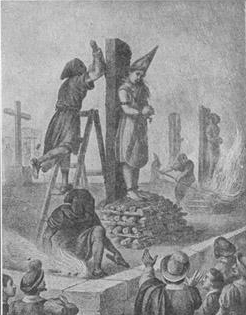
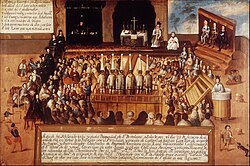
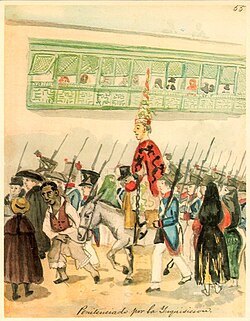
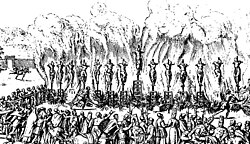
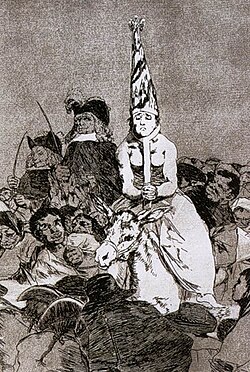
The final sentencing often culminated in an auto-da-fé (act of faith), a public ritual of penance and punishment. Outcomes ranged from fines and public shaming to execution by burning, either in persona (the person themselves) or in effigie (a representation of the person if they were deceased or absent).
Statistical Overview of the Inquisition
The following table provides a summary of documented cases and executions across various tribunals between 1540 and 1700.
| Tribunal | Documented Cases | Executions (in persona) | Estimated Total Trials |
|---|---|---|---|
| Barcelona | 3,047 | 37 | ~5,000 |
| Zaragoza | 5,967 | 200 | ~7,600 |
| Valencia | 4,540 | 78 | ~5,700 |
| Seville | 1,962 | 96 | ~6,700 |
| Mexico | 950 | 17 | ~2,400 |
| Lima | 1,176 | 30 | ~2,200 |
| Total | 44,674 | 826 | ~87,000 |
Frequently Asked Questions
What was the primary purpose of the Spanish Inquisition?
The primary purpose was to uphold religious orthodoxy within the Spanish monarchy's realms, specifically by identifying and punishing heretics, with an initial focus on converts from Judaism and Islam.
What is an auto-da-fé?
An auto-da-fé, meaning "act of faith," was a public ceremony where the Inquisition announced the sentences of those it had tried, often involving public penance or execution by burning.
What were the 'blood purity' statutes?
Known as limpieza de sangre, these statutes were laws that discriminated against individuals based on their ancestry, specifically targeting those with Jewish or Muslim heritage regardless of their current faith.
How many people were executed by the Spanish Inquisition?
Estimates vary by period; during its peak (1480–1530), approximately 2,000 executions occurred. Between 1540 and 1700, documented records show 826 executions in persona, though total trials are estimated at around 87,000.
Did the Inquisition operate outside of Spain?
Yes, the Inquisition extended to the Spanish Empire, with established tribunals in the Viceroyalty of New Spain (Mexico) and the Viceroyalty of Peru (Lima), the latter of which ended in 1820.