Space Launch System: NASA's Super Heavy-Lift Powerhouse for Artemis
The Space Launch System (SLS) is a colossal super heavy-lift launch vehicle designed by NASA to propel humans and cargo deeper into space than ever before. Serving as the backbone of the Artemis program, the SLS is engineered to send the Orion spacecraft, and its crew of four, toward the Moon and eventually toward Mars. By leveraging heritage technology from the Space Shuttle and Delta IV programs, the SLS provides the immense thrust required to escape Earth's gravity with heavy payloads.
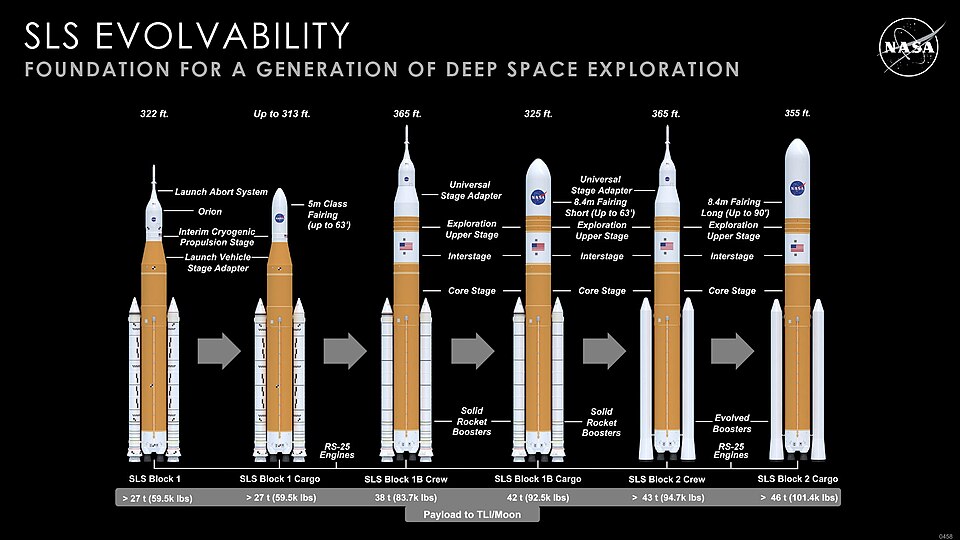
The vehicle is a massive feat of engineering, standing 98 meters (322 ft) tall with a total mass of 2,610,000 kg. Its primary mission is to deliver payloads to Low Earth Orbit (LEO) or push them toward a Trans-Lunar Injection (TLI) trajectory, the path required to reach the Moon.
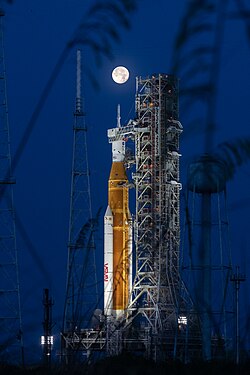
Key Facts
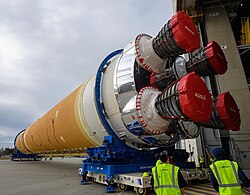
- Project Cost: US$ 31.6 billion as of 2025 (excluding Orion).
- Launch Cost: Approximately US$ 2.5 billion per flight (excluding Orion).
- Maximum Thrust: 39 MN (8,800,000 lbf).
- Payload Capacity: 95,000 kg to LEO and 27,000 kg to TLI.
- Flight Record: 2 launches with a 100% success rate.
- Primary Manufacturers: Aerojet Rocketdyne, Boeing, Northrop Grumman, and United Launch Alliance.
The Architecture of a Giant
The SLS utilizes a 2.5-stage design, combining powerful solid boosters with a liquid-fueled core and an upper stage to achieve the velocities needed for deep-space travel.
Solid Rocket Boosters (SRB)
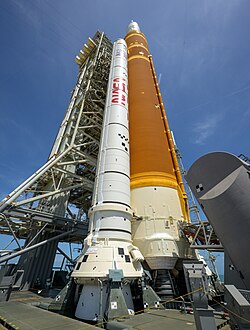
Two five-segment solid rocket boosters provide the initial surge of power during liftoff. These boosters, derived from Space Shuttle technology, stand 54 meters tall and burn for 126 seconds. They utilize APCP (Ammonium Perchlorate Composite Propellant) to generate a combined sea-level thrust of 29.2 MN.
The Core Stage
The core stage is the heart of the rocket, measuring 64.6 meters in height. It is powered by four RS-25 engines, which burn a combination of liquid hydrogen (LH2) and liquid oxygen (LOX). These engines provide a vacuum thrust of 9.1 MN each and operate for 480 seconds.
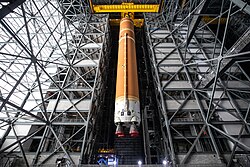
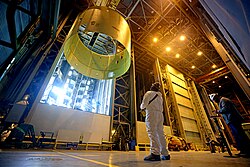
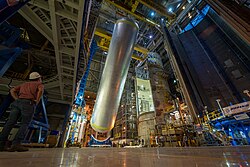
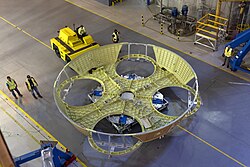
The construction of the core stage involves massive components, including the liquid hydrogen tank and the "boat-tail" engine fairing, which protects the engine section during ascent.
Upper Stages: ICPS and Beyond
To push the Orion spacecraft toward the Moon, the SLS uses an upper stage. The Interim Cryogenic Propulsion Stage (ICPS) is the current standard, powered by a single RL10 engine. It burns for 1,125 seconds to achieve the final velocity for lunar transit.
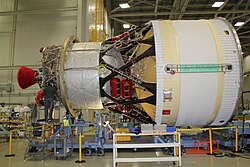
Looking forward, NASA has planned the Centaur V as a future upper stage. This stage would utilize two RL10 engines to increase payload capacity and efficiency.
Technical Specifications Summary
| Component | Metric | Value |
|---|---|---|
| Total Height | Meters | 98 m |
| Total Mass | Kilograms | 2,610,000 kg |
| Max Thrust | Meganewtons | 39 MN |
| LEO Payload | Kilograms | 95,000 kg |
| TLI Payload | Kilograms | 27,000 kg |
| Core Engines | Type | 4 × RS-25 |
Development and Evolution
The SLS was born from the need for a heavy-lift capability following the retirement of the Space Shuttle. It draws design influence from the Ares V and Delta IV rockets. While early plans envisioned several "Block" variants to increase lift capacity—including the Exploration Upper Stage (EUS)—many of these evolutions beyond Block 1 have been cancelled.
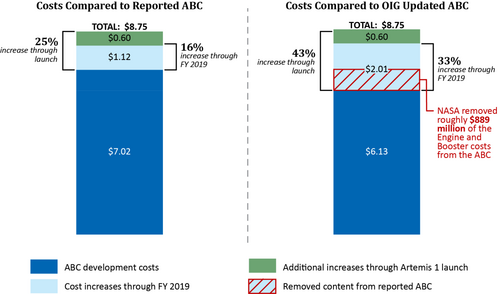
The development process has not been without controversy. A March 2020 Inspector General report highlighted accounting practices used to mask cost increases, specifically regarding the movement of booster costs to different cost centers.
Future Propulsion: BOLE
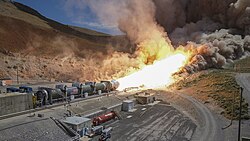
NASA is exploring the BOLE (Booster Obsolescence and Life Extension) prototype to modernize the booster systems, with test fires scheduled for June 2025.
Operational History
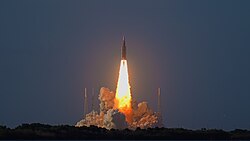
The SLS made its historic first flight on November 16, 2022, as part of the Artemis I mission. This uncrewed flight successfully demonstrated the rocket's ability to send the Orion spacecraft around the Moon and back to Earth. Subsequent missions, such as Artemis II, are designed to carry a crew of four, marking a return to human deep-space exploration.
Frequently Asked Questions
What is the primary purpose of the Space Launch System?
The SLS is designed as a super heavy-lift vehicle to support the Artemis missions, sending astronauts and cargo to the Moon and providing a foundation for future human missions to Mars.
How much does it cost to launch the SLS?
The cost per launch is approximately US$ 2.5 billion, though this figure excludes the cost of the Orion spacecraft.
What engines power the SLS core stage?
The core stage is powered by four RS-25 engines, which are high-performance liquid hydrogen and liquid oxygen engines derived from the Space Shuttle program.
What is the difference between LEO and TLI payload capacity?
LEO (Low Earth Orbit) capacity refers to the mass the rocket can place in a near-Earth orbit (95,000 kg), while TLI (Trans-Lunar Injection) refers to the mass it can push toward the Moon (27,000 kg).
What happened to the Exploration Upper Stage (EUS)?
While the EUS was planned to increase the payload capacity for Block 1B configurations, variants beyond Block 1, including the EUS, have been cancelled.