Michoud Assembly Facility: NASA's Industrial Powerhouse for Deep Space Exploration
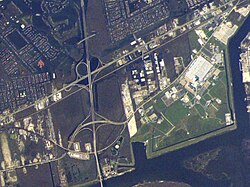
Located in New Orleans East, Louisiana, the Michoud Assembly Facility (MAF) is one of the world's largest and most critical industrial complexes for aerospace manufacturing. Spanning 832 acres, this NASA-owned site serves as the primary hub for the structural assembly of the vehicles that carry humanity beyond Earth's orbit. From the moon-bound rockets of the 1960s to the modern Artemis missions, MAF has remained at the forefront of American space exploration.
Organizationally part of NASA's Marshall Space Flight Center, the facility is a multi-tenant complex. This allows government agencies and commercial contractors to collaborate within a massive, environmentally controlled space, ensuring that the most sensitive aerospace components are built to exacting standards.
Key Facts
- Scale: Features 43 acres (1.87 million sq ft) of environmentally controlled space under a single roof.
- Workforce: Employs more than 4,200 people.
- Current Projects: Fabrication of the Space Launch System (SLS) core stage and the Orion spacecraft pressure vessel.
- Legacy: Built the first stages of the Saturn V and the external tanks for the Space Shuttle program.
- Location: New Orleans, Louisiana.
A Legacy of Manufacturing Excellence
The facility's origins date back to 1940, when it was constructed by Higgins Industries for World War II production. Originally intended for plywood C-76 cargo planes and Higgins Boat landing craft, the site cost $180 million. While the aircraft production was largely cancelled, the infrastructure laid the groundwork for future industrial use.
During the Korean War, the Chrysler Corporation utilized the site as the Michoud Ordnance Plant to produce engines for Patton and Sherman tanks. This existing infrastructure eventually caught the eye of Wernher von Braun, leading NASA to take management of the site in 1961.
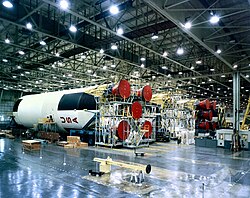
Between 1961 and 1972, MAF was instrumental in the Apollo program. Chrysler and Boeing collaborated here to build the S-I, S-IB, and S-IC first stages of the Saturn rockets. Interestingly, the factory's 12-meter ceiling height influenced NASA's design choices; the ceiling was too low for the massive Saturn C-8 vehicle, which contributed to the selection of the smaller Saturn V for the lunar missions.
The Space Shuttle and International Space Station Eras
Following the Apollo program, MAF transitioned to supporting the Space Shuttle. From 1973 to 2010, Martin Marietta used the facility to construct the External Tank (ET)—the large orange fuel tank that provided liquid oxygen and hydrogen to the shuttle's main engines. A total of 136 tanks were produced here, including ET-122, which flew on the final shuttle mission, STS-134.
In addition to the shuttle tanks, the facility fabricated modular components for the International Space Station (ISS) from the mid-1990s until 2010.
Modern Missions: SLS and Orion
Today, the facility is the heart of the Artemis program. Boeing utilizes MAF to fabricate and assemble the core stage of the Space Launch System (SLS), the most powerful rocket NASA has ever created. Simultaneously, Lockheed Martin uses the site to build the pressure vessel for the Orion spacecraft, which is designed to carry four to six astronauts to the Moon and beyond.
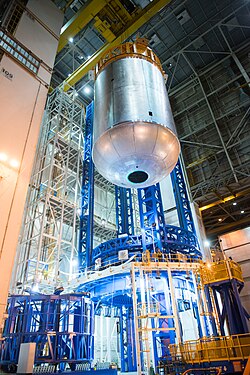
The manufacturing process involves highly specialized equipment, including vertical assembly buildings where massive tanks are welded and tested. The SLS core stage is a marvel of engineering, ranking as the third most powerful rocket in history, following the N1 and SpaceX Starship.
Resilience in the Face of Disaster
The facility's location in New Orleans has exposed it to significant environmental challenges. During Hurricane Katrina in 2005, the facility avoided catastrophic flooding thanks to a natural ridge and the heroic efforts of 38 NASA and Lockheed Martin employees. These workers stayed behind to operate pumping systems, removing over one billion gallons of water. For their bravery, each was awarded the NASA Exceptional Bravery Medal.
Despite the flooding avoidance, the main building's roof was breached, damaging the ET-122 tank. The tank was later refurbished and successfully flown. More recently, in 2017, an EF3 tornado damaged several buildings, including the main manufacturing plant, contributing to delays in the first SLS launch.
Facility Infrastructure and Logistics
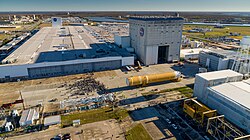
The MAF complex is designed for the movement of oversized aerospace components. The main manufacturing building (Building 103) is 512 by 340 meters and features polished concrete internal roads for trams and overhead cranes.
| Building/Area | Primary Function | Key Details |
|---|---|---|
| Main Manufacturing Building (103) | Preliminary fabrication and welding | 512m x 340m; 40+ sub-areas |
| Vertical Assembly Buildings (110 & 115) | Vertical welding and testing | North VAB added in 2011 |
| Shipping Port | Logistics and transport | Pegasus Barge for transport to KSC |
| Saturn Boulevard | Internal transport route | Former 1,700m paved runway |
Once components are completed, they are transported via Saturn Boulevard to the shipping port. From there, the Pegasus Barge carries the hardware to the Kennedy Space Center in Florida, or occasionally to the Stennis Space Center in Mississippi for testing.
Frequently Asked Questions
What is currently being built at the Michoud Assembly Facility?
The facility is currently used by Boeing to manufacture the core stage of the Space Launch System (SLS) rocket and by Lockheed Martin to build the pressure vessel for the Orion spacecraft.
How did the facility survive Hurricane Katrina?
MAF survived due to a natural ridge on its northwestern boundary, surrounding levees, and the efforts of 38 employees who stayed to pump over one billion gallons of water out of the facility.
Why was the Saturn V chosen over the Saturn C-8?
The Saturn C-8 was a larger direct-ascent vehicle that could not be built at MAF because the factory's ceiling height was limited to 12 meters.
What is the significance of the Pegasus Barge?
The Pegasus Barge is the primary means of transporting massive, completed aerospace components from the MAF shipping port to the Kennedy Space Center or other NASA testing sites.
Who manages the Michoud Assembly Facility?
The facility is owned by NASA and is organizationally part of the Marshall Space Flight Center.