Soviet Killing Fields and Mass Graves of the Great Purge
In the final years of the USSR and following its dissolution in 1991, a grim geography of killing fields and burial sites began to emerge across the former Soviet Union. While some of these sites date back to the Red Terror (the period of political repression and mass killings by the Bolsheviks), many were the result of the secret police's routine practice of using unmarked graves in existing cemeteries to dispose of victims of interrogation and execution.
The most significant concentration of these sites originated during the Great Purge, a campaign of political repression that reached its peak between August 5, 1937, and November 17, 1938. During this window, the NKVD (the Soviet secret police) carried out 12 national operations, resulting in the documented execution of at least 680,000 men and women, though the actual figure is likely higher.
To manage mass murder on this scale, NKVD People's Commissar Yezhov ordered subordinates to identify secluded areas near major urban centers for the rapid concealment of thousands of bodies. These sites were often euphemistically referred to as "army firing ranges." This terminology has created a historical distinction between "killing fields," where victims were both executed and buried (such as Sandarmokh), and burial sites where victims were executed elsewhere and transported for concealment.
Key Facts
- Documented Deaths: At least 680,000 people were executed by the NKVD during 12 national operations between 1937 and 1938.
- Systemic Concealment: The NKVD established special "zones" near cities to hide mass graves, often labeling them as firing ranges.
- Geographic Reach: Mass burial sites have been uncovered across Russia, Ukraine, and Belarus.
- Ongoing Discovery: New sites continue to be found, including a 2002 discovery under a Ukrainian monastery.
Major Burial Sites by Region
Ukraine
Ukraine contains numerous sites of mass execution and burial. The Bykivnia Graves near Kyiv are among the most prominent, containing an estimated 30,000 victims.
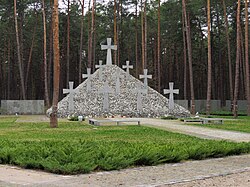
Other significant mass graves are located in Uman, Bila Tserkva, Cherkasy, and Zhytomyr. In Vinnytsia, 9,432 corpses were exhumed following the discovery of a massacre site.
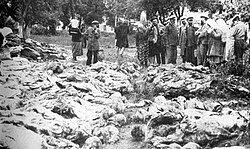
Additionally, the Tatarka common graves serve as a reminder of the systemic violence in the region.
Belarus
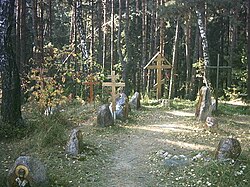
In Belarus, the site at Kurapaty near Minsk is one of the most notorious. It is estimated that at least 50,000 people were shot there, although reports in the Soviet press suggested considerably higher numbers.
Russian Federation
The Russian Federation hosts a wide array of memorial sites, ranging from the forests of the northwest to the outskirts of Moscow and the depths of Siberia.
Northwest RussiaIn Karelia, the site of Sandarmokh was discovered in July 1997; it contains at least 6,067 victims, representing half of all those shot in Karelia during the Great Terror. Other sites include the Krasny Bor Forest and the Levashovo Memorial Cemetery in St. Petersburg, where 19,520 people are believed to be buried. In 2002, the Toksovo site near St. Petersburg was uncovered, potentially containing up to 30,000 bodies.
Moscow and Surrounding AreasThe Butovo firing range is a major site of remembrance; the names of 20,702 victims are etched on granite walls in the Garden of Remembrance, which opened in September 2017.
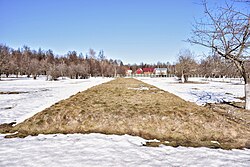
Other Moscow-area sites include Kommunarka, where 6,609 names are displayed on the Wall of Remembrance (opened October 2018), and the Donskoye Cemetery, which housed a secret crematorium and three secret mass graves containing tens of thousands of sets of ashes.
SiberiaIn the Irkutsk Region of East Siberia, the Pivovarikha site was established as a memorial area in 1989. While an exact number of burials at the site is unknown, the Memorial online database lists 10,609 people shot throughout the Irkutsk Region during the Great Terror, with the Open List database naming 1,384 who were executed specifically in the city of Irkutsk.
Summary of Notable Mass Burial Sites
| Site Name | Location | Estimated/Documented Victims |
|---|---|---|
| Bykivnia Graves | Kyiv, Ukraine | ~30,000 |
| Kurapaty | Minsk, Belarus | 50,000+ |
| Butovo Firing Range | Moscow, Russia | 20,702 |
| Levashovo Cemetery | St. Petersburg, Russia | 19,520 |
| Sandarmokh | Karelia, Russia | 6,067+ |
| Kommunarka | Moscow, Russia | 6,609 |
| Vinnytsia | Vinnytsia, Ukraine | 9,432 (exhumed) |
Frequently Asked Questions
What was the Great Purge?
The Great Purge was a period of intense political repression in the Soviet Union, peaking between 1937 and 1938, characterized by mass arrests and executions carried out by the NKVD.
What is the difference between a killing field and a burial site?
A killing field is a location where victims were both executed and buried on-site. In contrast, many other burial sites were used solely to conceal bodies that had already been executed elsewhere.
Why were these sites called "firing ranges"?
The term "army firing range" was used as a euphemism by the NKVD to disguise the true purpose of these zones, which were actually designated areas for mass burials.
How many people were executed during the NKVD's national operations?
Between August 1937 and November 1938, the NKVD documented the execution of at least 680,000 people across 12 national operations, though the actual number is believed to be higher.
Are new mass graves still being discovered?
Yes, sites continue to appear; for example, a mass grave was discovered under the floor of a Ukrainian monastery as recently as 2002.