Soviet Armenia: The Rise and Fall of the Armenian SSR
The Armenian Soviet Socialist Republic (Armenian SSR) represents a transformative era in the Caucasus, spanning from 1920 to 1991. Often referred to by historians as the Second Republic of Armenia, this period saw the region evolve from a war-torn agricultural hinterland into a sophisticated industrial center. Over seven decades, the republic navigated the volatile shifts of Soviet ideology, from the early stability of the New Economic Policy to the terror of the Great Purge and the eventual drive toward national independence.
Established on November 29, 1920, following the Sovietization of the First Republic of Armenia, the state's status shifted several times. It initially became part of the Transcaucasian Socialist Federative Soviet Republic (TSFSR) in 1922 before being re-established as a full constituent union republic of the Soviet Union in 1936.
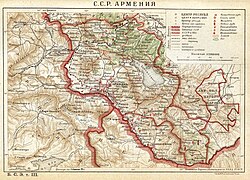
Key Facts
- Duration: 1920–1991 (with a period within the TSFSR from 1922–1936).
- Capital: Yerevan.
- Population Growth: Increased from approximately 880,000 in 1926 to 3.3 million by 1989.
- Official Languages: Armenian (state language) and Russian (official).
- Independence: Formally declared on August 23, 1990, and recognized on December 26, 1991.
- Economic Shift: Transitioned from a primarily agricultural economy to a major industrial production hub.
The Evolution of the Soviet State
Early Years and the New Economic Policy
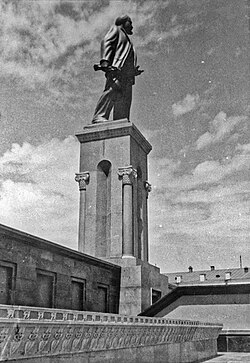
Following the initial turmoil of Sovietization, Vladimir Lenin appointed Alexander Miasnikian in 1921 to implement a more moderate approach tailored to Armenian national sensibilities. This coincided with the New Economic Policy (NEP), a period of relative stability that allowed for significant urban development. During this time, architect Alexander Tamanian began his ambitious city plan for Yerevan, and the population benefited from essential food and medical supplies provided by Moscow.
Stalinism and the Great Purge
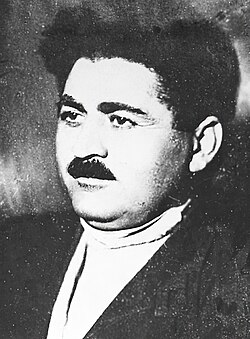
The stability of the NEP era vanished under the regime of Joseph Stalin. The republic suffered immensely during the Great Purge, a campaign of political repression and executions. A notable victim of this era was First Secretary Aghasi Khanjian, who was killed in 1936 by Lavrentiy Beria.
War, Repatriation, and the Khrushchev Thaw
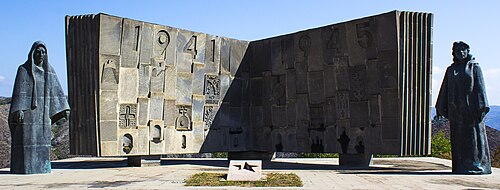
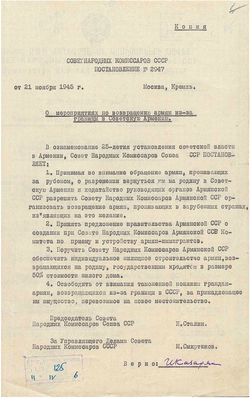
Armenia played a significant role in the Soviet victory during the Great Patriotic War (World War II). In 1945, a decree signed by Stalin facilitated the repatriation of Armenian diasporans to the republic, further boosting the population and cultural diversity of the region.
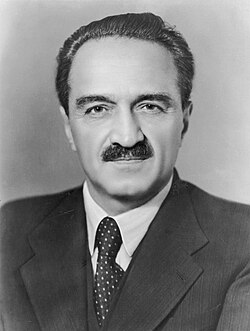
The atmosphere shifted again during the Khrushchev Thaw, a period of liberalization under Nikita Khrushchev. In 1954, Anastas Mikoyan called for the rehabilitation of the poet Yeghishe Charents, signaling a relaxation of strict Stalinist controls and a revival of intellectual life.
Governance and Society
The Armenian SSR operated as a unitary communist state. The First Secretary served as the administrative head, while the Chairman of the Council of Ministers led the government. The legislative body, the Supreme Soviet, was composed of members who were mandated to be part of the Communist Party of the Soviet Union.
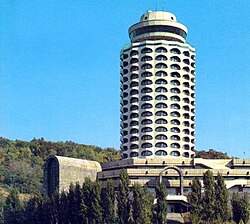
Culturally, the state was officially secular and practiced state atheism, though the Armenian Apostolic Church remained the faith of the majority. The republic also invested heavily in youth and education, exemplified by the construction of the Yerevan Youth Palace.
Economic Transformation
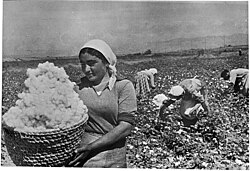
The republic's economy underwent a massive overhaul. While the 1930s saw large-scale agricultural efforts, such as cotton harvesting, the later decades focused on heavy industry and technology, making Armenia a vital production center for the wider Soviet Union.
The Path to Independence
The decline of the Soviet Union began in earnest with Mikhail Gorbachev's policies of glasnost (openness) and perestroika (restructuring). These reforms provided the political space for the Karabakh movement to emerge in 1988, as Armenians demonstrated in Yerevan for the unification of the republic with Nagorno-Karabakh.
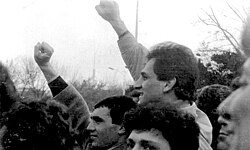
On August 23, 1990, local authorities declared state sovereignty. This culminated in an independence referendum on September 21, 1991, which was supported by over 99% of voters. By December 26, 1991, the Armenian SSR ceased to exist, giving way to the independent Republic of Armenia.
Summary of the Armenian SSR
| Category | Details |
|---|---|
| Timeline | 1920–1991 |
| Political Status | Independent (1920-22) → TSFSR (1922-36) → Union Republic (1936-90) → Sovereign (1990-91) |
| Capital | Yerevan |
| Population (1989) | 3,287,677 |
| HDI (1991) | 0.648 (Medium) |
| Currency | Soviet ruble |
Frequently Asked Questions
What was the difference between the First and Second Republics of Armenia?
The First Republic was a short-lived independent state (1918–1920), while the Second Republic refers to the Armenian Soviet Socialist Republic established after Sovietization in 1920.
What was the Karabakh movement?
The Karabakh movement began in 1988 during the era of glasnost and perestroika, consisting of mass demonstrations and political efforts to unify the Nagorno-Karabakh region with Armenia.
How did the population of Soviet Armenia grow so rapidly?
The population grew from roughly 880,000 in 1926 to 3.3 million in 1989 due to natural growth and the large-scale repatriation of Armenian genocide survivors and their descendants.
What was the "Khrushchev Thaw" in the context of Armenia?
The Khrushchev Thaw was a period of liberalization following Stalin's death, marked by the rehabilitation of persecuted figures like Yeghishe Charents and a general easing of political repression.
How did Armenians view the collapse of the Soviet Union?
Polls indicate a complex legacy; a 2017 Pew Research Center poll found that 79% of Armenians believed the dissolution of the Soviet Union was a bad thing for the country.