Southern Christian Leadership Conference: A Legacy of Nonviolent Civil Rights Action
The Southern Christian Leadership Conference (SCLC) stands as one of the most influential non-governmental organizations in United States history. Founded during the height of the American Civil Rights Movement, the SCLC was designed to harness the moral authority and organizational strength of Black churches to dismantle systemic segregation and secure voting rights for African Americans through nonviolent direct action.
Key Facts
- Founded: January 10, 1957.
- Headquarters: Atlanta, Georgia.
- Primary Goal: Ending all forms of segregation and securing civil rights.
- First President: Dr. Martin Luther King Jr.
- Key Achievements: Instrumental in the passage of the Civil Rights Act of 1964 and the Voting Rights Act of 1965.
- Current Leadership: DeMark Liggins (President/CEO).
The Founding and Early Vision
The SCLC emerged from a series of meetings in early 1957. Following initial gatherings in January, a pivotal follow-up meeting took place on February 13-14 at the New Zion Baptist Church in New Orleans. This meeting established a new organization with Dr. Martin Luther King Jr. as its president. While the group initially cycled through names such as the Negro Leaders Conference on Nonviolent Integration and the Southern Negro Leaders Conference, it officially adopted the name Southern Christian Leadership Conference in August 1957.
The organization's scope quickly expanded from focusing on bus desegregation to targeting all forms of racial segregation. Its first office was established in the Prince Hall Masonic Temple Building in Atlanta, with Ella Baker serving as the first and, for a significant period, the only staff member.
Empowering the Electorate: Citizenship Schools
A cornerstone of the SCLC's strategy was education. The Citizenship Schools, originally started in 1954 by Esau Jenkins and Septima Clark on the Sea Islands of South Carolina and Georgia, focused on adult literacy. These schools were essential because they taught adults how to pass discriminatory voter-registration literacy tests, fill out government forms, and manage financial accounts.
Under Septima Clark's leadership, the program became a massive popular education effort. The project trained over 10,000 teachers who reached more than 25,000 students. By 1968, this dedication to literacy and empowerment helped over 700,000 African Americans become registered voters.
Major Nonviolent Campaigns
The Albany Movement
In 1961 and 1962, the SCLC partnered with the Student Nonviolent Coordinating Committee (SNCC) for the Albany Movement in Georgia. While the campaign was initially viewed as unsuccessful due to a lack of immediate legislative gains and limited national attention, it served as a critical learning experience that informed the strategies used in later, more successful campaigns.
The Birmingham Campaign
The Birmingham campaign marked a turning point in the movement. One of its most poignant moments occurred on May 2, during the Children's Crusade. Under the direction of James Bevel, over 1,000 Black children joined demonstrations, with 2,500 more following the next day. The world watched as police commissioner "Bull" Connor used high-pressure fire hoses and police dogs against the students.
The resulting global public outrage forced the Kennedy administration to intervene. By May 10, a settlement was reached to desegregate downtown businesses, eliminate discriminatory hiring, and release jailed protesters.
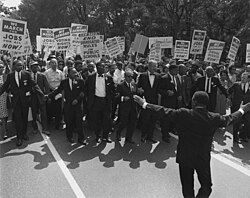
The March on Washington
Following the success in Birmingham, the SCLC joined forces with A. Philip Randolph, Bayard Rustin, and other civil rights leaders to organize the March on Washington for Jobs and Freedom on August 28, 1963. Despite fears from the political establishment that the event would turn violent, the march was a logistical triumph. Between 200,000 and 300,000 participants converged on the capital peacefully to demand federal civil rights legislation.
Selma and the Fight for Voting Rights
In 1965, the SCLC moved its focus to Selma, Alabama, to combat illegal injunctions blocking voter registration. In cooperation with SNCC, the SCLC organized rallies and registration drives. Protesters faced severe abuse from Sheriff Jim Clark, economic retaliation from the White Citizens' Council, and violence from the Ku Klux Klan.
After a federal court order, a historic march from Selma to Montgomery took place from March 21 to March 24, ending with a massive rally of 25,000 people. This pressure led directly to the enactment of the Voting Rights Act of 1965.
Challenges in Mississippi: The Grenada Freedom Movement
The SCLC's influence extended to Grenada, Mississippi, where the Grenada County Freedom Movement (GCFM) was formed as an affiliate in 1966. The movement attempted a massive school integration effort, encouraging 450 Black students to register at formerly white schools. This was met with fierce resistance; on September 12, a mob organized by the Klan attacked students and parents with clubs and whips while police failed to intervene.
Organizational Evolution and Leadership
The SCLC has navigated various leadership transitions since its inception. Following the assassination of Dr. King in 1968, Ralph Abernathy led the organization until 1977, followed by Joseph Lowery. In the late 1990s and early 2000s, the organization saw a period of transition involving Martin Luther King III, Fred Shuttlesworth, and others. In 2009, Bernice King was elected president but later declined the position in 2011 due to misaligned visions with the board.
| President | Term |
|---|---|
| Martin Luther King Jr. | 1957–1968 |
| Ralph Abernathy | 1968–1977 |
| Joseph Lowery | 1977–1997 |
| Martin Luther King III | 1997–2004 |
| Fred Shuttlesworth | 2004–2004 |
| DeMark Liggins | 2024–Present |
Strategic Relationships
The SCLC maintained a complex relationship with the Student Nonviolent Coordinating Committee (SNCC). While the SCLC acted as a mentor early on, the two organizations eventually diverged. The SCLC focused on large-scale, national campaigns led by the Black church, whereas SNCC focused on local community organizing and building political power among the poor. Additionally, the SCLC launched the SCOPE Project, which utilized white college students to register thousands of voters across the South.
Frequently Asked Questions
What was the primary purpose of the SCLC?
The SCLC was formed to coordinate nonviolent protests and campaigns to end racial segregation and secure full civil rights and voting access for African Americans in the United States.
How did Citizenship Schools help the movement?
Citizenship Schools provided adult literacy training, which enabled African Americans to pass discriminatory literacy tests required for voter registration and to navigate essential daily tasks like opening bank accounts.
What was the significance of the Children's Crusade?
The Children's Crusade in Birmingham brought international attention to the brutality of segregation when images of children being attacked by police dogs and fire hoses sparked global outrage and forced federal intervention.
What is the difference between the SCLC and SNCC?
The SCLC generally focused on high-profile, national campaigns and was rooted in the leadership of Black ministers. SNCC focused more on grassroots, local community organizing to build political power from the bottom up.
Which major laws were influenced by SCLC activities?
The SCLC's campaigns were instrumental in the passage of the Civil Rights Act of 1964 and the Voting Rights Act of 1965.