South American Flags: A Comprehensive Guide to National and Regional Symbols
The flags of South America are more than just colorful fabrics; they are profound symbols of identity, history, and political aspiration. From the bold stripes of the Andean nations to the unique emblems of international trade blocs, these banners tell the story of a continent defined by its struggle for independence and its drive toward regional integration.
Whether representing a sovereign state, a dependent territory, or a multinational organization, each flag utilizes specific colors and symbols to convey a unique national narrative.
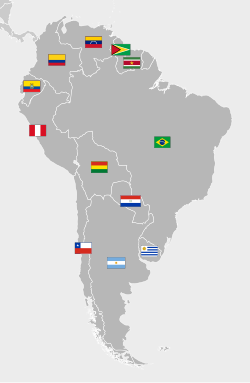
Key Facts
- Sovereign States: There are 12 sovereign nations in South America, each with its own distinct national flag.
- Regional Integration: Major international organizations like Mercosur and the Andean Community have their own flags to represent collective interests.
- Symbolism: Common themes in South American flags include the sky, the Andes mountains, and the blood shed during independence movements.
- Territorial Diversity: The continent includes various dependencies, including territories managed by the Netherlands, France, and the United Kingdom.
International and Regional Organizations
Beyond national borders, South America is home to several international organizations that promote economic and political cooperation. These entities use flags to symbolize unity among member states.
- Andean Community: Established its flag in 1996.
- Mercosur: The Southern Common Market adopted its flag in 1994.
- Union of South American Nations: This regional body introduced its flag in 2011.
Flags of Sovereign States
The national flags of South American countries often reflect their geography and the history of their liberation. For example, the flag of Chile (1817) features a blue square representing the sky and Pacific Ocean, a white star symbolizing the planet Venus, and stripes representing the snow-capped Andes and the blood of independence.
Similarly, the flag of Colombia (1861) uses a wide yellow band to recall the federation of Greater Colombia, a blue band for independence, and a red band to symbolize courage. Argentina has utilized its horizontal blue and white bicolor triband with the Sun of May since 1861.
Summary of National Flags
| Country | Adoption Date | Key Symbolic Elements |
|---|---|---|
| Argentina | 1861 | Blue and white triband with the Sun of May |
| Bolivia | 1851 | National colors |
| Brazil | 1889 | National colors |
| Chile | 1817 | Venus star, Andes mountains, Pacific Ocean |
| Colombia | 1861 | Greater Colombia, independence, and courage |
| Ecuador | 1860 | National colors |
| Guyana | 1966 | National colors |
| Paraguay | 2013 | National colors |
| Peru | 1825 | National colors |
| Suriname | 1975 | National colors |
| Uruguay | 1830 | National colors |
| Venezuela | 2006 | National colors |
Dependencies and Other Territories
Several areas in South America are not sovereign states but are managed as dependencies or overseas territories. These regions maintain their own flags to denote their specific status within a larger state.
- Netherlands: Aruba (constituent country, 1976), Curaçao (constituent country, 1984), and Bonaire (special municipality, 1981).
- United Kingdom: The Falkland Islands (overseas territory, 1999) and South Georgia and the South Sandwich Islands (overseas territory, 1999).
- France: French Guiana (overseas region and department, 2015).
Historical Evolution of Flags
The flags of the region have evolved significantly over the centuries. Brazil, for instance, transitioned from the Kingdom of Brazil (1822) to the Empire of Brazil (1822–1889), and through various iterations of the Republic from 1889 to the present.
Venezuela also saw a rapid succession of flags during its early republic stages, moving through the First, Second, and Third Republics between 1811 and 1819, followed by various state and republic designations until the current version adopted in 2006.
Other notable historical transitions include the various flags of British Guiana (1875–1966) and the Peru-Bolivian Confederation (1836–1839).
Frequently Asked Questions
What does the star on the Chilean flag represent?
The white star on the Chilean flag represents the planet Venus.
Which South American flags are associated with the Netherlands?
The flags of Aruba, Bonaire, and Curaçao are associated with the Netherlands.
What is the significance of the colors on the Colombian flag?
The yellow band recalls the federation of Greater Colombia, the blue band represents independence, and the red band symbolizes courage.
When was the current flag of Venezuela adopted?
The current flag of Venezuela was adopted in 2006.
Which international organizations have flags in South America?
The Andean Community, Mercosur, and the Union of South American Nations all have official flags.