Sorghum: The Resilient Ancient Grain for Food and Fuel
Known by many names—including broomcorn, great millet, jowar, and milo—sorghum (Sorghum bicolor) is a versatile grass species that has sustained human civilizations for millennia. Typically grown as an annual, though some cultivars are perennial, this hardy crop can reach heights of over 4 meters (13 ft). Its small grains, measuring 2 to 4 millimeters in diameter, serve as a critical source of nutrition and industrial raw material across the globe.
Key Facts
- Origin: Domesticated over 5,000 years ago in Eastern Sudan.
- Resilience: Highly tolerant of drought, toxic soils, and high altitudes.
- Nutrition: Rich in B vitamins, manganese, magnesium, and phosphorus.
- Global Trade: China is the world's largest importer, primarily for livestock feed.
- Versatility: Used for human food, animal forage, biofuel, and household items like brooms.
History and Domestication
The journey of Sorghum bicolor began more than 5,000 years ago in Eastern Sudan, specifically in the regions of the Gash and Atbara Rivers. Archaeological evidence from the Neolithic Butana Group culture near Kassala dates the crop back to 3500–3000 BCE. Its antiquity is further evidenced by sorghum bread found in Predynastic Egyptian graves dating back approximately 5,100 years.
![Piece of sorghum bread contained in basket, Predynastic Egypt, c. 3100 BCE (5,100 years ago). Egyptian Museum, Turin[24]](/images/d7/0a/d70ab003049c84f85f614d24aaf7f4810d6eefcc97915ea831b72a285a100aae.jpg)
The earliest domesticated varieties featured tight husks that required forceful removal. Over time, the crop spread to the Indian subcontinent about 4,000 years ago and West Africa about 3,000 years ago. Through continued cultivation, four additional races evolved to be free-threshing (meaning the grain separates easily from the husk), which significantly increased harvest productivity. These include the caudatum race in the Sahel, durra in India, guinea in West Africa, and magentiferum in Southern Africa.
![Domestication and the five major races of sorghum[25]](/images/d0/79/d079e34e87e259dc134d3c79fa489b4de16036d548bde1b0b85fbf72da673b7d.webp)
Cultivation and Agronomy
Sorghum is prized for its ability to thrive where other cereals fail. It is highly adaptable to various temperatures, with an optimum growth range between 12°C and 34°C (54°F to 93°F). The typical growing season spans 115 to 140 days.
The crop is remarkably flexible regarding soil quality, tolerating pH levels from 5.0 to 8.5 and growing in everything from sandy soils to heavy clay. To maximize yield and resilience, farmers often employ a 2- or 4-year crop rotation, frequently incorporating legumes or leaving the field fallow for two years. Like most cereal grains, sorghum requires nitrogen, phosphorus, and potassium for healthy development.
Global Production and Trade
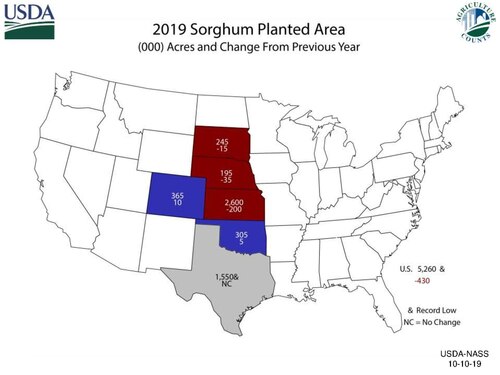
Sorghum is produced on a massive scale globally, with the United States leading in volume, followed by Mexico, Ethiopia, India, and China.
| Country | Production Volume |
|---|---|
| United States | 8.1 |
| Mexico | 4.8 |
| Ethiopia | 4.0 |
| India | 3.8 |
| China | 3.0 |
| Argentina | 1.6 |
| World Total | 57.3 |
International trade is heavily influenced by China, which is the world's largest importer. China utilizes sorghum primarily as a complementary livestock feed to maize. While trade has fluctuated due to geopolitical tariffs, the demand remains significant.
Nutritional Profile
Sorghum is a nutrient-dense grain. Per 100 grams, it provides approximately 329 calories, consisting of 72% carbohydrates (including 7% dietary fiber), 11% protein, and 3% fat.
It is particularly rich in several essential micronutrients. It provides significant percentages of the Daily Value (DV) for manganese (70%), magnesium (39%), copper (32%), and various B vitamins, including thiamine (28%) and vitamin B6 (26%).
Diverse Applications
Food and Drink
Sorghum is used in a wide array of culinary traditions. It is fermented to create traditional beers, such as Omalovu giilya in Namibia and Burukutu in Nigeria. In the United States, sweet sorghum is processed into a thick, sugary syrup.

Industrial and Biofuel Uses
Beyond the kitchen, sorghum serves as a vital biofuel feedstock. Its high sugar content in certain varieties makes it an efficient source for bioethanol production. Additionally, the sturdy panicle stalks are traditionally used to manufacture brooms.
Frequently Asked Questions
Where did sorghum originate?
Sorghum was first domesticated more than 5,000 years ago in Eastern Sudan, specifically in the area of the Rivers Atbara and Gash.
What makes sorghum a resilient crop?
Sorghum can tolerate high altitudes, toxic soils, and severe drought, and it can grow in a wide range of soil pH levels (5.0 to 8.5).
Is sorghum nutritious?
Yes, it is rich in protein (11%) and dietary fiber (7%), and it provides high levels of manganese, magnesium, and several B vitamins.
What is the difference between grain sorghum and sweet sorghum?
Grain sorghum is primarily grown for its seeds used in food and feed, while sweet sorghum is cultivated for its sugary stalks, which are used to produce syrup and bioethanol.
Who are the largest producers of sorghum?
The United States is the world's largest producer, followed by Mexico, Ethiopia, India, and China.