Job's Tears: The History, Cultivation, and Nutritional Value of Coix lacryma-jobi
Job's Tears, scientifically known as Coix lacryma-jobi, is a versatile cereal crop belonging to the Poaceae family. Often referred to as Adlay, this plant is recognized for its distinctive hard-coated seeds and its long history of use in food, crafts, and traditional medicine across Asia and beyond.
From its origins as a wild grass to its role as one of the earliest domesticated crops, Job's Tears has evolved to provide essential nutrients and medicinal benefits to various cultures. Domestication significantly altered the plant, resulting in a softer seed coat that is much easier to cook and digest than its wild counterparts.
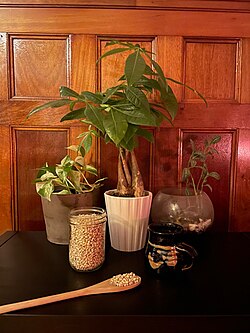
Key Facts
- Scientific Name: Coix lacryma-jobi.
- Ancient History: Archaeological evidence in northeastern India dates its presence to approximately 1000 BC.
- Nutritional Profile: High in carbohydrates (65%) and protein (14%).
- Primary Uses: Consumed as food (gruel, rice blends), used in alcoholic beverages, and applied in traditional medicine.
- Cultivation: Requires ground temperatures above 12 °C for planting.
Botanical Classification and Taxonomy
Job's Tears is classified under the kingdom Plantae and the family Poaceae. It is a monocot within the order Poales. The species Coix lacryma-jobi includes several recognized varieties, such as var. lacryma-jobi, var. ma-yuen, and var. puellarum.
Historical Significance and Distribution
The plant was introduced to subtropical India from the east Himalayan belt, with some scholars suggesting cultivation occurred as early as 2000–1000 BC. Its reach extends across East Asia, including Japan, and Mainland Southeast Asia, specifically Thailand and Myanmar. It is also found in Insular Southeast Asia, such as Borneo and the Philippines, and has reached the Americas.
Cultivation and Agricultural Management
Successful growth of Job's Tears depends on specific soil and climate conditions. Planting is recommended as soon as the ground temperature exceeds 12 °C to maximize the time available for emergence and anthesis (the period during which a flower is fully open and functional).
Sowing Methods
- Strip Sowing: Seeds are sown uniformly in trenches spaced about 50 cm apart, at a depth of 4–5 cm.
- Hole Sowing: Seeds are placed in holes 3–5 cm deep, with 3 to 4 seeds per hole.
Crop Management
Tillage is critical for promoting growth and preventing the plant from collapsing. A standard cycle involves three tillage stages:
- First Tillage: Performed when seedlings are 5–10 cm high to remove weeds and promote tillering.
- Second Tillage: Conducted when seedlings reach 15–20 cm.
- Third Tillage: Done at 30 cm, combined with fertilization to support root growth.
Nutritional Value and Composition
Job's Tears is a nutrient-dense grain, providing a significant source of energy and essential minerals. Its composition is detailed in the table below.
| Nutrient | Percentage |
|---|---|
| Carbohydrates | 65% |
| Protein | 14% |
| Fat | 5% |
| Crude Fiber | 3% |
| Phosphorus | 0.242% |
| Calcium | 0.07% |
| Iron | 0.001% |
Pests and Challenges
While Job's Tears is more resistant to locust attacks than corn or rice, it is susceptible to several insect pests. These include stem borers (Sesamia inferens and Ostrinia furnacalis), the rice skipper (Pelopidas mathias), thrips (Chaetanaphothrips orchidii), and various aphids such as Rhopalosiphum maidis and the woolly aphid Ceratovacuna lanigera.
Frequently Asked Questions
What are the primary food uses of Job's Tears?
It is commonly used in gruels, blended with cooked rice, or processed into dumplings (dango). In some traditions, roasted cracked grains are mixed with sugar to create snacks.
How does domestication affect the seed of Job's Tears?
Wild varieties possess a hard seed coat. Domestication has resulted in a softer coat, making the grain easier to cook and consume.
What is the ideal temperature for sowing Adlay?
Planting should occur when the ground temperature is above 12 °C.
Is Job's Tears used for anything other than food?
Yes, it is used in traditional medicine and for crafts, such as the creation of traditional necklaces in Zulu culture.
How does it compare to rice and corn regarding pests?
Job's Tears is generally less subject to attacks from locusts compared to rice and corn, although it still faces threats from stem borers and aphids.