Solubility in Chemistry: Principles, Factors, and Quantification
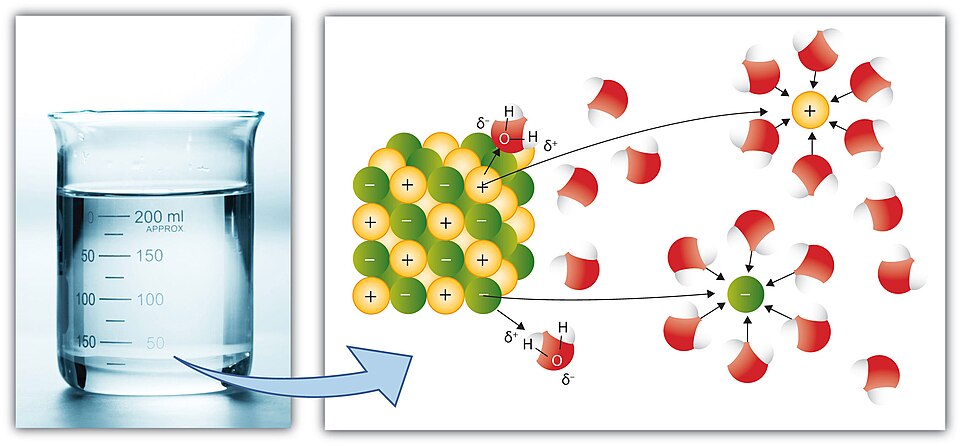
In the study of chemistry, solubility is defined as the ability of a substance, known as the solute, to dissolve in and form a solution with another substance, called the solvent. When a solute cannot form such a solution, it is described as having insolubility.
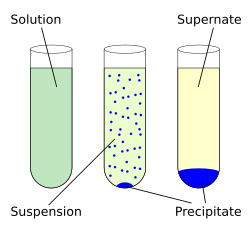
The limit of solubility is reached when a solution becomes saturated, meaning no additional solute can be dissolved at a given set of conditions. At this stage, the system reaches a solubility equilibrium. In some cases, two substances may be miscible, meaning they can mix in any proportion without a solubility limit.
While solvents are typically solids or liquids, solutes can exist as solids, liquids, or gases. It is important to note that gases are generally miscible in all proportions except under extreme conditions, and solids or liquids can only dissolve in a gas if they first transition into a gaseous state.
Key Facts
- Solubility is the maximum concentration of a solute in a saturated solution.
- Miscibility occurs when substances mix in all proportions without limit.
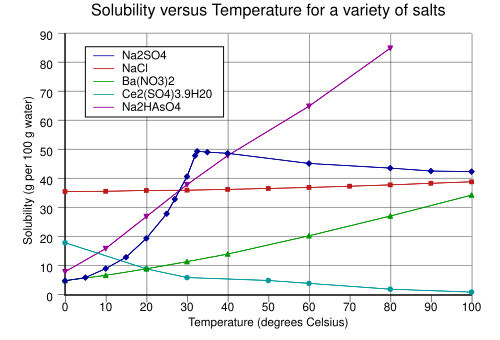
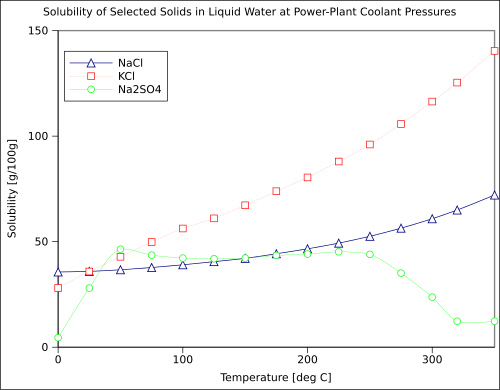
- Temperature typically increases the solubility of solids (endothermic) but decreases the solubility of gases in water (exothermic).
- Ksp (Solubility Product) is used to calculate the equilibrium of sparingly soluble ionic compounds.
- Retrograde solubility refers to substances that become less soluble as temperature increases.
Quantifying Solubility
Solubility is measured using various metrics depending on the scientific context. These are generally divided into measurements per quantity of solvent or per quantity of solution.
Per Quantity of Solvent
Chemical handbooks frequently use mass-to-volume or mass-to-mass ratios. Common units include:
- Grams of solute per 100 milliliters of solvent (g/100 mL).
- Grams of solute per deciliter (g/dL) or liter (g/L).
- Grams of solute per 100 grams or per kilogram of solvent (g/100 g or g/kg).
- Weight per weight (w/w) percentages.
Per Quantity of Solution
In specialized research, solubility is expressed as a dimensionless number between 0 and 1, often as a percentage. This is done using the mole fraction (moles of solute divided by total moles) or the mass fraction (mass of solute divided by total mass of the solution).
Describing the Extent of Solubility
The degree of solubility varies wildly, from titanium dioxide (essentially insoluble) to ethanol (infinitely soluble in water). The U.S. Pharmacopoeia provides standardized terms based on the mass of solvent (msv) required to dissolve one unit of mass of solute (msu).
| Term | Range (msv / msu) | Example |
|---|---|---|
| Very soluble | < 1 | Calcium nitrate |
| Freely soluble | 1 to 10 | Calcium chloride |
| Soluble | 10 to 30 | Sodium oxalate |
| Sparingly soluble | 30 to 100 | - |
| Slightly soluble | 100 to 1,000 | Calcium sulfate |
| Very slightly soluble | 1,000 to 10,000 | Dicalcium phosphate |
| Practically insoluble | ≥ 10,000 | Barium sulfate |
Factors Affecting Solubility
Temperature and Enthalpy
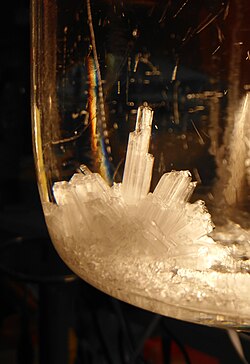
Solubility is a function of temperature, governed by the enthalpy (ΔH) of the dissolution reaction. If the reaction is endothermic (ΔH > 0), solubility typically increases with temperature. Conversely, if the reaction is exothermic (ΔH < 0), solubility decreases as temperature rises.
For example, sodium chloride's solubility is relatively independent of temperature (ΔH ≈ 0). However, calcium hydroxide exhibits retrograde solubility, becoming less soluble as it is heated. Gaseous solutes generally become less soluble in water as temperature increases but more soluble in organic solvents.
Pressure and Gas Solubility
The solubility of gases is specifically influenced by pressure, as described by Henry's Law. This law states that the concentration of a dissolved gas is proportional to its partial pressure above the liquid.
Redox Potential and Polarity
For solids dissolving via redox reactions, the potential of the environment matters. For instance, gold solubility in high-temperature water is nearly ten times higher when using a highly oxidizing Fe3O4-Fe2O3 buffer compared to a moderately oxidizing Ni-NiO buffer.
Theories and Applications
Solubility Product (Ksp)
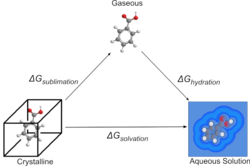
For ionic compounds, the solubility product (Ksp) is used to determine the equilibrium between a solid and its dissolved ions. For example, in the case of silver chloride (AgCl), the equilibrium is expressed as: AgCl(s) ⇌ Ag+(aq) + Cl-(aq). By using the Ksp value, chemists can calculate the exact molarity of the solute that will dissolve in a specific volume of water.
Solid Solutions and Incongruent Dissolution
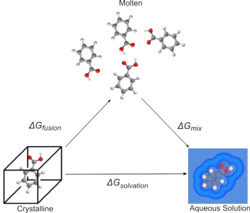
In solid compounds, solubility can depend on the phases that separate during equilibrium. Establishing "maximum solubility" in these cases is difficult and often requires the Gibbs phase rule and thermodynamic guidelines to identify crystallographic defects. Additionally, incongruent dissolution occurs when a solid dissolves to form a solution and a new, different solid phase.
Frequently Asked Questions
What is the difference between soluble and miscible?
Soluble refers to a solute's ability to dissolve in a solvent up to a certain limit (saturation). Miscible describes two substances that can mix in any proportion without a limit, such as ethanol and water.
Why do some substances become less soluble when heated?
This occurs when the dissolution process is exothermic (ΔH < 0). According to Le Chatelier's principle, adding heat to an exothermic reaction shifts the equilibrium back toward the solid state, reducing solubility. This is known as retrograde solubility.
How does Henry's Law apply to gas solubility?
Henry's Law states that the amount of a gas dissolved in a liquid is directly proportional to the partial pressure of that gas above the liquid. Increasing the pressure generally increases the solubility of the gas.
What is a saturated solution?
A saturated solution is one in which the maximum amount of solute has been dissolved in the solvent at a specific temperature and pressure. Any additional solute added will remain undissolved.
What is the solubility product (Ksp)?
The solubility product is an equilibrium constant for a solid substance dissolving in an aqueous solution. It represents the product of the molar concentrations of the ions in a saturated solution, each raised to the power of its stoichiometric coefficient.