Ammonia Partition Equilibrium in Water and Trichloromethane
In chemistry, the distribution of a solute between two immiscible solvents—liquids that do not mix—is a fundamental process known as partition equilibrium. This phenomenon occurs when a substance is soluble in both solvents, leading to a state where the solute is distributed between the two layers in a specific, constant ratio.
The Mechanism of Partitioning
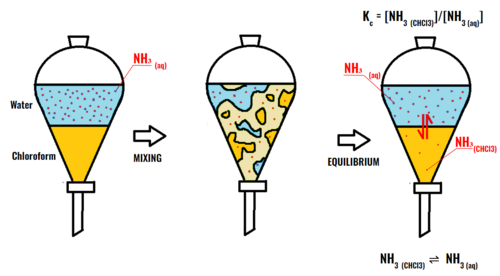
Consider the behavior of ammonia (NH3) when placed in a system containing water (aq) and trichloromethane (CHCl3). Because these two solvents are immiscible, they form distinct layers when combined. When ammonia is dissolved in water and then mixed with an equal volume of trichloromethane, the ammonia molecules migrate between the two liquids until a dynamic equilibrium is reached.
Calculating the Equilibrium Constant
The balance of ammonia between the organic and aqueous layers is defined by the equilibrium constant, denoted as Kc. This constant represents the ratio of the concentration of the solute in the organic solvent to its concentration in the water.
The mathematical expression for this equilibrium is:
Kc = [NH3 (CHCl3)] / [NH3 (aq)]
Measuring Concentrations
To determine the actual concentrations of ammonia in each layer, chemists use titration. This process involves reacting the ammonia in each layer with a standard acid solution of known concentration to quantify the amount of solute present.
Key Facts
- Solute: Ammonia (NH3).
- Solvents: Water (aqueous) and Trichloromethane (organic).
- Solvent Property: The two solvents are immiscible, meaning they do not mix.
- Equilibrium Constant (Kc): The value for this specific system is 0.4.
- Measurement Method: Titration with a standard acid solution.
| Parameter | Detail |
|---|---|
| Solute | Ammonia (NH3) |
| Aqueous Phase | Water (aq) |
| Organic Phase | Trichloromethane (CHCl3) |
| Kc Value | 0.4 |
Frequently Asked Questions
What is partition equilibrium?
Partition equilibrium is the state reached when a solute is distributed between two immiscible solvents such that the ratio of its concentrations in each layer remains constant.
What does the Kc value of 0.4 indicate for ammonia?
A Kc value of 0.4 indicates that ammonia is more soluble in the aqueous (water) layer than in the trichloromethane layer, as the concentration in the water is higher than in the organic solvent.
Why are water and trichloromethane used in this example?
They are used because they are immiscible solvents, which allows them to form two separate layers, making it possible to measure the concentration of the solute in each phase independently.
How is the concentration of ammonia determined in each layer?
The concentrations are established through titration, where a standard acid solution is used to react with the ammonia in each separate layer.