Calcium Carbonate: Properties, Polymorphs, and Industrial Applications
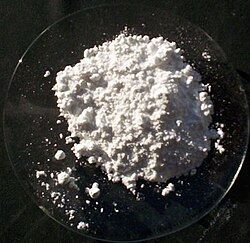
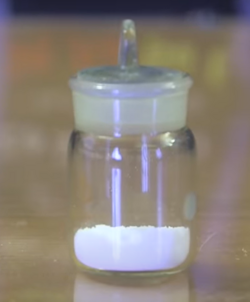
Calcium carbonate (CaCO3) is one of the most abundant and versatile compounds found in nature. From the towering cliffs of limestone and the elegance of pearls to the essential supplements used in human health, this chemical compound plays a critical role in both geological processes and industrial manufacturing. It typically appears as a fine white powder or colorless crystals and is characterized by a distinct chalky taste.
In its simplest form, calcium carbonate is a salt composed of calcium ions and carbonate ions. It is the primary component of many common materials, including chalk, marble, and the shells of marine organisms.

Key Facts

- Chemical Formula: CaCO3
- Molar Mass: 100.0869 g/mol
- Common Forms: Calcite, aragonite, limestone, marble, and chalk.
- Solubility: Very low in water (0.013 g/L at 25 °C) but soluble in dilute acids.
- Thermal Stability: Decomposes at high temperatures, releasing carbon dioxide.
- Safety: Low toxicity with an oral LD50 of 6450 mg/kg in rats.
Chemical Properties and Reactivity
Calcium carbonate exhibits the typical properties of carbonates, most notably its reaction with acids. When it encounters an acid, it releases carbonic acid, which rapidly disintegrates into water and carbon dioxide gas. This reaction is the reason why acidic rain can erode limestone buildings and statues.
The compound also undergoes calcination—a process of thermal decomposition. At temperatures above 550 °C, calcium carbonate begins to outgas carbon dioxide. For this process to occur at an economically viable rate in industrial kilns, temperatures typically need to reach approximately 898 °C to exceed total atmospheric pressure.
Structural Polymorphs
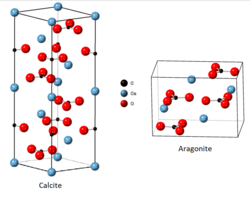
Calcium carbonate exists in several polymorphs—different crystalline forms of the same chemical compound. The most common are calcite and aragonite.
Calcite
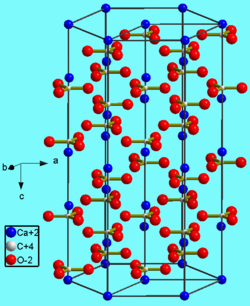
Calcite is the most stable polymorph of calcium carbonate. It possesses a trigonal crystal structure and can range from transparent to opaque. A specific transparent variety known as Iceland spar was historically used in the 19th century to create polarized light.
![Calcite is the most stable polymorph of calcium carbonate. It is transparent to opaque. A transparent variety called Iceland spar (shown here) was used to create polarized light in the 19th century.[30]](/images/c5/0e/c50e12890265fb287b8e57737b77682cc570d3f7082c4196be712d257577db91.jpg)
Aragonite and Other Forms
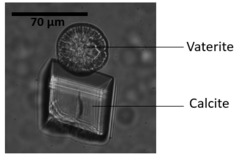
Aragonite is another common polymorph, often found in biological sources like seashells and pearls. While calcite is more stable, aragonite is frequently selected by organisms for shell construction. Other forms include vaterite, a less stable polymorph.
Natural Occurrence
Calcium carbonate is ubiquitous in the Earth's crust and biosphere, appearing in both geological and biological contexts.
Geological Sources
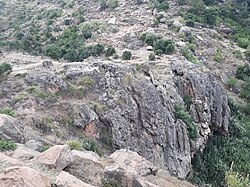
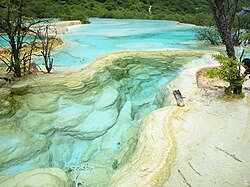
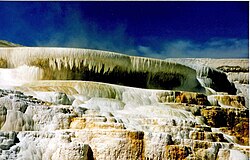
It is the primary constituent of sedimentary rocks such as limestone and chalk, as well as metamorphic rocks like marble. It also forms deposits such as tufa and travertine, which often precipitate from hot springs or surface waters.
Biological Sources
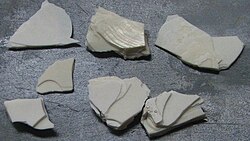
Many marine organisms utilize calcium carbonate to build their protective structures. This includes the shells of clams, oysters, and the formation of pearls. Even earthworms possess calciferous glands that fix CO2 to produce calcium carbonate.
Solubility and Scaling
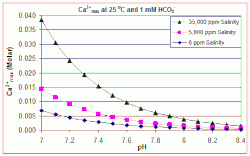
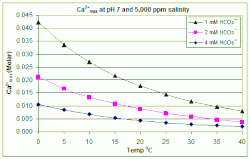
The solubility of calcium carbonate is highly sensitive to pH, temperature, and the partial pressure of carbon dioxide (PCO2). In water, it exists in a complex equilibrium involving bicarbonate and carbonate ions.
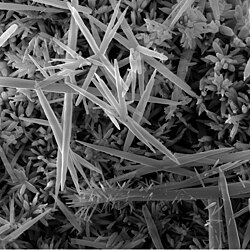
A common practical example of this chemistry is limescale. In environments like kettles or swimming pools, changes in temperature and pH can cause calcium carbonate to precipitate out of the water, forming hard, needle-like crystal deposits.
Industrial and Health Applications
Due to its abundance and safety, calcium carbonate is used across a wide array of sectors:
- Construction: Used as a primary material in cement and as a decorative stone (marble).
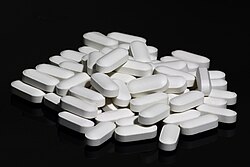
- Health: Used in 500-milligram calcium supplements to treat or prevent calcium deficiency and as an antacid.
- Agriculture: Applied to soils to neutralize acidity (liming).
- Manufacturing: Used as a filler in plastics and as a pigment (E170) in food.
Summary of Physical Properties
| Property | Calcite | Aragonite |
|---|---|---|
| Density | 2.711 g/cm3 | 2.83 g/cm3 |
| Melting Point | 1,339 °C | 825 °C |
| Crystal System | Trigonal | Orthorhombic |
| Stability | Most Stable | Metastable |
Frequently Asked Questions
What is the difference between calcite and aragonite?
Calcite and aragonite are polymorphs of calcium carbonate. Calcite is the more thermodynamically stable form with a trigonal structure, while aragonite has a different crystal structure and is often produced biologically by mollusks.
Why does calcium carbonate dissolve in acid?
Calcium carbonate reacts with acids to produce calcium ions, water, and carbon dioxide gas. This chemical reaction breaks down the solid structure of the carbonate, leading to dissolution.
What causes limescale in kettles?
Limescale is caused by the precipitation of calcium carbonate from hard water. When water is heated, the solubility of calcium carbonate decreases and dissolved CO2 is expelled, causing the mineral to crystallize on surfaces.
Is calcium carbonate safe for human consumption?
Yes, it is widely used as a food additive (E170) and as a dietary calcium supplement. It has a low toxicity profile, though it is often used specifically for calcium supplementation or as an antacid.
At what temperature does calcium carbonate decompose?
Decomposition begins above 550 °C, where it starts to release carbon dioxide. However, for rapid industrial decomposition (calcination), temperatures typically need to reach approximately 898 °C.