Ooids: The Science of Layered Sedimentary Grains
In the shallow, warm waters of the tropics, a fascinating geological process creates tiny, egg-like spheres known as ooids. Derived from the Ancient Greek word ōión, meaning "egg stone," ooids are small, spheroidal sedimentary grains characterized by a distinct layered or "coated" structure. While most commonly composed of calcium carbonate, these grains can also form from phosphate- or iron-based minerals.
These grains typically develop on the sea floor in shallow tropical environments, such as the Persian Gulf or the waters surrounding the Bahamas. Over time, as these grains are buried under subsequent layers of sediment, they can be cemented together to form a specific type of limestone known as oolite.
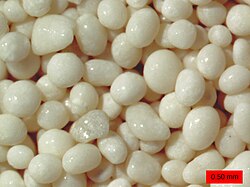
Key Facts
- Size: Ooids are generally 2 mm or smaller in diameter.
- Composition: Primarily calcium carbonate (aragonite or calcite), though some are iron- or phosphate-based.
- Environment: Most common in shallow, agitated tropical seas.
- Rock Type: When cemented together, they form oolite, a member of the limestone family.
- Pisoids: Similar to ooids but larger than 2 mm in diameter.
How Ooids Form
An ooid begins its life with a nucleus—a tiny starting point such as a quartz grain, a fragment of a shell, or other small debris. Around this nucleus, concentric layers of minerals precipitate, creating a structured cortex. These crystals may be arranged radially, tangentially, or randomly.
The mineralogy of ooids varies based on the environment and era. Modern ooids are frequently composed of aragonite (a polymorph of calcium carbonate) or high-magnesium calcite. Some are bimineralic, containing layers of both. Ancient ooids, however, are often calcitic. This may be because they precipitated as calcite during "calcite sea" intervals or because original aragonite was replaced by calcite through a process called neomorphic replacement.
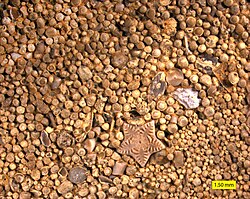
The Influence of Ocean Chemistry
The determination of whether an ooid becomes calcitic or aragonitic is often linked to strontium/calcium substitution within the crystal structure. This process is influenced by temperature fluctuations in marine environments, which affect salinity levels. Historically, marine calcitic ooids were prevalent during the Jurassic and Ordovician Periods, driven by low Mg/Ca ratios resulting from seafloor spreading.
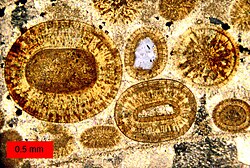
Growth Modes and Factors
Scientists identify different ways these grains grow. Ooids with radial crystals grow as ions extend the existing crystal lattices. Those with tangential crystals—which are often minute and needle-like—may grow through a "snowball" effect, accumulating tiny crystals from the surrounding water or sediment, or by crystallizing directly on the surface.
Some ooids exhibit a micritic texture, meaning they are very fine-grained and lack clear layering. Scanning electron microscopy has revealed that these textures often contain microbial borings that were later filled with cement.
Factors Driving Growth
Several environmental variables dictate the growth of ooids:
- Supersaturation: The concentration of calcium carbonate in the water.
- Nuclei Availability: The presence of particles to start the growth process.
- Agitation: The movement of the grains, which helps create the spherical shape.
- Water Depth: Shallow depths are typically required.
- Microbial Influence: Some ooids form statically within microbial mats, suggesting organic life plays a role in their development.
Ooimmuration and Fossil Preservation
A specialized taphonomic process known as ooimmuration occurs when fossils are incorporated into ooids, often serving as the nucleus. The resulting mineral cortex acts as a protective shield, guarding the fossil from bioerosion, fragmentation, and abrasion. This process is particularly valuable to paleontologists because it preserves fine organic remains that would otherwise be washed away by ocean currents.
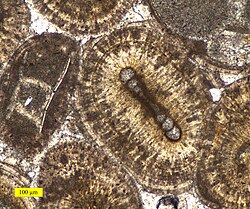
Summary of Ooid Characteristics
| Feature | Ooids | Pisoids | Oolite |
|---|---|---|---|
| Size | ≤ 2 mm | > 2 mm | Rock mass (composed of ooids) |
| Structure | Concentric layers | Concentric layers | Cemented grains |
| Primary Composition | Calcium Carbonate | Calcium Carbonate | Limestone |
| Typical Environment | Shallow tropical seas | Marine or Hot Springs | Sedimentary basins |
Frequently Asked Questions
What is the difference between an ooid and a pisoid?
The primary difference is size. Ooids are small sedimentary grains typically 2 mm or less in diameter, while pisoids are larger than 2 mm.
How does ooimmuration help preserve fossils?
Ooimmuration occurs when an ooid cortex forms around a fossil. This layer protects the fossil from being broken, worn down by abrasion, or destroyed by biological organisms (bioerosion).
What are the most common minerals found in ooids?
Most ooids are made of calcium carbonate, specifically in the forms of aragonite or calcite. However, some can be composed of phosphate- or iron-based minerals.
Where can ooids be found today?
Modern ooids are most commonly found in shallow tropical marine environments, such as the Persian Gulf and the Bahamas.
What is a "calcite sea"?
A calcite sea refers to a period in Earth's history where the geochemistry of the ocean—specifically low Mg/Ca ratios—favored the precipitation of low-magnesium calcite over aragonite.