Soil Alkalinity: Chemical Processes and Impact on Soil Structure
Soil alkalinity occurs when there is a significant presence of sodium carbonate (Na2CO3) or sodium bicarbonate (NaHCO3) within the soil. These compounds can enter the environment through the natural weathering of soil minerals or be introduced via floodwaters and irrigation. Because sodium carbonate is highly soluble, it fundamentally alters the chemical balance and physical structure of the soil.
The Chemistry of Alkalinity
When sodium carbonate undergoes hydration, it dissociates into sodium cations (Na+) and carbonate anions (CO32-). The carbonate anion acts as a weak base, accepting protons through a process called hydrolysis. This occurs in two stages:
- First, carbonate reacts with water to produce a bicarbonate ion (HCO3-) and a hydroxyl ion (OH-).
- Second, the bicarbonate ion further hydrolyzes to produce carbonic acid (H2CO3) and another hydroxyl ion.
Carbonic acid is unstable and eventually breaks down into water and carbon dioxide gas, which escapes into the atmosphere. This leaves behind soluble sodium hydroxide, resulting in a high pH (low pOH). While calcium carbonate (CaCO3) follows similar dissolution reactions, sodium carbonate is approximately 78,000 times more soluble. This allows it to dissolve far more carbonate, pushing soil pH values above 8.5—surpassing the maximum pH typically achieved by the equilibrium of calcium carbonate and dissolved carbon dioxide.
pH and Ion Concentration
The alkalinity of soil is measured by pH, the negative decimal logarithm of the hydronium (H3O+) concentration. In pure water at 25°C, the dissociation constant (Kw) is 10-14, meaning neutral water has a pH of 7 and a pOH of 7. In any aqueous solution, the sum of pH and pOH remains constant at 14.
Water with an excess of hydroxyl ions (OH-) is considered alkaline or basic (pH > 7). Soil moisture is classified as very alkaline when the pH exceeds 10, while moisture with a pH below 4 is considered very acid.
Impact on Soil Structure and Clay Particles
The high concentration of carbonate ions causes calcium (Ca2+) to precipitate as solid calcium carbonate (limestone), effectively immobilizing the calcium ions. This shift creates an abundance of sodium (Na+) ions in the soil solution.
Clay particles possess negative electric charges on their surfaces. In the presence of high sodium levels, these particles adsorb more Na+ in the diffuse double layer (DDL)—also known as the diffuse adsorption zone (DAZ) or electrical double layer (EDL)—and release previously adsorbed calcium. This process increases the exchangeable sodium percentage (ESP).
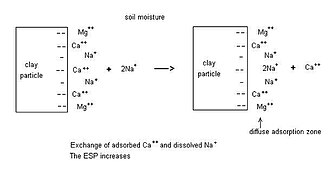
Because sodium has a smaller electric charge and is more mobile than calcium, the DDL expands as sodium occupies it. The thickness of this layer is also affected by ion concentration; as soil dries and ion concentration increases, the DDL shrinks, causing clay particles to adhere more firmly, leading to soil compaction and desiccation cracks.
Soil Dispersion and Crop Impact
When clay particles with an ESP greater than 16 come into contact with non-saline soil moisture, the DDL expands significantly, causing the soil to swell—a phenomenon known as dispersion. This leads to:
- Deterioration of soil structure.
- Formation of surface crusts and top-layer compaction.
- Reduced water infiltration and availability.
- Increased surface runoff and waterlogging.
- Impaired seedling emergence and reduced crop production.
Interestingly, saline conditions can counteract this swelling, meaning saline soils often maintain better physical properties than purely alkaline soils.
Soil Types and Vulnerability
Alkalinity problems are most severe in clay soils compared to sandy, silty, or loamy soils. Specifically, swelling clays like montmorillonite or smectite are more susceptible than illite or kaolinite. This is due to their higher cation exchange capacity (CEC) and larger specific surface areas (the ratio of surface area to volume).
Some clay minerals, such as bentonite, are almost fully sodium-saturated (nearly 100% ESP). Due to their impermeability, they are frequently used in civil engineering to create seepage curtains beneath dams.
Measuring Irrigation Water Quality
To assess the risk of alkalinity in irrigation, two primary indexes are used:
| Index | Full Name | Preferred Value | Key Components |
|---|---|---|---|
| SAR | Sodium Adsorption Ratio | < 10 (Max 20) | Na, Ca, Mg |
| RSC | Residual Sodium Carbonate | < 0.5 (Max 1) | HCO3, CO3, Ca, Mg |
Sodium Adsorption Ratio (SAR)
The SAR measures the relative concentration of sodium to calcium and magnesium. Over time, the ESP of the soil tends to equilibrate with the SAR of the water applied to it. The formula is:
SAR = [Na] / √[Ca/2 + Mg/2]
Residual Sodium Carbonate (RSC)
The RSC accounts for the bicarbonates and carbonates that contribute to alkalinity. The formula is:
RSC = [HCO3 + CO3] − [Ca + Mg]
When calculating these values, it is essential to consider the water quality at the crop root zone, accounting for the leaching factor and the partial pressure of dissolved CO2. The USDA utilizes an adjusted SAR to calculate water sodicity.
Key Facts
- Sodium carbonate is 78,000 times more soluble than calcium carbonate, leading to soil pH values above 8.5.
- Dispersion occurs in clay soils with an ESP > 16, causing soil swelling and poor water infiltration.
- Montmorillonite and smectite clays are more prone to alkalinity due to higher specific surface areas and CEC.
- Bentonite is a nearly 100% sodium-saturated clay used for impermeable barriers in engineering.
- SAR and RSC are the primary metrics for evaluating the alkalinity hazard of irrigation water.
Frequently Asked Questions
What causes soil to become alkaline?
Soil alkalinity is caused by the presence of sodium carbonate or sodium bicarbonate, which can result from the natural weathering of minerals or be introduced through irrigation and floodwaters.
How does sodium affect the physical structure of clay soil?
Sodium increases the thickness of the diffuse double layer (DDL) around clay particles. This causes the soil to swell and disperse, leading to compaction, surface crusting, and reduced water infiltration.
Why are some clay soils more susceptible to alkalinity than others?
Clays like montmorillonite and smectite have larger specific surface areas and higher cation exchange capacities (CEC) than clays like kaolinite, making them more likely to adsorb sodium and experience alkalinity issues.
What is the difference between saline and alkaline soils regarding physical properties?
Saline soils often have better physical properties because the high concentration of ions in the soil solution counteracts the swelling and dispersion caused by sodium.
What are the ideal SAR and RSC values for irrigation water?
For optimal soil health, the Sodium Adsorption Ratio (SAR) should preferably be less than 10 (and not much higher than 20), and the Residual Sodium Carbonate (RSC) should preferably be less than 0.5 (and not much higher than 1).