Small Indian Mongoose
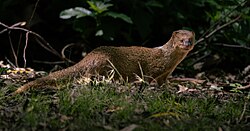
The small Indian mongoose (Urva auropunctata) is a slender carnivore native to Iraq and northern India. While it plays a natural role in its home range, it has become one of the most widely recognized invasive species globally after being introduced to various Caribbean and Pacific islands. Known for its agility and opportunistic diet, this species has left a significant mark on the ecosystems where it was introduced.
Key Facts
- Scientific Name: Urva auropunctata
- Conservation Status: Least Concern (IUCN 3.1)
- Native Range: Iraq, Iran, Afghanistan, Pakistan, India, Nepal, Bhutan, Bangladesh, and Myanmar.
- Physical Traits: Slender body, elongated head, pointed snout, and long claws.
- Primary Diet: Insects, small rodents, amphibians, and reptiles.
- Global Status: Listed as an invasive and alien species by the European Commission.
Taxonomy and Classification
The small Indian mongoose was first described by Brian Houghton Hodgson in 1836 as Mangusta auropunctata based on a specimen from central Nepal. Over the following century, other researchers proposed different names for specimens found in Afghanistan (Mangusta pallipes) and India (Herpestes palustris). Eventually, the species was grouped under the genus Herpestes.
Modern scientific classification has since shifted. All Asian mongooses are now placed in the genus Urva. Furthermore, while the small Indian mongoose was once thought to be a subspecies of the Javan mongoose (H. javanicus), genetic analysis of hair and tissue samples confirmed that they are two distinct species forming separate clades.
Physical Description
This mongoose is characterized by a slender build and an elongated head with a pointed snout. Adults typically measure between 509 and 671 mm (20.0–26.4 inches) in head and body length. They possess short ears and feet with five toes equipped with long claws.
There is a noticeable difference in size between the sexes, known as sexual dimorphism, with males generally possessing larger bodies and wider heads. Interestingly, populations on islands often show increased size and more pronounced sexual dimorphism compared to native populations, likely due to a lack of ecological competitors.
Distribution and Habitat
In its native range, the small Indian mongoose is found across a broad stretch of Asia, from Iraq through southeastern Iran and Afghanistan to Myanmar. It is highly adaptable, living at elevations up to 2,100 meters (6,900 feet). In Iraq, it inhabits the alluvial plains of the Tigris–Euphrates river system, including orchards, crop fields, and the Hammar Marshes.
Beyond its native range, the species has been introduced to several European countries, Okinawa in Japan, and numerous islands in the Caribbean, Indian, and Pacific Oceans.
The Impact of Global Introductions
The small Indian mongoose was introduced to many regions as a biological control agent to manage rodent populations on sugarcane plantations.
The Caribbean and Greater Antilles
In 1872, nine mongooses were brought from India to Jamaica to control black and brown rats. While they reproduced quickly, the results were ecologically disastrous. Introduced to Cuba, Hispaniola, Puerto Rico, and the U.S. Virgin Islands, the mongooses preyed on native fauna. This led to a sharp decline in endemic reptiles, such as the green iguana, and the total elimination of the ground lizard from St. Croix by 1962. Native snakes were largely extirpated on many islands, with some species potentially becoming extinct.
Hawaii and Okinawa
In Hawaii, mongooses were shipped from Jamaica to plantations. Although early reports suggested they reduced rat and insect populations, they also preyed on native birds and raided the nests of green sea turtles for eggs and hatchlings.
In Japan, the species was introduced to Okinawa in 1910 and Amami Ōshima in 1979 to control the venomous pit viper (Protobothrops flavoviridis). However, the mongoose became a pest itself. In a significant conservation victory, the Japanese Ministry of the Environment announced the eradication of the species from Amami Ōshima on September 3, 2024.
The Dalmatian Islands
Introduced to Mljet island in 1910 to control the horned viper, the mongoose eventually shifted its diet to resident and migratory birds and domestic poultry. Despite bounties and the introduction of wild boars to curb their numbers, the population spread to other islands like Hvar and Čiovo.
Behavior, Diet, and Health
The small Indian mongoose is a communicative animal, utilizing approximately 12 different vocalizations. Its diet is highly opportunistic and varies by region. In Pakistan, it feeds heavily on insects such as dragonflies, grasshoppers, and ants, as well as various rodents like the house mouse and Asian house shrew.
Analysis of scat and faecal pellets has revealed a diverse diet including fish scales, feathers, small amphibians, reptiles, seeds, and fruits. Regarding health, populations in Okinawa have shown infections of Leptospira and antibiotic-resistant Escherichia coli. In Puerto Rico, the species serves as a major vector for rabies, though transmission to humans remains low.
| Feature | Details |
|---|---|
| Scientific Name | Urva auropunctata |
| Body Length | 509–671 mm |
| Native Range | Iraq to Myanmar |
| Conservation Status | Least Concern |
| Key Threats Caused | Predation of endemic birds, reptiles, and turtle eggs |
| Disease Vectors | Rabies (Puerto Rico), Leptospira (Okinawa) |
Frequently Asked Questions
Why was the small Indian mongoose introduced to the Caribbean?
They were introduced primarily to control black and brown rat populations on sugarcane plantations to prevent crop failure and economic loss.
How does the small Indian mongoose differ from the Indian grey mongoose?
The small Indian mongoose is generally smaller in size than the sympatric Indian grey mongoose (U. edwardsii).
What is the ecological impact of mongooses in Hawaii?
Beyond preying on rats, they have negatively impacted native birds that evolved without mammalian predators and have preyed upon green sea turtle eggs and hatchlings.
Has the mongoose been successfully removed from any areas?
Yes, the Japanese Ministry of the Environment announced that the small Indian mongoose was eradicated from Amami Ōshima Island on September 3, 2024.
What do small Indian mongooses eat in their native range?
Their diet is varied, consisting of insects (like grasshoppers and beetles), small rodents, amphibians, reptiles, and occasionally plant matter such as seeds and fruits.