Introduced species: From Global Migration to Ecological Impact
The movement of plants and animals across the globe is a constant process, but not all migrations happen naturally. When a species is transported outside its native distributional range through human activity—whether intentionally or by accident—it is known as an introduced species. Also referred to as alien, exotic, non-native, or immigrant species, these organisms can fundamentally alter the environments they enter.
While some introduced species coexist peacefully with local wildlife, others can trigger significant ecological shifts. Understanding the distinction between a species that is simply "present" and one that is "invasive" is critical for conservation and environmental management.
The Spectrum of Introduction: From Alien to Invasive
Not every species brought to a new region becomes a permanent fixture of the landscape. Scientists use specific terminology to describe the different stages of establishment:
- Introduced Species: Any species living outside its native range due to human activity.
- Naturalized Species: Introduced species that successfully establish themselves and spread beyond the initial point of introduction without further human help.
- Invasive Species: Naturalized species that cause substantial negative effects on the local ecosystem, economy, or human health.
This human-driven process is distinct from biological colonization, where species reach new areas through natural means, such as rafting on debris or being carried by storms. To describe these new arrivals, scientists use the Latin term neobiota (new biota), which refers to organisms that are new to an established biological network, such as a food web. Neobiota is further divided into neozoa (animals) and neophyta (plants).
Defining the Impact
The impact of these species varies wildly. Some are introduced as biocontrols—organisms used intentionally to combat pests as a beneficial alternative to chemical pesticides. Others integrate seamlessly into their new homes with no negative impact. However, invasive species are viewed with urgency. For example, U.S. Executive Order 13112 defines invasive species as alien species likely to cause environmental or economic harm. Similarly, Great Britain's Wildlife and Countryside Act 1981 prohibits the introduction of animals not naturally occurring in the wild or those previously proven to be invasive.
| Term | Definition | Ecological Status |
|---|---|---|
| Introduced | Brought to a new area by humans | May or may not survive long-term |
| Naturalized | Established and spreading naturally | Integrated into the local environment |
| Invasive | Spreading and causing harm | Disruptive to native biodiversity |
The Nature of Introductions
The movement of species is often categorized by the intent behind the action. The widespread phenomenon of intentional introduction is sometimes described as biological globalization.
Intentional Introductions
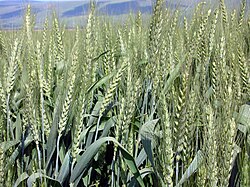
Humans often move species for economic gain or personal enjoyment. Wheat, for instance, was introduced worldwide from its place of origin in Mesopotamia to support global agriculture.
Some introductions are driven by "cultural nostalgia," where migrants bring familiar organisms to their new homes. Notable examples include:
- Common Starlings: Introduced to New York City's Central Park in 1890 and 1891 by Eugene Schieffelin, who aimed to bring all birds mentioned in Shakespeare's plays to North America.
- European Rabbits: Released in Victoria, Australia, by landowner Thomas Austin for hunting purposes, later becoming a major invasive pest.
- Common Wall Lizard: Introduced to North America around 1950 by George Rau following a trip to Italy.
Ornamental plants and animals are also frequently moved for aesthetic reasons. The Aesculus hippocastanum (Horse Chestnut), native to Greece and the Balkan peninsula, was spread across Europe and North America as an ornamental tree.
![Aesculus hippocastanum, native to Greece and the Balkan peninsula, has been introduced across most of Europe and parts of North America as an ornamental plant.[38]](/images/8a/5b/8a5bd67e5b4d6b8adf59f5d0697405e3e2bfee675faa02700a92d0bba75e335c.jpg)
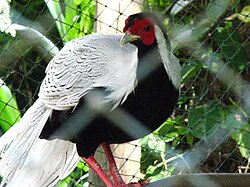
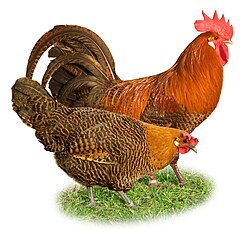
Similarly, colorful birds like the silver pheasant or livestock like chickens, which originated in Asia, have been introduced globally for human use and enjoyment.
Unintentional Introductions
Many species arrive in new lands by accident. While most do not become invasive, a small percentage can cause profound changes. In the U.S. and Canada, 179 coccinellid (lady beetle) species were introduced; only 27 became established, and only a few are invasive. One such example is the multicolored Asian lady beetle (Harmonia axyridis), which has become so abundant in North America that it likely outweighs all native lady beetles in observations.
Other accidental introductions occur in marine environments. The seaweed Caulerpa taxifolia was first spotted in the Mediterranean Sea in 1984. By 1997, it covered 50 km, threatening sublittoral ecosystems (the area just below the low-tide mark). It is believed to have arrived either via an aquarium or by migrating through the Suez Canal from the Red Sea.
Animal introductions for pest control can also backfire. The small Indian mongoose (Urva auropunctata) was introduced to Hawaii and the West Indies in the late 1800s. Because local prey had no defenses against the mongoose's speed, the introduction nearly led to the local extinction of several species.
Introductions on a Planetary Scale
The concept of introduced species extends beyond Earth. Scientists have hypothesized that microbial life could contaminate other planetary bodies if introduced via spacecraft or space probes, either accidentally or deliberately.
On a more theoretical level, some suggest that life on Earth itself began billions of years ago through the introduction of life from other planets by a sentient race. Looking forward, there are proposals to introduce life to other habitable planets in different star systems. As part of this research, some projects have suggested analyzing biological remains left behind during the Moon landings between 1969 and 1972 to see if any organisms survived.