Slave Ships of the Atlantic Trade: History, Conditions, and Abolition
From the 17th to the 19th century, specialized cargo vessels known as slave ships—or "Guineamen," due to their frequent travel to the Guinea coast of West Africa—were used to transport millions of enslaved Africans to the Americas. Driven by the demand for unpaid labor on plantations, this trafficking became a highly profitable industry, peaking in the final two decades of the 18th century during and after the Kongo Civil War.
The journey from Africa to South America, the Caribbean, and the southeastern coast of the modern-day United States is known as the Middle Passage, a central leg of the broader triangular trade. It is estimated that as many as 20 million Africans were transported via these vessels.
Key Facts
- Scale: Up to 20 million Africans were transported across the Atlantic.
- Mortality: Average captive death rates were 15%, sometimes reaching one-third of those on board.
- Duration: The voyage typically lasted between one and two months.
- Legislation: The Slave Trade Act 1788 (Dolben's Act) was the first British law to limit the number of slaves per ship.
- Abolition: The UK and US outlawed the slave trade in 1807, with US law taking effect on January 1, 1808.
Conditions Aboard Slave Ships
The Experience of the Enslaved
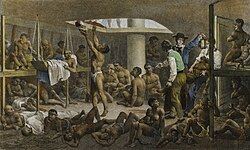
To maximize profit, ship owners designed hulls with minimal headroom, cramming as many captives as possible into the holds. Enslaved people were often naked, shackled with various types of chains, and pinned to floorboards for long periods. This extreme overcrowding led to a lack of oxygen and physical trauma, such as skin on elbows wearing down to the bone.
Health conditions were catastrophic. Captives suffered from dehydration and a wide array of diseases, including dysentery, scurvy, malaria, smallpox, yellow fever, typhoid fever, and sleeping sickness. Those who died or were dying were frequently dumped overboard. Firsthand accounts, such as those from Olaudah Equiano, provide harrowing evidence of these adverse conditions.
![Plan of the British slave ship Brooks, 1788, showing how 454 slaves were accommodated on board after the Slave Trade Act 1788. This same ship had reportedly carried as many as 609 slaves and was 267 tons burden, making 2.3 slaves per ton.[1] Published by the Society for Effecting the Abolition of the Slave Trade](/images/8c/98/8c9872ce386e0979ed74b28800975f1ba001a8571321783d36b24011f1d2b22a.jpg)
Regulation and the Slave Trade Act 1788
The Slave Trade Act 1788, also known as Dolben's Act, was introduced to the UK Parliament by Sir William Dolben. This act established the first legal limits on the number of slaves a ship could carry based on tonnage: 1.67 slaves per ton for ships up to 207 tons, and one slave per ton thereafter. For example, the ship Brookes was limited to 454 people, having previously carried as many as 609.
While intended to reduce overcrowding, the act was controversial. Some abolitionists, including William Wilberforce, opposed the regulation because they feared it suggested the slave trade only needed reform rather than total abolition.
The Crew and Sailors
While conditions for the crew were better than those for the enslaved, they remained brutal. Sailors were often poorly paid and subject to harsh discipline. Because the lower decks were reserved for captives, crew members often slept without shelter on the open deck. The expected mortality rate for the crew was approximately 20%, caused by disease (primarily malaria and yellow fever), flogging, or uprisings.
Due to the notoriety of these voyages, many crew members were coerced into service or were former prisoners. Interestingly, records show that Black sailors—from Africa, the Caribbean, or Britain—were part of these crews, with some serving as essential translators.
Abolition and the End of the Trade
The United Kingdom and the United States both outlawed the slave trade in 1807. Following these laws, any British or US slave ship leaving Africa was legally classified as a pirate vessel and subject to capture by the Royal Navy or US Navy. By 1815, Spain, Portugal, France, and the Netherlands also agreed to abolish the trade at the Council of Vienna.
Despite legal bans, the trade persisted clandestinely. Between 1807 and 1860, British vessels captured 1,600 slave ships and freed 160,000 people. To evade capture, illegal slave ships adopted faster, more maneuverable designs, such as the Baltimore Clipper, and used expensive copper sheathing on hulls to reduce drag from marine weed.
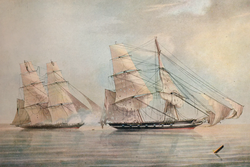
Some captured vessels were repurposed for naval use. The HMS Black Joke, for instance, became a notable Royal Navy ship used to capture other slave traders and free hundreds of enslaved people.
| Category | Details |
|---|---|
| Common Name | Guineamen |
| Primary Route | West Africa to the Americas (Middle Passage) |
| Average Mortality | 15% (Captives); ~20% (Crew) |
| Key Regulations | Tonnage Act 1684 (Portugal); Slave Trade Act 1788 (UK) |
| Abolition Year | 1807 (UK and US) |
Frequently Asked Questions
What was the Middle Passage?
The Middle Passage was the leg of the triangular trade in which enslaved Africans were transported across the Atlantic Ocean to the Americas.
Why were slave ships called "Guineamen"?
They were called Guineamen because the trade involved transporting human beings to and from the Guinea coast of West Africa.
What was the purpose of Dolben's Act?
The Slave Trade Act 1788, or Dolben's Act, was designed to regulate conditions on British slave ships by placing a legal limit on the number of enslaved people that could be carried based on the ship's tonnage.
How did slave ships change after the trade was outlawed?
To avoid capture by naval warships, illegal slave ships became faster and more maneuverable, often utilizing designs like the Baltimore Clipper and adding copper sheathing to their hulls to increase speed.
Who were the crew members on these ships?
The crews consisted of poorly paid sailors, often coerced or recruited from prisons. This included Black sailors from Africa, the Caribbean, or Britain, some of whom served as translators.