Sir Francis Dashwood: The Notorious Life of the Monks of Medmenham
Sir Francis Dashwood was a man of profound contradictions. A high-ranking politician and Fellow of the Royal Society, he was equally famous for his appetite for debauchery and his leadership of the infamous Hellfire Club. From the halls of Parliament to the clandestine rituals of Medmenham Abbey, Dashwood's life mirrored the excesses and intellectual curiosity of the 18th-century British aristocracy.
Early Life and Education
Born in December 1708 in Great Marlborough Street, London, Dashwood was the only son of Sir Francis Dashwood, 1st Baronet, and Mary, the daughter of the 4th Earl of Westmorland. He was educated at Eton College, where he formed a connection with William Pitt the Elder. At the age of fifteen, following his father's death in 1724, he inherited the family estates and the Baronetcy of Dashwood of West Wycombe.
The Grand Tour and European Notoriety
Dashwood spent much of his youth traveling Europe, participating in the Grand Tour—a traditional trip for upper-class young men to study classical art and culture. However, his travels were marked by eccentricity and scandal. While in Russia, he impersonated Charles XII of Sweden in an attempt to seduce Anna Ioannovna, and he was eventually expelled from the Papal States.
His journeys took him through France and Germany in 1726, and Italy between 1729 and 1731, and again from 1739 to 1741. During these visits, he explored Florence, Rome, Livorno, and the excavations at Herculaneum, befriending the theologian Antonio Niccolini. In 1733, he also traveled to St Petersburg via Copenhagen with George, Lord Forbes.
The Society of Dilettanti and the Divan Club
In 1732, Dashwood helped form the Society of Dilettanti, a dining club for approximately 40 members who shared a passion for classical art acquired during their travels. While the society had a serious academic side, it was often viewed as a cover for drinking. Horace Walpole once critically described it as a club where the only real qualification was "being drunk." Despite this, Dashwood's intellectual pursuits led to his election as a Fellow of the Royal Society (FRS) in 1746 and a fellow of the Society of Antiquaries of London (FSA) in 1769.
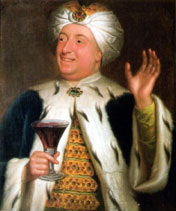
In 1744, Dashwood and John Montagu founded the Divan Club, a short-lived group dedicated to those who had visited the Ottoman Empire. This club was disbanded within two years.
The Hellfire Club and the Monks of Medmenham
Dashwood is most remembered for his role in the Hellfire Club. In 1746, he founded the "Knights of St. Francis" at the George and Vulture Inn, a burlesque parody of the Franciscan order. He sought to replace the austerities of monastic life with "convivial gaiety" and "unrestrained hilarity."
By 1752, the group moved to West Wycombe and eventually to Medmenham Abbey, where they became known as the "Monks of Medmenham." The abbey, rented by Dashwood and several associates including John Wilkes and Paul Whitehead, was restored in the Gothic Revival style by architect Nicholas Revett. The members, which included figures like Benjamin Franklin and the Duke of Queensberry, followed a "rigorously pagan" practice, dedicating themselves to Bacchus and Venus.
![Portrait by William Hogarth from the late 1750s, parodying Renaissance images of Francis of Assisi. The bible has been replaced by a copy of the erotic novel Elegantiae Latini sermonis, and the profile of his friend Lord Sandwich peers from the halo.[d]](/images/ea/61/ea61d29524dcf33f9d8abb202179da1ad33331fd80ce1e265d98ad91f55a41a6.jpg)
The club's motto, "Fay ce que voudras" (Do what thou wilt), was displayed in stained glass. Rituals reportedly involved mock Christian rites, heavy drinking, and the use of ritual clothing—white ensembles for members and red for the "Abbot." While some accounts of their orgies may have been embellished by satirists like Charles Johnstone, the club remained a symbol of aristocratic rebellion.
Political Career and Public Service
Dashwood's political life was characterized by his opposition to Robert Walpole's administration. He secured a seat in Parliament for New Romney in 1741 and later introduced a failed poor-relief bill in 1747 that suggested public works to fight unemployment.
His political peak came in 1762 when he was appointed Chancellor of the Exchequer under Prime Minister John Stuart, 3rd Earl of Bute. However, his tenure was widely mocked; he was criticized for a lack of financial knowledge, and his budget speech was reportedly met with laughter. He resigned in 1763.
In 1763, he became the 11th Baron le Despencer and served as the Lord-Lieutenant of Buckinghamshire. In his later years, he served as joint Postmaster General under Lord North from 1770 to 1781.
Key Facts
- Full Title: Sir Francis Dashwood, 11th Baron le Despencer.
- Key Associations: Founder of the Monks of Medmenham and leading member of the Society of Dilettanti.
- Political Peak: Served as Chancellor of the Exchequer (1762–1763).
- Academic Honors: Fellow of the Royal Society (FRS) and Society of Antiquaries (FSA).
- Notable Estate: West Wycombe Park, where he built a church and a mausoleum.
- Death: Died December 11, 1781, and was buried in his own mausoleum.
| Category | Details |
|---|---|
| Born | December 1708, London |
| Education | Eton College |
| Major Clubs | Society of Dilettanti, Divan Club, Hellfire Club |
| Political Seats | New Romney, Weymouth and Melcombe Regis |
| Key Offices | Chancellor of the Exchequer, Joint Postmaster General |
| Died | December 11, 1781 |
Frequently Asked Questions
What was the Hellfire Club?
The Hellfire Club, specifically the branch known as the Monks of Medmenham, was a private society of high-society men who engaged in mock-religious rituals, heavy drinking, and pagan worship as a parody of organized religion.
Was Sir Francis Dashwood a successful politician?
While he held high offices, including Chancellor of the Exchequer, his financial competence was widely questioned, and his budget speech was famously ridiculed by his contemporaries.
What was the Society of Dilettanti?
It was a dining club for men who had traveled to Italy and other parts of Europe, intended to promote the study and appreciation of classical art and antiquity.
Where is Sir Francis Dashwood buried?
He is buried in a mausoleum he constructed at his estate in West Wycombe, alongside his wife.
Who were some of the other members of the Monks of Medmenham?
Members included prominent figures such as Benjamin Franklin, the Duke of Queensberry, the Earl of Bute, and the satirist John Wilkes.