Sir Edward Belcher: The Controversial Navigator of the Royal Navy
Sir Edward Belcher was a man of immense technical skill and polarizing leadership. Born in Halifax, Nova Scotia, as the second son of Andrew Belcher, he entered the Royal Navy in 1812. He carried a distinguished lineage, being the great-grandson of Jonathan Belcher, a former colonial governor of Massachusetts, New Hampshire, and New Jersey. While his career was marked by significant contributions to global cartography and exploration, it was ultimately overshadowed by a disastrous Arctic expedition and a reputation for severity.
A Career of Global Surveys
Belcher established himself as a premier surveyor early in his career. In 1825, he served as a surveyor on Frederick William Beechey's expedition to the Pacific and the Bering Strait. His expertise in hydrography—the science of surveying and charting bodies of water—led him to various critical assignments, including surveying the Irish Sea aboard HMS Lightning in 1835 and commanding surveying vessels along the British seas and the north and west coasts of Africa in 1836.
Continuing the work Beechey had left unfinished, Belcher surveyed the Pacific coast of South America. While aboard HMS Sulphur, he was diverted in 1840 to participate in the war in China. During this period, on January 25, 1841, Belcher landed at Possession Point on the north shore of Hong Kong Island, where he conducted the first British survey of Hong Kong harbour.
![HMS North Star destroying Pomare's Pā, 1845. Painting by John Williams.[4]](/images/3a/e8/3ae8c11c0b5b2e452f0971a473824bab019318f0e7556574ee7dc579f1dbdb2b.jpg)
Following the war's conclusion in 1842, Belcher was recognized as a Knight Bachelor. He continued his surveying work until 1847, operating HMS Samarang across the Philippines, the East Indies, and Port Hamilton.
The Search for Sir John Franklin
In 1852, Belcher was appointed to lead the largest and final Admiralty expedition to locate the missing Sir John Franklin. His mission was twofold: find Franklin and locate Sir Richard Collinson and Sir Robert McClure, whose ships had vanished after entering the Bering Strait.
Belcher commanded a fleet of five vessels:
- HMS Assistance: Belcher's flagship.
- HMS Resolute: Commanded by Henry Kellett.
- Pioneer: A steam tender commanded by Sherard Osborn.
- Intrepid: A steam tender commanded by Sir Leopold McClintock.
- HMS North Star: A depot ship commanded by William Pullen.
The strategy involved splitting the fleet. Belcher and one tender entered the Wellington Channel between Cornwallis and Devon Islands, while Kellett headed west toward Melville Island. The North Star remained at Beechey Island to serve as a supply base.
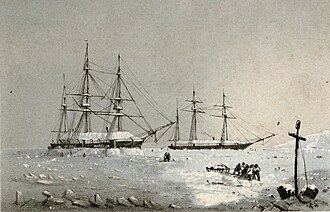
The expedition faced brutal conditions. By early winter, the Assistance and Pioneer were frozen in at Northumberland Sound, while the Resolute and Intrepid were trapped off Melville Island. Despite the ice, the crew conducted extensive exploration via manhauled sledges (sleds pulled by people). In April 1853, Leopold McClintock led a 105-day journey covering 1,400 miles (2,300 km), resulting in the discovery of Prince Patrick Island.
Another party successfully located Robert McClure, whose ship was frozen in at Mercy Bay. Belcher himself traveled north by sledge and discovered a channel at the northern tip of Devon Island, which he hoped Franklin might have used to reach Baffin Bay. However, when the ice broke up that summer, Belcher's ships were trapped once again in the Wellington Channel.
The Abandonment and Aftermath
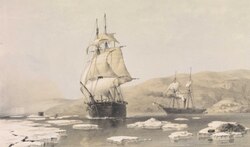
By February 1854, Belcher's confidence in the safety of his crew waned. In April, he ordered Kellett to abandon his ships and return to the North Star by sledge. By late July, Belcher abandoned his own two ships. The party eventually returned to England with the help of the ships Phoenix and Breadalbane.
As was standard for any captain who lost a ship, Belcher faced a court martial. Although he was exonerated, his sword was returned to him "without observation," a subtle sign of disapproval. He never held an active command again.
The Legacy of the Resolute Desk
In a strange twist of fate, the HMS Resolute did not sink. It broke free from the ice and drifted to the Davis Strait, where it was found by an American whaler. The United States government returned the ship to the United Kingdom. Years later, when the vessel was dismantled, its timbers were used to craft a desk for the President of the United States. This Resolute desk, a gift from Queen Victoria, remains in use in the Oval Office today.
Key Facts
- First Survey of Hong Kong: Belcher conducted the first British survey of Hong Kong harbour in 1841.
- Arctic Fleet: He led a five-ship expedition in 1852 to find Sir John Franklin.
- Major Discovery: His expedition discovered Prince Patrick Island.
- The Resolute Desk: The timbers of his abandoned ship, HMS Resolute, now form the desk used by U.S. Presidents.
- Reputation: Despite his technical success, he was described by a Navy Hydrographer as a "tyrannical martinet."
| Period | Region | Key Achievement/Outcome |
|---|---|---|
| 1825 | Pacific & Bering Strait | Surveyor for Frederick William Beechey |
| 1841 | Hong Kong | First British survey of Hong Kong harbour |
| 1843–1847 | East Indies & Philippines | Surveying work aboard HMS Samarang |
| 1852–1854 | Arctic | Rescued Robert McClure; abandoned four ships |
Frequently Asked Questions
Why was Sir Edward Belcher court-martialed?
Belcher underwent a court martial because it was automatic Royal Navy procedure for any captain who lost a ship during their command.
What happened to the HMS Resolute?
After being abandoned in the ice, the ship drifted to the Davis Strait, was recovered by an American whaler, and eventually returned to the UK, where its wood was used to create the Resolute desk.
Did Belcher find Sir John Franklin?
No, Belcher did not find Sir John Franklin, although his expedition did rescue Sir Robert McClure and discover Prince Patrick Island.
How was Belcher viewed by his peers?
While technically proficient, he was viewed poorly as a leader; a Hydrographer of the Navy described him as a "tyrannical martinet" who made his ships a "floating hell."
What honors did Belcher receive later in life?
He was appointed Knight Commander of the Order of the Bath in 1867 and promoted to admiral in 1872.