Siege of Mafeking: The 217-Day Stand of the Second Boer War
The Siege of Mafeking was a pivotal, though strategically debated, encounter during the Second Boer War. Lasting from October 13, 1899, to May 17, 1900, the battle for the town of Mafeking (now Mahikeng) in South Africa became a global media sensation. While its military impact was limited, the siege transformed Colonel Robert Baden-Powell into a national hero and provided a desperate morale boost for the British Empire during a struggling campaign.
The event gained additional prestige due to the presence of high-profile figures within the besieged town, including Lord Edward Cecil, son of the British prime minister, and Lady Sarah Wilson, a daughter of the Duke of Marlborough and aunt of Winston Churchill. Lady Sarah Wilson notably became the first female war correspondent by reporting from the town.
Key Facts
- Duration: 217 days (7 months and 4 days).
- Outcome: British victory; town relieved.
- British Commander: Colonel Robert Baden-Powell.
- Boer Commanders: Piet Cronjé, Jacobus Snyman, and Petrus Liebenberg.
- Casualties: 212 British killed and 600+ wounded; approximately 2,000 Boer casualties.
- Legacy: Inspired the formation of the Boy Scout Movement.
Prelude to the Siege
Before the war broke out, Lord Wolseley, the British Army's Commander-in-Chief, dispatched Colonel Robert Baden-Powell to the Cape Colony. His mission was to raise two regiments of mounted rifles from Rhodesia to maintain a mobile cavalry force on the frontier of the Boer republics—the Transvaal and the Orange Free State.
Due to political fears that military escalation might provoke the Boers, the British government provided rifles and ammunition but no horses or artillery. Baden-Powell was forced to recruit in secret and organize his own transport. He chose Mafeking as a supply hub because of its railway connection between Bulawayo and Kimberley and its existing food stocks. However, this left the town isolated and exposed.
Baden-Powell decided to immobilize half of his force to defend the town, believing that a defensive posture would tie down superior Boer numbers more effectively than an attack. The defending force of roughly 2,000 included the Protectorate Regiment, the Bechuanaland Rifles, the Cape Police, and local volunteers. To bolster the perimeter, 300 African natives were armed and nicknamed the Black Watch.
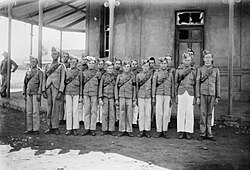
In a move that would later influence the Boy Scouts, Lord Edward Cecil formed the Mafeking Cadet Corps, consisting of boys aged 12 to 15 who served as messengers and orderlies.
The 217-Day Defense
War was declared on October 12, 1899. By the following day, Boer forces under General Piet Cronjé had cut the railway and telegraph lines, effectively sealing the town. Shelling began on October 16 after the British refused to surrender.
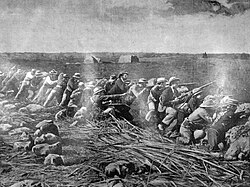
The garrison defended a six-mile (10 km) perimeter using an extensive network of trenches and gun emplacements. To deceive the Boers, Baden-Powell employed various psychological tactics: laying fake landmines, simulating the avoidance of non-existent barbed wire, and moving a makeshift searchlight (made from a biscuit tin and acetylene lamp) to suggest a larger force.
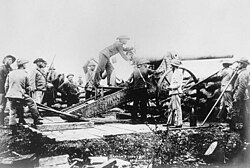
The defenders also utilized improvised weaponry, including a howitzer built in the railway workshops and an old cannon from 1770. In one daring raid, an armored train loaded with sharpshooters armed with Martini-Henry Mark IV rifles attacked the heart of the Boer camp before returning to the town.
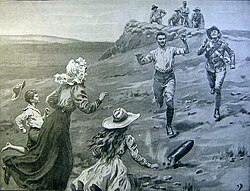
To maintain civilian morale, Sunday ceasefires were negotiated. These allowed for theatrical performances and sports, most notably cricket matches. When General Jacobus Snyman threatened to fire on the players, he eventually relented and invited the British to a game; Baden-Powell famously replied that he first had to finish his current match, where the score was "200 days, not out"!
The Final Boer Attack
On May 12, 1900, Field Cornet S. Eloff led 240 Boers in a surprise assault. Guided by a deserter, they breached the western defenses and entered the stadt (the African village), setting fire to huts to signal their progress. They captured the police barracks and took Colonel C. O. Hore and 29 others prisoner.
The garrison responded rapidly. The Barolong African police cut off Eloff's escape route, while Major Alick Godley and the Protectorate Regiment isolated the attackers into three groups. By nightfall, the remaining Boers in the barracks capitulated. The British suffered 12 dead and 8 wounded, while the Boers lost 60 killed or wounded and 108 captured.
Siege Currency and Stamps
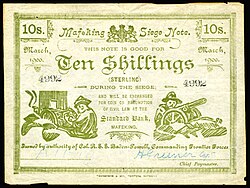
Due to a shortage of genuine banknotes, Baden-Powell authorized the issuance of siege banknotes in late 1899. Printed by Townshend & Son and backed by the Standard Bank of South Africa, these notes came in denominations of one, two, three, and 10 shillings, as well as £1 notes. While intended for exchange after the war, most were kept as souvenirs.
The town also produced unique stamps, including a one-penny stamp featuring Cadet Sgt. Major Goodyear on a bicycle and a threepenny stamp featuring Baden-Powell.
Relief and Aftermath
The siege ended on May 17, 1900, when a flying column of 2,000 British soldiers, including Canadians from "C" Battery, Royal Canadian Field Artillery, and volunteers from Kimberley, fought their way into the town under the command of Colonel B. T. Mahon.
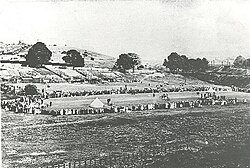
The news triggered massive celebrations in Britain, leading to the creation of the verb maffick (meaning to celebrate extravagantly and publicly). However, the military assessment was mixed. While the public saw a victory, some British commanders believed Baden-Powell had been foolish to allow himself to be besieged and had overstated the strategic value of tying down Boer forces.
Summary of the Siege of Mafeking
| Category | British Empire | Boer Republics |
|---|---|---|
| Commanders | Robert Baden-Powell | Piet Cronjé, Jacobus Snyman |
| Troop Strength | ~2,000 | ~8,000 (peak) |
| Casualties | 212 killed, 600+ wounded | ~2,000 |
| Key Assets | Armored train, Mafeking Cadets | "Long Tom" artillery |
Frequently Asked Questions
How did the Siege of Mafeking lead to the Boy Scouts?
The use of the Mafeking Cadet Corps—boys aged 12 to 15 who served as messengers and orderlies—provided Robert Baden-Powell with a practical model for youth organization, which he later expanded into the Boy Scout Movement in 1908.
What does the term "mafficking" mean?
The term is a back-formation from the town's name, Mafeking. It describes the extravagant and public celebrations that occurred across Britain following the relief of the town in May 1900.
Was the siege strategically important?
Military historians debate this; while it tied down several thousand Boer troops and provided a massive publicity victory for Britain, some commanders felt it was a distraction that wasted resources and supplies.
What was the "Black Watch" in Mafeking?
The "Black Watch" was the nickname given to 300 armed African natives who were tasked with guarding the perimeter of the town during the siege.
Why did Baden-Powell issue his own currency?
Because the town was cut off from the rest of the colony, there was a severe lack of genuine banknotes. Baden-Powell authorized woodcut-printed coupons and notes backed by the Standard Bank of South Africa to facilitate local trade.