Seventh Ward: A Cultural and Historical Heart of New Orleans
The Seventh Ward is a legally defined voting ward and a vibrant neighborhood located in New Orleans, Louisiana. As a sub-district of the Mid-City District Area, it serves as a critical piece of the city's cultural mosaic, historically serving as a primary residence for citizens of Creole descent. From its bustling music scene to its academic institutions, the Seventh Ward embodies the resilience and artistic spirit of New Orleans.
Key Facts
- Location: District 4, Mid-City District, New Orleans, Louisiana.
- Total Area: 1.16 square miles of land.
- Population: 5,116 residents (as of 2010).
- Geography: Stretches from the Mississippi River to Lake Pontchartrain.
- Notable Landmarks: Frenchmen Street, Dillard University, and the New Orleans Fairgrounds.
Geography and Boundaries
The Seventh Ward is geographically the third largest of the 17 wards in New Orleans, following the 9th and 15th Wards. Its boundaries are defined by the New Orleans City Planning Commission and include a network of streets such as A.P. Tureaud Avenue, Agriculture, Allen, Industry, St. Anthony, Duels, Frenchmen, and Hope Streets to the north.
To the east, the ward is bordered by Elysian Fields Avenue, which separates it from the 8th Ward. The southern boundary is marked by St. Claude and St. Bernard Avenues, North Rampart Street, and Esplanade Avenue. To the west, the boundary is North Broad Street. The neighborhood's reach extends from the riverfront up to Lake Pontchartrain, with the 5th Ward located across Bayou St. John.
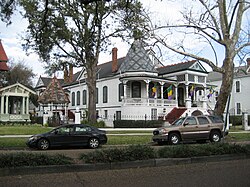
Adjacent Neighborhoods
- North & East: St. Roch
- South: Marigny and Tremé
- West: Fairgrounds
Landmarks and Local Features
The Seventh Ward is home to several prestigious institutions and cultural hubs. Dillard University is located within the ward, as is a significant portion of the University of New Orleans campus near the lakefront. For entertainment and culture, Frenchmen Street—renowned for its live music and dining—sits at the front of the ward near the French Quarter.
Other notable sites include the New Orleans Fairgrounds, which hosts horse racing and the New Orleans Jazz & Heritage Festival, and the historic Saint Louis Cemetery #3. The London Avenue Canal also traverses the ward, running from Gentilly Ridge toward the lake.
History and Resilience
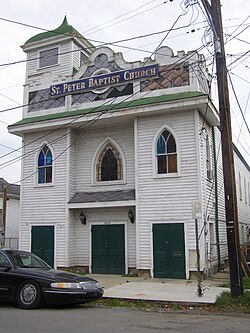
Development in the Seventh Ward followed the natural topography of the region. The high ground near the riverfront was developed first, forming the Marigny Triangle of the Faubourg Marigny. Early 19th-century Creole-style mansions still line the Esplanade Ridge, which was one of the first areas developed away from the riverfront. Historically, the Pontchartrain Railroad—the first U.S. railroad away from the Atlantic coast—ran along Elysian Fields for a century.
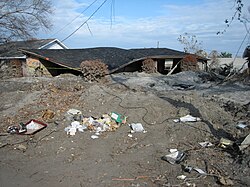
The neighborhood faced a catastrophic turning point in 2005 during Hurricane Katrina. The London Avenue Canal breached on both sides, causing massive flooding across the majority of the ward. Despite the devastation, many residents have since returned to rebuild their community.
Education and Infrastructure
The area falls under the jurisdiction of the Orleans Parish School Board. A significant project in the neighborhood's recovery was the construction of the Nora Navra Branch of the New Orleans Public Library, which opened in 2017. The previous facility was demolished after FEMA estimated it had suffered over 50% damage during Hurricane Katrina.
The new library was built using a "design-build" process—a method specifically permitted for Katrina-affected parishes under Louisiana law. Designed by Lee Ledbetter & Associates and Gould Evans Associates, the facility emphasizes cost-effectiveness through water-saving features, reduced utility usage, and improved access to public transportation.
Notable Residents
The Seventh Ward has been a breeding ground for world-class talent in music, arts, and politics. It is the birthplace or former home of jazz legends such as Jelly Roll Morton, Sidney Bechet, and Allen Toussaint. In the modern era, it has produced figures like actor Anthony Mackie, playwright Tyler Perry, and singer-songwriter Frank Ocean.
The ward's political influence is also evident, having produced New Orleans mayors Ernest Morial, Sidney Barthelemy, and C. Ray Nagin, as well as civil rights leader A. P. Tureaud.
Seventh Ward Summary
| Category | Details |
|---|---|
| Total Area | 1.16 sq mi (3.0 km) |
| Elevation | 0 ft (0 m) |
| 2010 Population | 5,116 |
| Planning District | District 4, Mid-City District |
| Key Institutions | Dillard University, University of New Orleans |
Frequently Asked Questions
What are the boundaries of the Seventh Ward?
The ward is bounded by A.P. Tureaud Avenue, Agriculture, Allen, Industry, St. Anthony, Duels, Frenchmen, and Hope Streets to the north; Elysian Fields Avenue to the east; St. Claude and St. Bernard Avenues, North Rampart Street, and Esplanade Avenue to the south; and North Broad Street to the west.
How did Hurricane Katrina affect the Seventh Ward?
The neighborhood suffered disastrous flooding when the London Avenue Canal breached catastrophically on both sides, damaging a majority of the ward and its surrounding areas.
Which famous musicians are associated with the Seventh Ward?
The ward is associated with many jazz and R&B icons, including Jelly Roll Morton, Sidney Bechet, Allen Toussaint, Lee Dorsey, and more recently, Frank Ocean and August Alsina.
What is the significance of the Nora Navra Branch library?
The library represents the neighborhood's recovery from Hurricane Katrina. It was rebuilt using a specialized "design-build" process to be more environmentally sustainable and cost-effective than the previous facility.
What is the historical significance of the Creole population in the ward?
Historically, the Seventh Ward was the primary place of birth and residence for many of New Orleans' citizens of Creole descent.