Securitate: The Secret Police of Communist Romania
The Departamentul Securității Statului, commonly known as the Securitate (meaning "Security"), served as the formidable secret police agency of the Socialist Republic of Romania. Established in the aftermath of World War II, it became one of the most pervasive surveillance apparatuses in the Eastern Bloc, designed to maintain the grip of the Communist Party over the Romanian population through a combination of psychological warfare, mass surveillance, and brutal repression.
Key Facts
- Founded: August 30, 1948, with guidance from the Soviet MGB.
- Scale: By 1989, it employed approximately 15,312 officers and 23,370 security troops.
- Informant Network: Estimated at 400,000 informants by 1989, creating a ratio of one agent or informer for every 43 citizens.
- Dissolution: Disbanded on December 30, 1989, following the Romanian Revolution.
- Primary Goal: To defend the regime against internal and external enemies.
Founding and Soviet Influence
The Securitate was officially established as the General Directorate for the Security of the People (DGSP) via Decree 221/30. Its creation was heavily influenced by the Soviet Union, specifically the SMERSH counter-intelligence unit. The early operational framework was managed by the "Mobile Brigade" (Brigada Mobilă), led by NKVD colonel Alexandru Nicolschi.
The agency's first Director General, Gheorghe Pintilie (born Panteleymon Bodnarenko), was an NKVD general, ensuring that the Securitate's methods and loyalty were aligned with Soviet interests from its inception.

Methods of Control and Repression
The Securitate employed a wide array of tactics to stifle dissent, ranging from sophisticated electronic surveillance to overt violence. In the 1980s, the agency focused on manipulating the public through frame-ups, public denunciations, and the spread of vicious rumors to isolate dissidents.
Surveillance and Psychological Warfare
The agency's presence was ubiquitous. Telephone conversations were routinely monitored, and the General Directorate for Technical Operations (DGTO)—established with KGB assistance—planted microphones in private homes and public buildings. This created a climate of fear where citizens believed that one in four Romanians was an informer, making organized opposition nearly impossible.
Targeting Intellectuals and Defectors
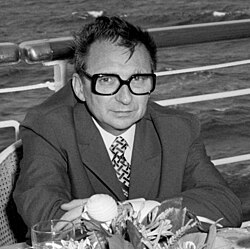
The regime specifically targeted "intellectuals"—a term used to describe university students, writers, and scientists who opposed the Communist Party. In extreme cases, the Securitate attempted assassinations. A notable target was Ion Mihai Pacepa, a high-ranking defector. Following his defection in 1978, Nicolae Ceaușescu placed a two-million-dollar bounty on his head, with additional rewards offered by Yasser Arafat and Muammar al-Gaddafi.
Human Rights Abuses
The agency's cruelty extended to medical and reproductive control. Securitate agents were stationed in gynecological wards to enforce mandatory pregnancy tests and penalize those who terminated pregnancies. In a more sinister operation during the 1977 Jiu Valley coal miners' strike, some leaders were subjected to five-minute chest X-rays by Securitate doctors in an attempt to induce cancer.
Organizational Structure
The Securitate was divided into specialized directorates to ensure total control over every facet of Romanian life:
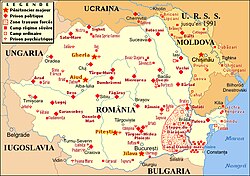
- Directorate for Penitentiaries: Managed notorious prisons such as Aiud, Gherla, and Pitești, as well as forced labor camps.
- Directorate for Internal Security: Monitored the Communist Party (PCR) and eventually included a top-secret division that spied on the Securitate itself to ensure loyalty to Ceaușescu.
- Directorate for Security Troops: A 20,000-strong paramilitary force equipped with artillery and armored personnel carriers.
- Directorate V: Provided bodyguards for high-ranking officials, including President Ceaușescu.
Funding and the IKEA Connection
Beyond state funding, declassified files reveal that the Securitate received six-figure payments from the furniture retailer IKEA during the 1980s. IKEA reportedly overcharged for products manufactured in Romania, with the excess funds deposited into accounts controlled by the secret police.
The Downfall and Legacy
The Securitate collapsed alongside the regime of Nicolae Ceaușescu during the Romanian Revolution of 1989. On December 30, 1989, the agency was officially dissolved. Its functions were split among several new, separate institutions to prevent the centralization of power:
- SRI (Romanian Intelligence Service): Internal tasks and counterespionage.
- SIE (Foreign Intelligence Service): External intelligence.
- SPP (Protection and Guard Service): Protection of officials.
- STS (Special Telecommunications Service): Technical operations.
| Feature | Details |
|---|---|
| Active Period | 1948 – 1989 |
| Parent Agency | Ministry of Interior / Ministry of State Security |
| Personnel (1989) | ~15,000 agents, ~23,000 troops, ~400,000 informants |
| Key Figures | Gheorghe Pintilie (First Director), Iulian Vlad (Last Director) |
| Successor Agencies | SRI, SIE, SPP, STS |
Frequently Asked Questions
How many informants did the Securitate have?
By 1989, the Securitate had approximately 400,000 informants. Between 1980 and 1989 alone, over 200,000 new informants were recruited, including doctors, clergy, and artists.
What was the role of the Soviet Union in the Securitate?
The agency was founded with the help and direction of the Soviet MGB and SMERSH. Its first director, Gheorghe Pintilie, was an NKVD general, and the technical surveillance division was established with KGB assistance.
Who was Ion Mihai Pacepa?
Ion Mihai Pacepa was a high-ranking Securitate officer who defected in 1978. He exposed the regime's espionage activities and collaboration with radical groups, leading Ceaușescu to place a massive bounty on his head.
What happened to the Securitate after the 1989 Revolution?
The agency was dissolved on December 30, 1989. Its responsibilities were divided among new agencies, including the Romanian Intelligence Service (SRI) and the Foreign Intelligence Service (SIE), to ensure no single agency held such absolute power again.
How did the Securitate fund itself outside of the state budget?
Declassified archives indicate that the Securitate received six-figure payments from IKEA in the 1980s through a system of overcharging for Romanian-made products.