Nicolae Ceaușescu: The Rise and Fall of Romania's Last Communist Leader
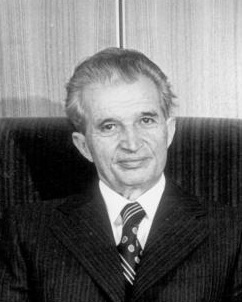
Nicolae Ceaușescu was the second and final leader of Communist Romania, serving as the General Secretary of the Romanian Communist Party from 1965 until his dramatic overthrow in 1989. His tenure was marked by a transition from early popularity and a non-aligned foreign policy to a rigid, totalitarian regime characterized by a pervasive personality cult—the excessive public admiration and idealized portrayal of a political leader.
Ceaușescu's grip on power was absolute, spanning roles as General Secretary, President of the State Council, and eventually President of the Socialist Republic of Romania. His rule ended in a violent revolution that culminated in his execution alongside his wife, Elena.
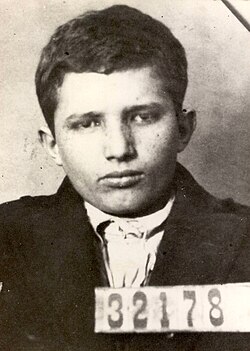
Key Facts
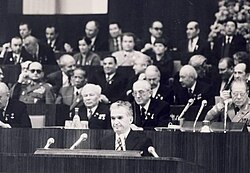
- Tenure: General Secretary of the Romanian Communist Party (1965–1989).
- Head of State: President of the State Council (1967–1974) and President of the Republic (1974–1989).
- Ideology: Communism, later influenced by Maoist and Juche (North Korean) ideas.
- End of Rule: Overthrown during the 1989 Romanian Revolution.
- Fate: Executed by firing squad on December 25, 1989, after being convicted of genocide.
The Ascent to Power
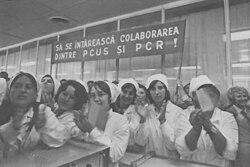
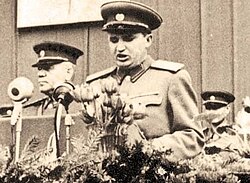
Nicolae Ceaușescu joined the Romanian Communist Party in 1932. Following the death of longtime leader Gheorghiu-Dej on March 19, 1965, Ceaușescu emerged as a compromise candidate amidst Politburo infighting. He was elected General Secretary on March 22, 1965.
His early years in power were defined by a desire to reclaim national identity. He restored the party's name to the Communist Party of Romania and oversaw the adoption of a new constitution in August 1965, renaming the country the Socialist Republic of Romania. By December 1967, he consolidated his authority by becoming President of the State Council.
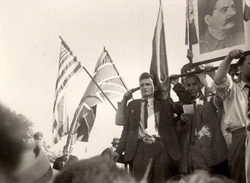
Governance and Totalitarian Control
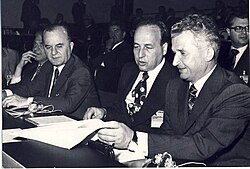
While Ceaușescu initially gained some support, his regime evolved into a strict totalitarian state. He maintained control through the Securitate (the secret police), ensuring that thousands of dissidents were imprisoned or confined to psychiatric institutions.
Foreign Relations and Non-Alignment
Ceaușescu pursued a distinct foreign policy, often distancing Romania from the Soviet Union. A pivotal moment occurred on August 21, 1968, when he publicly condemned the Warsaw Pact invasion of Czechoslovakia, a move that earned him temporary respect in the West.
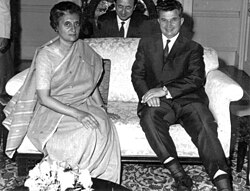
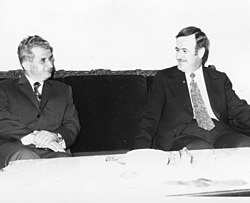
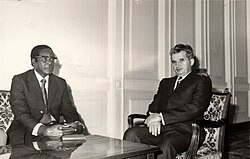
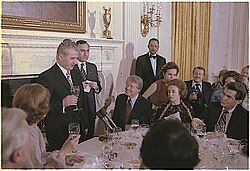
He cultivated relationships with a wide array of global leaders, from Western presidents like Jimmy Carter to socialist leaders like Deng Xiaoping and Kim Il Sung. In his later years, he sought to emulate the Juche ideology of North Korea and Maoist principles to reform the Romanian state.
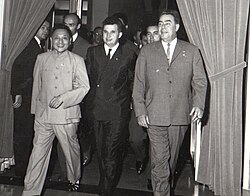
![Ceaușescu with Kim Il Sung of North Korea in 1978. In reforming the state, Ceaușescu sought to emulate Juche and Maoist ideas[40][41][42]](/images/ba/a1/baa19449dd6f1721b9dcbd4cecbed494dd9f814cb512c291b65458a2f5b80917.jpg)
The Personality Cult and Systematization
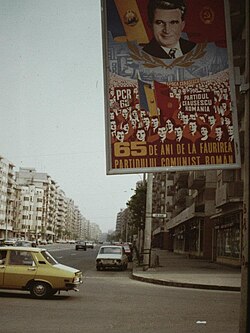
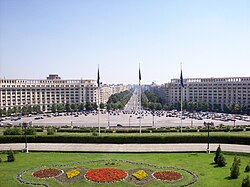
By the 1970s, Nicolae and his wife, Elena, developed an extensive personality cult. This was reflected in massive propaganda campaigns and the "Systematization" program, which involved the demolition of traditional villages and historic urban areas to make way for monolithic concrete structures, most notably the Bulevardul Unirii in Bucharest.
Economic Decline and the Path to Revolution
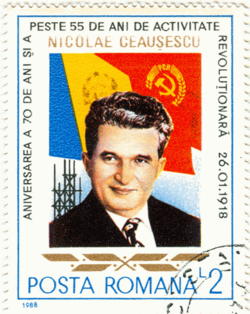
Romania's economic stability deteriorated as Ceaușescu prioritized paying off the national foreign debt over the welfare of his citizens. This led to severe austerity, food shortages, and widespread hardship.
| Year | Gross External Debt (Billions USD) | Net Status |
|---|---|---|
| 1975 | 2.9 | Debtor |
| 1980 | 9.4 | Debtor |
| 1985 | 6.6 | Debtor |
| 1988 | 2.2 | Creditor |
| 1989 | 0.0 | Creditor |
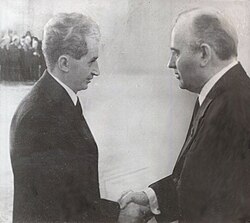
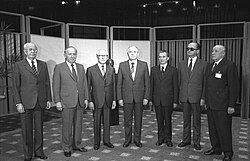
Internal unrest grew, evidenced by the 1987 Brașov rebellion. Despite the crumbling economy and increasing isolation from other Soviet-bloc leaders—including Mikhail Gorbachev—Ceaușescu refused to implement reforms.
The 1989 Revolution and Execution
![Ceaușescu receiving the presidential sceptre, 1974[125]](/images/bb/1b/bb1be199fc6ea341c4836b6c55a6be8d7dc7847f3706c5e0374887c3d3428495.jpg)
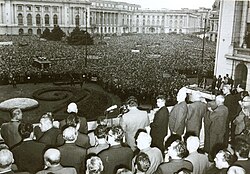
The collapse of the regime began in Timișoara in December 1989, quickly spreading to Bucharest. On December 21, Ceaușescu attempted to address a massive crowd in Revolution Square, but the speech failed to quell the anger of the people.
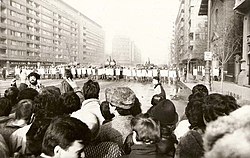
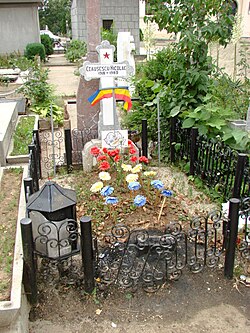
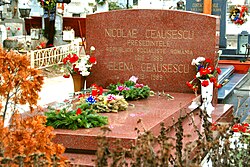
On December 22, Nicolae and Elena Ceaușescu attempted to flee the city by helicopter. They were captured, put on a summary trial, and convicted of genocide against Romanian dissidents. On December 25, 1989, they were executed by firing squad in Târgoviște.
Frequently Asked Questions
How did Nicolae Ceaușescu come to power?
He was elected General Secretary of the Romanian Communist Party on March 22, 1965, as a compromise candidate following the death of the previous leader, Gheorghe Gheorghiu-Dej.
What was the "personality cult" of the Ceaușescus?
It was a state-sponsored effort to present Nicolae and Elena Ceaușescu as infallible, heroic figures through pervasive propaganda, monuments, and mandatory public praise.
Why was Ceaușescu executed?
Following the 1989 Revolution, he and his wife were captured and tried by a military tribunal. They were convicted of genocide and other crimes against the Romanian people and executed by firing squad.
What was the impact of his economic policies?
Ceaușescu's obsession with eliminating foreign debt led to extreme austerity measures, resulting in severe shortages of food, heating, and electricity for the general population during the 1980s.
Who succeeded Nicolae Ceaușescu?
Immediately after his fall, the National Salvation Front Council took interim control, and Ion Iliescu eventually became the President of Romania.