Sea Anemones: Biology, Anatomy, and Ecology of Marine Polyps
Sea anemones are predatory marine invertebrate animals belonging to the order Actiniaria. While their vibrant, flower-like appearance led to their name—derived from the terrestrial anemone plant—these creatures are far from botanical. They are members of the phylum Cnidaria, making them close relatives of corals, jellyfish, and hydras. Unlike their jellyfish cousins, sea anemones lack a medusa (swimming) stage in their life cycle, existing primarily as polyps.
Most sea anemones are sessile, meaning they remain fixed in one place, attached to hard surfaces. However, nature provides variety: some species dwell in soft sediments, while a few are pelagic, floating freely near the ocean surface.
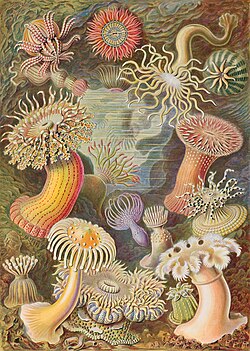
Key Facts
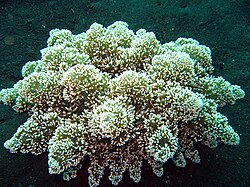
- Classification: Order Actiniaria, Phylum Cnidaria, Class Anthozoa.
- Diet: Predatory carnivores that use stinging cells called cnidocytes to capture prey.
- Symbiosis: Often form mutualistic bonds with clownfish or photosynthetic algae.
- Reproduction: Capable of both sexual reproduction (eggs and sperm) and asexual reproduction (fission).
- Range: Found globally from shallow coastal waters to the deep ocean.
Anatomy and Physical Structure
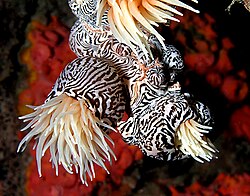
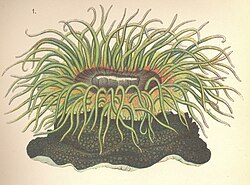
A typical sea anemone consists of a columnar trunk topped by an oral disc. This disc features a central mouth surrounded by a ring of tentacles. These tentacles are equipped with cnidocytes—specialized stinging cells that paralyze prey.
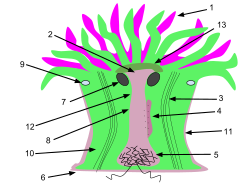
The base of the anemone is usually a pedal disc (or basal disc), an adhesive foot that anchors the animal to rocks, shells, or timber. Species that live in soft sediment replace this disc with a bulbous lower end called a physa. While most anemones are small (1 to 5 cm in diameter), some species, such as Urticina columbiana and Stichodactyla mertensii, can exceed one meter in diameter.
For defense, many species possess acontia, which are thin, stinging filaments that can be ejected from the body to deter predators.
The Digestive System
Sea anemones possess an incomplete gut. The gastrovascular cavity serves as both the stomach and the primary circulatory system. Because there is only one opening, the mouth functions as both the entrance for food and the anus for the excretion of waste. To assist in feeding, a ciliated groove called a siphonoglyph helps move food particles inward and circulates water through the cavity.
Behavior, Feeding, and Movement

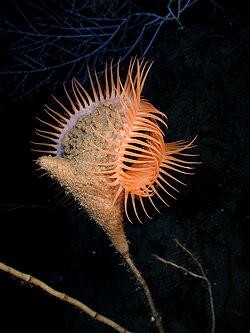
As predators, sea anemones use a cocktail of toxins, including neurotoxins, to immobilize fish and crustaceans. Once paralyzed, the prey is thrust into the mouth for digestion. Some species, like the Venus flytrap sea anemone, are suspension feeders that orient themselves to face the current to catch drifting particles.
Despite their sedentary nature, sea anemones are remarkably flexible. Their bodies contain longitudinal, transverse, and diagonal muscle sheets, allowing them to bend, twist, and contract. They can retract their tentacles and oral disc entirely into the gullet, closing the opening with a sphincter muscle for protection.
Ecological Relationships and Habitat
Sea anemones are found worldwide, with the highest diversity occurring in tropical waters. They often engage in mutualism—a relationship where both species benefit. A famous example is the bond between clownfish (Amphiprioninae) and sebae anemones; the fish are immune to the anemone's sting and find shelter among the tentacles, while the fish provide nutrients and protection to the host.
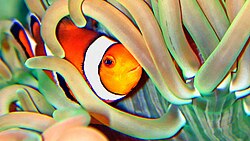
Many anemones also host symbiotic single-celled algae, such as zooxanthellae (dinoflagellates) or zoochlorellae (green algae), which live within the anemone's cells and provide additional nourishment through photosynthesis.
Environmental Threats
Sea anemone populations face two primary threats. First, the expanding global trade in marine ornamentals for reef aquariums leads to over-collection from the wild. Second, the prospect of deep-sea mining poses a risk of irreversible ecological damage to their deep-ocean habitats.
Life Cycle and Reproduction
Sea anemones employ two primary methods of reproduction:
- Sexual Reproduction: They release eggs and sperm into the water. Fertilized eggs develop into planktonic planula larvae, which eventually settle on the seabed to grow into juvenile polyps.
- Asexual Reproduction: Some species can reproduce by breaking into smaller pieces or splitting in half, with each fragment regenerating into a complete polyp.
Fossil Record and Taxonomy
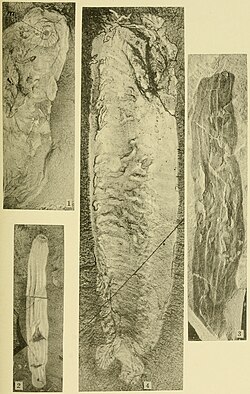
Because they lack hard skeletal parts, sea anemones do not fossilize easily. However, Mackenzia, found in the Middle Cambrian Burgess Shale of Canada, is one of the oldest identified fossils. More recently, in 2024, over 100 fossils of Arenactinia ipuensis were discovered in Brazil, dating to the Silurian period. These are particularly valuable as they are preserved in three-dimensional form.
| Category | Details |
|---|---|
| Phylum | Cnidaria |
| Class | Anthozoa (Subclass Hexacorallia) |
| Order | Actiniaria |
| Feeding Method | Predatory / Suspension Feeding |
| Key Feature | Cnidocytes (stinging cells) |
| Temporal Range | 508 Ma to Present |
Frequently Asked Questions
Are sea anemones dangerous to humans?
Most sea anemones are harmless to humans. However, a few highly toxic species, such as Actinodendron arboreum, Phyllodiscus semoni, and some Stichodactyla species, can cause severe injuries and may potentially be lethal.
How do clownfish survive the anemone's sting?
Clownfish have evolved specific adaptations that make them unaffected by the toxins of their host anemone, allowing them to seek shelter among the tentacles without being paralyzed.
Do sea anemones have a brain?
Sea anemones do not have a centralized brain; instead, they possess a decentralized nervous system that allows them to respond to stimuli and coordinate muscle movements.
Can sea anemones move from one place to another?
While primarily sessile, some sea anemones can move slowly by gliding on their pedal disc or, in rare cases, by detaching and floating. They can also change their body shape dramatically to contract or expand.
What is the difference between a sea anemone and a coral?
Both are anthozoans, but corals typically secrete a hard calcium carbonate exoskeleton to build reefs, whereas sea anemones remain soft-bodied and do not produce a hard skeleton.