Schwerin: The Scenic Capital of Mecklenburg-Vorpommern
Nestled in the heart of northern Germany, Schwerin serves as the capital of the state of Mecklenburg-Vorpommern. Known for its stunning waterways and rich aristocratic history, the city blends natural beauty with architectural grandeur, making it a focal point of culture and administration in the region.
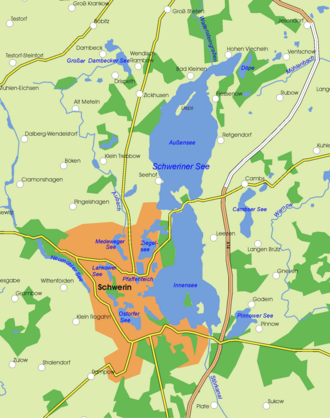
The city is defined by its relationship with water, situated at the coordinates 53°38′N 11°25′E. With a total area of 130.46 km², Schwerin is an urban district that balances a dense city center with expansive lakes and green boroughs.
Key Facts
- State Capital: The administrative center of Mecklenburg-Vorpommern, Germany.
- Population: Approximately 98,308 residents (as of December 31, 2024).
- UNESCO Site: Home to the Schwerin Residence Ensemble, inscribed as a World Heritage Site in 2024.
- Water-Rich: The city limits encompass 12 distinct lakes, the largest being Lake Schwerin.
- Elevation: Sits at an average elevation of 38 meters above sea level.
Geography and Natural Landscape
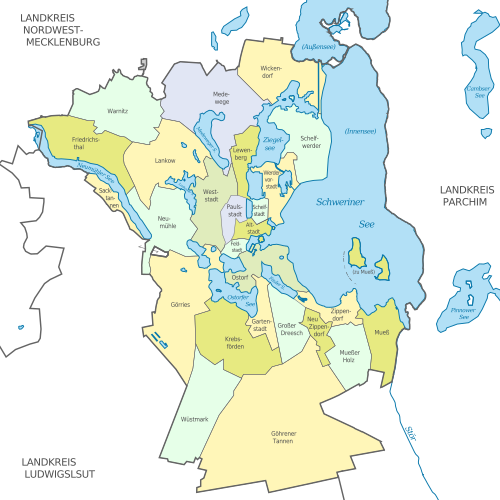
Schwerin is characterized by its abundance of lakes and islands. The most prominent is Lake Schwerin (Schweriner See), which covers 61.5 km² and is divided into the Outer Lake (Außensee) and Inner Lake (Innensee) by Paul's Dam (Paulsdamm). This lake features several islands, including Kaninchenwerder, Großer Stein, and Ziegelwerder.
Beyond the main lake, the city is dotted with smaller bodies of water that contribute to its unique microclimate and aesthetic appeal, ranging from the larger Ziegelsee to the small Burgsee, which surrounds the city's famous castle island.
| Lake Name | Size (km²) | Notable Islands |
|---|---|---|
| Lake Schwerin | 61.5 | Kaninchenwerder, Großer Stein, Ziegelwerder |
| Brick Lake (Ziegelsee) | 3.0 | Kleine & Große Murrkiteninsel |
| Lake Ostorf | 2.1 | Toteninsel, Tannenwerder |
| New Mill Lake | 1.7 | - |
| Lake Medewege | 1.0 | - |

History and Governance
Schwerin's historical trajectory is closely tied to the Duchy of Mecklenburg. In 1358, the town became part of the duchy and served as its seat. Around 1500, construction began on the Schwerin Palace to serve as a residence for the dukes. Following the division of Mecklenburg in 1621, the city became the capital of the Duchy of Mecklenburg-Schwerin.
While the capital was briefly moved to Ludwigslust between 1765 and 1837, Schwerin was eventually reinstated as the administrative heart of the region. Today, the city is governed by a Lord Mayor and a city council. The most recent council elections in June 2024 saw a diverse political landscape, with the Alternative for Germany (AfD) and the Christian Democratic Union (CDU) securing the highest number of seats.
Cultural Landmarks and Sights
The crown jewel of the city is the Schwerin Castle, part of the Schwerin Residence Ensemble. This site was recognized as a UNESCO World Heritage Site in 2024 due to its cultural significance. The ensemble covers an area of 2,275.77 hectares and represents a masterpiece of residential architecture.
Other notable landmarks include the Schwerin Cathedral, Saint Paul's Church, the Orangerie, and the historic Schelfstadt district with its Schelfkirche. The city also preserves the Pfaffenteich, a scenic pond that serves as a central gathering point for residents and visitors.
Demographics and Climate
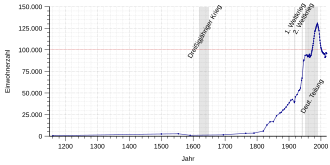
The population of Schwerin has fluctuated significantly over the centuries. From a small settlement of 500 people in 1160, it grew steadily, peaking at over 130,000 in the late 1980s before stabilizing near 98,000 in recent years. The city is divided into 18 boroughs, with the Altstadt and Mueßer Holz being among the most populous.
The climate is temperate, with an average annual precipitation of 628.5 mm. Summer temperatures typically peak in July and August, with record highs reaching 38.4°C, while winter lows can drop as far as -27.0°C.
Notable People
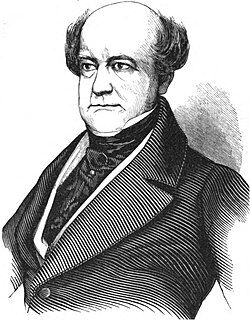
Schwerin has been the birthplace or home to many influential figures across various fields:
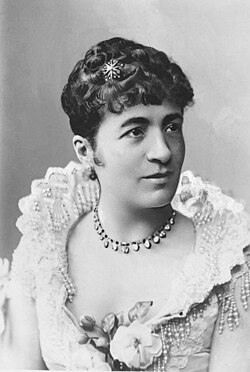
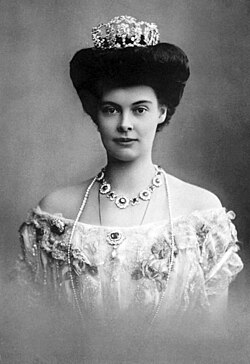
- Aristocracy: Duchess Cecilie of Mecklenburg-Schwerin, the last Crown Princess of the German Empire.
- Science: Walther Flemming, the founder of cytogenetics (the study of cell inheritance).
- Arts: Oliver Riedel, musician and member of the band Rammstein.
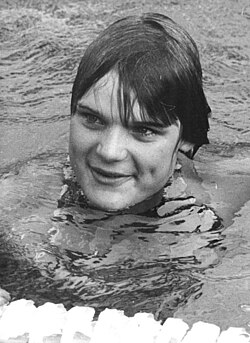
- Sports: Peter Kretschmer, a gold medalist in sprint canoeing (2012).
Frequently Asked Questions
What is the most famous landmark in Schwerin?
The most famous landmark is Schwerin Castle, which is part of the UNESCO World Heritage Residence Ensemble.
How many lakes are located within the city limits?
There are 12 lakes within Schwerin's city limits, with Lake Schwerin being the largest.
Who is the current acting Lord Mayor of Schwerin?
As of 2026, Bernd Nottebaum (CDU) is the acting Lord Mayor.
When did Schwerin become a UNESCO World Heritage Site?
The Schwerin Residence Ensemble was inscribed as a UNESCO World Heritage Site in 2024 during the 46th Session.
What is the population of Schwerin?
As of December 31, 2024, the total population of Schwerin was 98,308.