Saxe-Meiningen: The History and Legacy of the Ernestine Duchy
The Duchy of Saxe-Meiningen was a sovereign state located in what is now the southwest of the German state of Thuringia. Ruled by the Ernestine line of the House of Wettin, this duchy existed from 1680 until the collapse of the German monarchies in 1918. Its history is a complex tale of dynastic partitions, territorial growth, and cultural patronage.
Key Facts
- Duration: 1680–1918 (as a duchy); 1918–1920 (as a republic).
- Dynasty: House of Wettin (Ernestine line).
- Capital: Meiningen.
- Final Area: 2,468 km² with 278,762 inhabitants by 1910.
- Successor State: Merged into the state of Thuringia on May 1, 1920.
The Origins of the House of Wettin
The House of Wettin held vast territories across Saxony, Saxony-Anhalt, and Thuringia since the Middle Ages. A pivotal moment occurred during the Leipziger Teilung (Leipzig Partition) of 1485, which split the family into two primary branches: the Albertine and the Ernestine. Thuringia fell under the Ernestine holdings of the Electorate of Saxony (Kursachsen).
Over the following centuries, the Ernestine line continued to fragment. In 1641, the senior line split into three duchies, including the Duchy of Saxe-Gotha. Duke Ernst I of Saxe-Gotha famously opposed primogeniture—the right of the firstborn child to inherit the entire estate. Consequently, upon his death in 1675, his holdings were divided among his seven sons.
This division led to several settlements between 1679 and 1681, resulting in the creation of several smaller princedoms: Saxe-Gotha, Saxe-Coburg, Saxe-Meiningen, Saxe-Eisenberg, Saxe-Hildburghausen, and Saxe-Saalfeld.
The Rise of the Duchy of Saxe-Meiningen
Bernhard, the third son of Ernst I, was granted the town of Meiningen along with various other holdings, including Wasungen, Salzungen, Maßfeld, Sand, Herrenbreitungen, Herpf, Stepfershausen, Utendorf, Mehlis, and the former Franconian lands of the House of Henneberg. Bernhard established Meiningen as his residence and became the first Duke of Saxe-Meiningen.
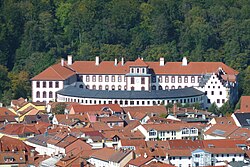
Under Bernhard I, the duchy began to establish its cultural identity. In 1682, he commissioned the construction of Schloss Elisabethenburg, and in 1690, he founded the Hofkapelle (Court Orchestra), which later featured Johann Ludwig Bach as Kapellmeister in 1711.
Territorial Expansion and Political Shifts
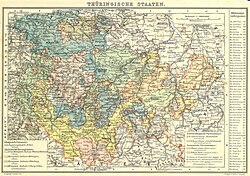
The duchy's borders shifted significantly over time. Following the extinction of the Saxe-Gotha-Altenburg line in 1825, Duke Bernhard II acquired the lands of Saxe-Hildburghausen and the Saalfeld territory of Saxe-Coburg-Saalfeld.
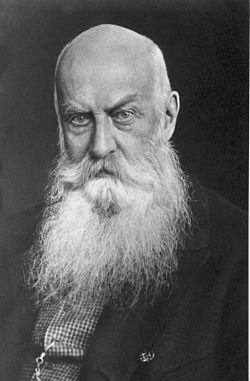
Political tensions rose during the 1866 Austro-Prussian War. Because Bernhard II supported Austria, the Prussian Prime Minister Otto von Bismarck forced his abdication in favor of his son, George II. This political maneuver paved the way for Saxe-Meiningen to join the North German Confederation.
By 1910, the duchy spanned 2,468 km² and included the districts of Hildburghausen, Sonneberg, and Saalfeld, as well as the northern exclaves of Camburg and Kranichfeld. The dukes also maintained a summer residence at Altenstein Castle.
The End of the Monarchy
The era of the duchy came to an abrupt end during the German Revolution following World War I. Duke Bernhard III, who was the brother-in-law of Emperor Wilhelm II, was forced to abdicate. His brother, Ernst, refused to succeed him on November 11–12, 1918.
The territory transitioned into the Free State of Saxe-Meiningen before finally merging into the newly formed state of Thuringia on May 1, 1920.
Summary of the Duchy's Evolution
| Period | Political Status | Key Event/Change |
|---|---|---|
| 1680–1806 | State of the Holy Roman Empire | Established via partition of Saxe-Gotha |
| 1806–1813 | State of the Confederation of the Rhine | Napoleonic era realignment |
| 1815–1866 | State of the German Confederation | Acquisition of Saxe-Hildburghausen (1826) |
| 1867–1871 | State of the North German Confederation | Abdication of Bernhard II; accession of Georg II |
| 1871–1918 | Constituent state of the German Empire | Final period of ducal rule |
| 1918–1920 | Republic (Free State) | German Revolution and abdication |
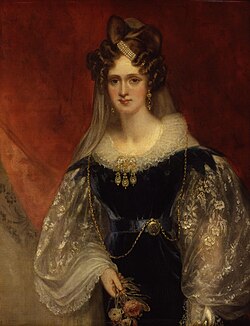
The legacy of the duchy is also reflected in its royal connections, such as Adelaide of Saxe-Meiningen, who became the Queen Consort of the United Kingdom and Hanover as the spouse of William IV.
Frequently Asked Questions
How was the Duchy of Saxe-Meiningen created?
It was established in 1681 through the partition of the Ernestine Duchy of Saxe-Gotha among the seven sons of Duke Ernst the Pious, who had opposed the system of primogeniture.
Who was the first and last Duke of Saxe-Meiningen?
The first duke was Bernhard I (reigned 1680–1706), and the last was Bernhard III (reigned 1914–1918).
Why did Duke Bernhard II have to abdicate?
Bernhard II supported Austria during the Austro-Prussian War of 1866. As a result, the victorious Prussian Prime Minister Otto von Bismarck forced him to abdicate in favor of his son, George II.
What happened to the duchy after 1918?
Following the German Revolution, the monarchy was abolished and the territory became the Free State of Saxe-Meiningen. On May 1, 1920, it merged into the modern state of Thuringia.
What were the primary territories of the duchy by 1910?
The duchy included the districts (Kreise) of Hildburghausen, Sonneberg, and Saalfeld, along with the northern exclaves of Camburg and Kranichfeld.