Saxe-Coburg and Gotha: The History of an Ernestine Dynasty
The Duchy of Saxe-Coburg and Gotha was a prominent Ernestine duchy located in Thuringia, ruled by a branch of the House of Wettin. Existing from 1826 to 1918, this state comprised territories in what are now the German states of Thuringia and Bavaria. While its geographical footprint was modest, its influence was global, as the ruling house became one of the most successful dynastic exports in European history.
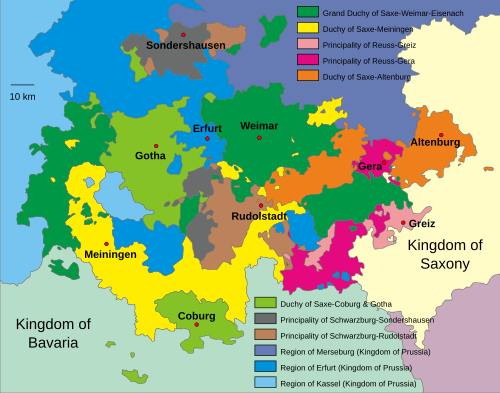
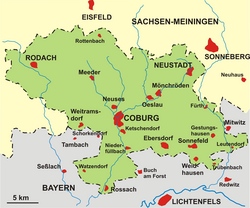
The duchy operated as a constitutional monarchy, maintaining a unique dual-capital system with Gotha serving the northern region and Coburg serving the south. This administrative split reflected the complex territorial rearrangements of the early 19th century.
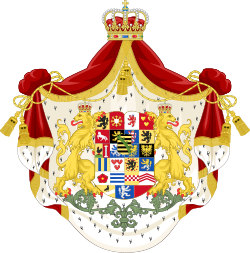
Key Facts
- Duration: 1826 to 1918.
- Ruling House: House of Wettin (Ernestine branch).
- Capitals: Gotha (North) and Coburg (South).
- Political Status: Member of the German Confederation (1815–1866) and a Federal State of the German Empire (1867–1918).
- Dissolution: Ended during the German Revolution of November 1918.
- Legacy: The ruling family provided sovereigns for the United Kingdom, Belgium, Portugal, and Bulgaria.
The Formation and Evolution of the Duchy
The duchy was established on November 12, 1826, following the Treaty of Hildburghausen. This treaty was the result of the Gothaische Teilung (Gothan Division), an extensive rearrangement of the Ernestine duchies triggered by the extinction of the Saxe-Gotha-Altenburg line. Through a series of exchanges, the Duchy of Saxe-Coburg-Saalfeld acquired the Duchy of Saxe-Coburg and other districts, effectively creating the new entity.
Initially, the state existed as a double duchy under a personal union ruled by Duke Ernest I. It wasn't until the state constitution (Staatsgrundgesetz) of 1852 that the two duchies were bound in a political and real union, creating a quasi-federal unitary state. Despite this, attempts to fully merge the two administrations often failed due to disputes over state debts and administrative control.
The Principality of Lichtenberg
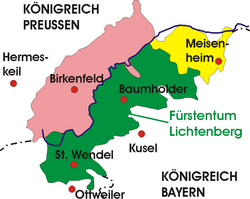
An interesting territorial footnote was the Principality of Lichtenberg on the Nahe River. Granted to the sovereign of Saxe-Coburg-Saalfeld in 1816 by the Congress of Vienna for assistance against France, it remained a distant exclave. Due to its distance from the main territories and unrest following the Hambach Festival, the Duke sold the principality to Prussia in 1834.
Dynastic Reach and Global Influence
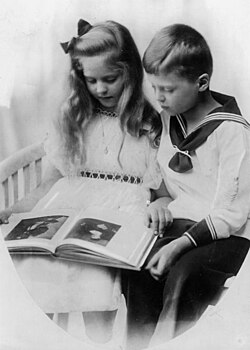
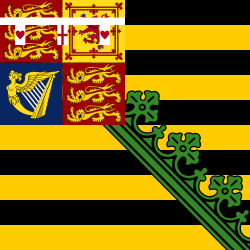
The House of Saxe-Coburg and Gotha became a powerhouse of European diplomacy. In the early 20th century, members of the family sat on the thrones of the United Kingdom, Belgium, Portugal, and Bulgaria. The British connection was particularly strong through Prince Albert, the husband of Queen Victoria.
Succession laws were strict; for instance, the British heir apparent was prohibited from inheriting the duchy if other eligible male heirs existed. This led to the throne passing to Prince Alfred and later to Charles Edward. Charles Edward, the son of Prince Leopold, began his reign in 1900 under a regency. However, his decision to side with Germany during World War I resulted in him being stripped of his British titles in 1919.
Governance, Military, and Economy
Politically, the duchy held one vote in the Bundesrat (the federal council of the German Empire) and two votes in the Reichstag. Each duchy maintained its own Landtag (state parliament), elected by male taxpayers over the age of 25. While a central Ministry of State existed in Gotha, Coburg maintained significant independence over local affairs such as police, education, and finance.
Economically, the state transitioned through various currencies, moving from the Conventionsthaler to the German gold mark and finally the Papiermark. To facilitate international trade, the duchy employed trade consuls across the globe, including in the Americas and Asia. Notably, during the American Civil War, Ernst Raven served as a consul in Texas, recognized by the Confederate Government.
Military Integration
By 1867, the duchy's independent army was integrated into the Prussian-led military system. Its forces became part of the 6th Thuringian Infantry Regiment No. 95. Unlike the mandatory service in Prussia, Saxe-Coburg and Gotha filled its military quotas via a draft ballot.
Cultural Life and the Dual Court
The dual-capital nature of the state created a unique cultural rhythm. The entire ducal court, including the Court Theater, migrated twice a year: moving to Coburg for the summer and Gotha for the winter. This necessitated the construction of two nearly identical theater buildings to accommodate the court's movements.
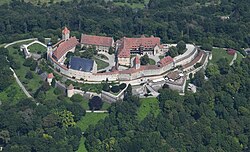
The family maintained several lavish residences, including Friedenstein in Gotha and Ehrenburg in Coburg, as well as the Rosenau and Callenberg castles. These sites served as the centers of political and social life for the Ernestine line.
The Fall of the Monarchy and Aftermath
The end of the duchy came abruptly during the November Revolution of 1918, when Duke Charles Edward was forced to abdicate. The state split into two independent entities: the Free State of Coburg and the Free State of Saxe-Gotha.
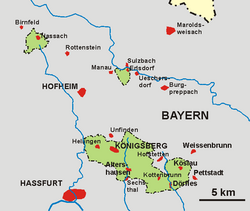
Recognizing that they were too small to be economically viable, both states sought merger. Following a referendum in 1919, the Free State of Coburg joined the Free State of Bavaria on July 1, 1920. Meanwhile, the Free State of Gotha merged with six other Thuringian states to form the modern Free State of Thuringia on May 1, 1920.
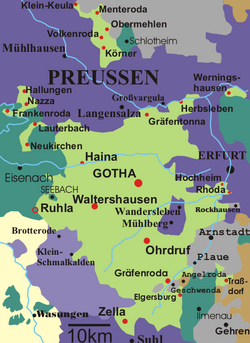
| Region | Area (km²) | Area (sq mi) | Population |
|---|---|---|---|
| Saxe-Coburg | 562 | 217 | 74,818 |
| Saxe-Gotha | 1,415 | 546 | 182,359 |
| Total | 1,977 | 763 | 257,177 |
Frequently Asked Questions
Why did the duchy have two capitals?
The duchy was formed from the union of two separate territories, Coburg and Gotha. Because they maintained distinct administrative identities and local governments, the court moved between the two cities seasonally to maintain presence in both regions.
How is the House of Saxe-Coburg and Gotha related to the British Royal Family?
Prince Albert, a member of the house, married Queen Victoria. While the British line descended from them, King George V changed the family name to Windsor in 1917 during World War I to distance the monarchy from its German roots.
What happened to the territories after 1918?
The duchy split into the Free State of Coburg and the Free State of Gotha. Coburg eventually joined Bavaria after a referendum, while Gotha became part of the newly formed state of Thuringia.
Who was the last reigning Duke?
The last reigning Duke was Charles Edward, who abdicated in November 1918 during the German Revolution.
What was the Gothaische Teilung?
The Gothaische Teilung (Gothan Division) was a major territorial rearrangement of the Ernestine duchies in 1826, mediated by the King of Saxony, which led to the creation of the Duchy of Saxe-Coburg and Gotha.