Saxe-Meiningen: The History and Legacy of an Ernestine Duchy
The history of the Duchy of Saxe-Meiningen is a complex tale of dynastic splits, artistic patronage, and political shifts within the heart of Germany. Emerging from the expansive holdings of the House of Wettin, this small but culturally significant state played a distinct role in the fragmented landscape of the Ernestine duchies before its eventual integration into the modern state of Thuringia.
The House of Wettin and the Ernestine Line
Since the Middle Ages, the House of Wettin ruled vast territories across what are now the German states of Saxony, Saxony-Anhalt, and Thuringia. A pivotal moment occurred during the Leipziger Teilung (Leipzig Partition) of 1485, which split the family into two primary branches: the Albertine and the Ernestine, named after the founding princes Albrecht and Ernst.
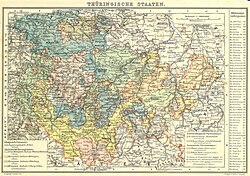
Thuringia fell under the control of the Ernestine branch of the Electorate of Saxony (Kursachsen). Over time, this line continued to subdivide. By 1572, the branches of Saxe-Coburg-Eisenach and Saxe-Weimar were established, and by 1641/41, the senior line split again into three duchies, including the Duchy of Saxe-Gotha.
The creation of Saxe-Meiningen was a direct result of Duke Ernst I of Saxe-Gotha's opposition to primogeniture—the legal right of the firstborn child to inherit the entire estate. Upon his death in 1675, Ernst I left his holdings to be shared among all his sons. This arrangement proved impractical, leading to a series of settlements between 1679 and 1681 that carved the territory into six separate princedoms: Saxe-Gotha, Saxe-Coburg, Saxe-Meiningen, Saxe-Eisenberg, Saxe-Hildburghausen, and Saxe-Saalfeld.
The Rise of the Duchy of Saxe-Meiningen
Bernhard, the third son of Ernst I, became the first duke of Saxe-Meiningen. His initial holdings included the town of Meiningen and several other territories, such as Wasungen, Salzungen, Maßfeld, Sand, Herrenbreitungen, Herpf, Stepfershausen, Utendorf, and Mehlis. He also acquired the former Franconian lands of the extinct House of Henneberg.
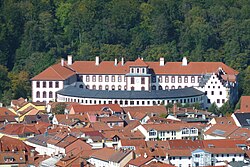
Duke Bernhard I established Meiningen as his residence and commissioned the construction of Schloss Elisabethenburg starting in 1682. He also fostered a rich musical culture by establishing the Hofkapelle (Court Orchestra) in 1690, which later welcomed Johann Ludwig Bach as Kapellmeister in 1711.
The duchy's borders expanded significantly in 1825 following the extinction of the Saxe-Gotha-Altenburg line. Duke Bernhard II acquired the lands of the former Duchy of Saxe-Hildburghausen and the Saalfeld territory from the former Saxe-Coburg-Saalfeld duchy.
Political Turmoil and the North German Confederation
The mid-19th century brought political instability. During the 1866 Austro-Prussian War, Duke Bernhard II supported Austria. Following the victory of Prussia, Prime Minister Otto von Bismarck forced Bernhard II to abdicate in favor of his son, George II. This political maneuver cleared the way for Saxe-Meiningen to join the North German Confederation.
By 1910, the duchy had reached a size of 2,468 km² (953 sq mi) with a population of 278,762. Its administrative structure since 1868 included the districts (Kreise) of Hildburghausen, Sonneberg, and Saalfeld, along with the northern exclaves of Camburg and Kranichfeld. The ducal family maintained a summer residence at Altenstein Castle.
Key Facts
- Founder: Duke Bernhard I, third son of Ernst I of Saxe-Gotha.
- Key Residence: Schloss Elisabethenburg, built starting in 1682.
- Cultural Milestone: Establishment of the Hofkapelle (Court Orchestra) in 1690.
- Peak Size (1910): 2,468 km² with 278,762 inhabitants.
- Political Shift: Forced abdication of Bernhard II in 1866 due to Prussian pressure.
- Dissolution: Ended in November 1918 during the German Revolution.
| Category | Details |
|---|---|
| Dynasty | House of Wettin (Ernestine line) |
| Established | 1680/1681 |
| Major Territories | Meiningen, Hildburghausen, Sonneberg, Saalfeld |
| Final Ruler | Duke Bernhard III |
| Successor State | Free State of Saxe-Meiningen → State of Thuringia |
The End of the Duchy
The collapse of the monarchy came during the German Revolution following World War I. Duke Bernhard III, who was the brother-in-law of Emperor Wilhelm II, was forced to abdicate. His brother, Ernst, refused to succeed him on November 11/12, 1918. The resulting Free State of Saxe-Meiningen existed briefly before becoming part of the newly formed state of Thuringia on May 1, 1920.
Frequently Asked Questions
How was the Duchy of Saxe-Meiningen created?
It was created as a result of Duke Ernst I of Saxe-Gotha's refusal to follow primogeniture. After his death in 1675, his holdings were split among his sons, leading to several settlements between 1679 and 1681 that established the duchy under his third son, Bernhard.
What was the significance of the Hofkapelle?
The Hofkapelle was the Court Orchestra established by Duke Bernhard I in 1690, marking the duchy's commitment to musical excellence. It notably featured Johann Ludwig Bach as Kapellmeister starting in 1711.
Why did Duke Bernhard II have to abdicate?
Duke Bernhard II supported Austria during the Austro-Prussian War of 1866. Because Prussia won the war, Otto von Bismarck forced the Duke to abdicate in favor of his son, George II, to facilitate the duchy's entry into the North German Confederation.
When did Saxe-Meiningen cease to be an independent entity?
The monarchy ended in November 1918 during the German Revolution. After a short period as a Free State, it was officially incorporated into the state of Thuringia on May 1, 1920.