Santa Cruz Province: The Rugged Heart of Argentine Patagonia
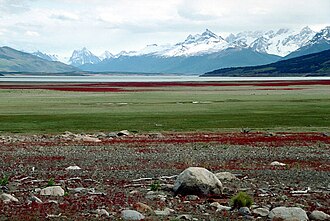
Located in the southernmost reaches of Argentina, Santa Cruz is a land of dramatic contrasts, where windswept plateaus meet the towering peaks of the Andes. As the second-largest province in the country, it serves as a gateway to some of the most pristine wilderness on Earth, characterized by massive glaciers, deep blue lakes, and a history of resilience.
From its Atlantic coastline to the border with Chile, Santa Cruz is the least densely populated region of mainland Argentina. This vast expanse is not only a hub for breathtaking tourism but also a critical economic driver for the nation due to its abundance of natural resources.
Key Facts
- Capital: Río Gallegos.
- Area: 243,943 km², making it the second-largest province in Argentina.
- Population: 337,226 (2022 Census).
- HDI: 0.854 (Very High), ranking 5th nationally.
- Geography: Divided between the Andean mountains in the west and central/eastern plateaus.
- Climate: The windiest province in Argentina, with mean wind speeds of 10 m/s.
History and Heritage
Long before European arrival, the region was inhabited by the Tehuelches, indigenous people who maintained their independence until the late 19th century. Evidence of early human presence remains today in the form of ancient art.
![Ochre-ink art in Cueva de las Manos, Santa Cruz. Made by the long-vanished Toldense people,[4] they are 13,000–9,000 years old.](/images/b4/08/b40889ccc4fd746420f7a40fa57fda01e8d6c3e80dd05a0672daec3a60f2c0d4.jpg)
European exploration began in 1520 when Ferdinand Magellan arrived at San Julián Bay. Over the following centuries, the region saw various attempts at settlement by the Spanish and Jesuits, as well as visits from explorers like Charles Darwin in 1834. Following the "Conquest of the Desert" in the 1870s, the area was organized as the Territory of Santa Cruz, eventually achieving full province status in 1957.
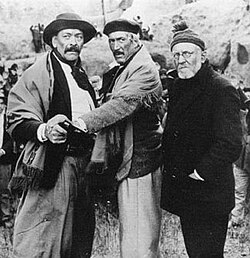
The 20th century brought political turbulence and growth. In 1922, a significant strike by sheep ranch laborers occurred, an event later dramatized in the 1974 film La Patagonia rebelde.
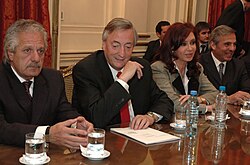
The province also played a pivotal role in national politics through Néstor Kirchner, a local lawyer who rose from the Río Gallegos City Council to become the President of Argentina in 2003.
Border Disputes with Chile
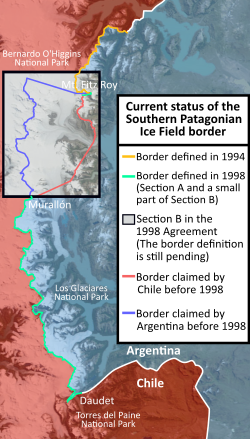
Santa Cruz has a complex border history with Chile, particularly regarding the Southern Patagonian Ice Field. While an 1898 agreement defined much of the border, disputes persisted between Mount Fitz Roy and Cerro Daudet. A 1998 redraw settled several areas, though some sections remain pending. Another conflict over the Del Desierto Lake was resolved in Argentina's favor in 1994.
Geography and Natural Wonders
The province is geographically split into two primary zones: the Andes to the west and the plateaus to the center and east. The Andean region is home to the Southern Patagonian Ice Field and a series of massive lakes, including Lake Buenos Aires, Lake Viedma, and Lake Argentino.
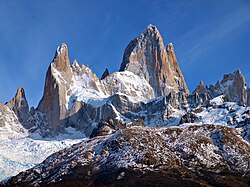
Tourism is heavily driven by these natural landmarks, most notably the Perito Moreno Glacier near El Calafate and the granite spires of Mount Fitz Roy near El Chaltén.
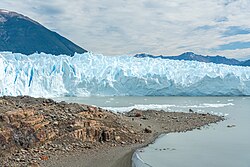
Climate and Environment
The climate is relatively cold for its latitude, influenced by the cold Falkland Current. The province is characterized by extreme winds, with gusts reaching up to 200 km/h. Precipitation is unevenly distributed; the Andes block most moisture, leaving the eastern plateaus dry (often receiving less than 200 mm annually), while the western Andean slopes can receive over 1,000 mm.
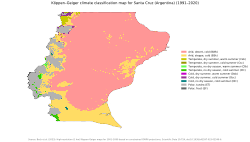
Economy and Demographics
Despite its low population density, Santa Cruz is one of Argentina's most prosperous provinces. Its economy is bolstered by rich natural resources, including oil and minerals. In 2011, it recorded the highest per capita income in Argentina at US$36,550.
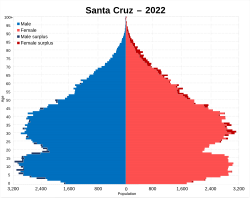
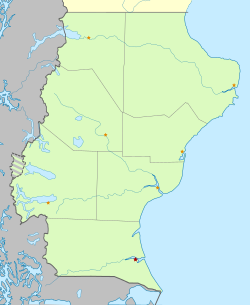
The province is organized into seven departments, with the most populous being Güer Aike (capital Río Gallegos) and Deseado (capital Puerto Deseado).
| Category | Detail |
|---|---|
| Total Area | 243,943 km² |
| Total Population (2022) | 337,226 |
| Population Density | 1.38 inhabitants/km² |
| GDP (Total) | US$ 5.2 billion |
| GDP Per Capita | US$ 13,800 |
| Human Development Index | 0.854 (Very High) |
Frequently Asked Questions
What is the capital of Santa Cruz Province?
The capital is Río Gallegos, which has served as the administrative center since 1888.
Why is Santa Cruz considered the windiest province in Argentina?
Due to the lack of significant landmasses south of 46°S, the region is exposed to strong, consistent winds from the west, southwest, and northwest, with mean speeds of 10 meters per second.
What are the main tourist attractions in the region?
The most prominent attractions include the Perito Moreno Glacier near El Calafate and the trekking trails around Mount Fitz Roy near El Chaltén.
Who were the original inhabitants of Santa Cruz?
The Tehuelches were the indigenous people of the province, maintaining their independence until the late 19th century.
How does the precipitation vary across the province?
Precipitation is much higher in the Andean region (over 1,000 mm) because the mountains block moisture from the Pacific, leaving the eastern plateaus very dry (often under 200 mm).