Russification Policies and Social Repression in the Russian Empire
The Russian Empire employed a systematic process known as Russification—the forced adoption of Russian language, culture, and administration—to consolidate control over its diverse territories. This policy was characterized by harsh repressions and the systematic erasure of national identities, particularly among Polish and Ukrainian populations.
The Repression of Polish Society
Following the November Uprising (1830–1831) and the January Uprising (1863–1864), the Tsarist regime intensified its crackdown on Polish national identity. One of the most severe consequences was mass deportation; in 1864 alone, approximately 80,000 Poles were exiled to Siberia in the empire's largest single deportation action.
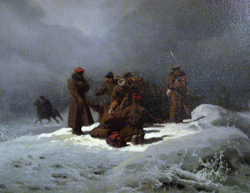
Cultural and educational erasure became a primary tool of control. The Polish language lost its official status and was discriminated against in public life. According to historian Norman Davies, this era saw the burning of books, the destruction of churches, and the murder of priests. Education in Polish was nonexistent, and the few remaining elementary schools suffered from constant underfunding.
Military Occupation of Warsaw
Under Tsarist rule, Warsaw functioned more like a military base than a civilian city. The urban landscape was dominated by 12 Russian garrisons, complete with horse stables, laundry shacks, and cabbage pickleries. Economic pressure was applied to Polish businesses; stores where Russian was not spoken were routinely denied operating licenses, and Polish names were even removed from botanical signs.
Social Decay and Exploitation
Widespread poverty and hunger led to extreme social vulnerabilities. By 1884, there were approximately 185 Russian military brothels, including 16 official establishments. These institutions were sites of severe abuse, where women—often forced into the trade by desperation—faced beatings and death at the hands of soldiers.
The system was highly stratified. While cheap army brothels sold sex for as little as 30 kopecks (less than one-third of a rouble), high-ranking officers had access to exclusive brothels. Between 1888 and 1895, Nikolai Kleigels, the chief of police, managed these elite houses, selling young Polish girls in exotic costumes for 10 roubles per visit. The authorities categorized these women as inexpensive, medium-priced, or exclusive based on their beauty, age, and demeanor.
Furthermore, army-licensed brothels were forced to provide a "patriotic duty" to the regiments, granting one free visit per soldier weekly. Infantry sergeants led battalions of 186 men (divided into nine companies) to these houses, where each girl was required to service 20–21 members of a battalion before she could earn money for food. Jewish girls were particularly vulnerable due to official Tsarist antisemitism and the mass expulsions of Litvaks ordered by Alexander III.
The Ukrainian Experience and the Ems Ukaz
The approach to Ukrainians differed from that of the Poles. Officially, Ukrainians were viewed as "part of the Russian people" and were referred to as Little Russians. Because they were seen as Russians, they did not face the same individual-level discrimination and could pursue any career provided they spoke Russian.
However, the Ukrainian language was systematically suppressed. In 1804, Ukrainian was banned as a subject and language of instruction in schools. This was followed by a 1863 ban on Ukrainian books and the secret Ems Ukaz issued by Alexander II. This decree prohibited the importation and publication of most Ukrainian-language books, public lectures, performances, and even the printing of Ukrainian texts accompanying musical scores. Consequently, Ukrainians living under Austria-Hungary enjoyed significantly more rights than those in the Russian Empire.
Resistance and the Path to Change
Despite the oppression, national consciousness continued to grow. The Revolution in the Kingdom of Poland (1905–1907) led to general improvements in the social situation shortly before the empire's dissolution. This period saw the emergence of major political entities, such as the Polish Socialist Party.
Nevertheless, tensions remained high. In 1907, the New York Times described aspects of society as "risky" or "distressing." Civilians feared imprisonment for simple interactions with police, and police units feared violent retaliation. This volatility was evidenced by a 1909 ambush that severely wounded a gendarme chief in Warsaw and a 1910 bomb explosion at the Grodzisk station that killed or wounded several gendarmes.
Key Facts
- Mass Deportation: 80,000 Poles were exiled to Siberia in 1864.
- Language Suppression: Polish lost official status; Ukrainian was banned in schools (1804) and via the Ems Ukaz.
- Military Presence: Warsaw hosted 12 Russian garrisons under Tsarist rule.
- Systemic Abuse: 185 military brothels existed by 1884, with forced "patriotic duty" visits for soldiers.
- Political Evolution: The 1905–1907 Revolution fostered the growth of parties like the Polish Socialist Party.
| Target Group | Primary Repressions | Key Legal/Political Actions |
|---|---|---|
| Poles | Mass exile, language discrimination, business license denials | Post-November and January Uprisings crackdowns |
| Ukrainians | Language bans in schools and publications | Ems Ukaz (Alexander II) |
| Jewish Population | Mass expulsions, extreme economic vulnerability | Official Tsarist antisemitism (Alexander III) |
Frequently Asked Questions
What was the Ems Ukaz?
The Ems Ukaz was a secret decree issued by Alexander II that prohibited the publication and importation of most Ukrainian-language books, as well as public performances, lectures, and Ukrainian texts in musical scores.
How were Ukrainians viewed differently than Poles in the Empire?
Ukrainians were officially considered "Little Russians" and part of the Russian people. While their language was suppressed, they did not face the same individual-level discrimination as Poles, provided they could speak Russian.
What happened to Polish captives after the January Uprising?
Many were exiled to Siberia; the largest single action occurred in 1864, involving the deportation of approximately 80,000 people.
What was the "patriotic duty" in Russian military brothels?
It was a requirement for army-licensed brothels to provide one free visit per week to every soldier in the regiment, often organized by infantry sergeants.
How did the 1905–1907 Revolution affect the region?
The revolution led to a general improvement in the social situation and the development of major political parties, such as the Polish Socialist Party, shortly before the Russian Empire dissolved.