Ruby-throated Hummingbird: The Agile Aviator of Eastern North America
The ruby-throated hummingbird (Archilochus colubris) is a marvel of nature, known for its iridescent plumage and extraordinary flight capabilities. As the most common hummingbird species in eastern North America, these tiny birds are frequent visitors to gardens and forests, where they play a vital role in pollination. With a population estimated at 35 million in 2021, they are a familiar sight during the summer breeding season before embarking on one of the most grueling migrations in the animal kingdom.
From their specialized skeletal structure to their high-octane metabolism, every aspect of the ruby-throated hummingbird is designed for efficiency and agility. Whether hovering mid-air or crossing the Gulf of Mexico, these birds push the boundaries of avian physiology.
Key Facts
- Scientific Name: Archilochus colubris
- Population: Approximately 34–36 million (as of 2021).
- Conservation Status: Least Concern (IUCN 3.1).
- Migration: Travels between North American breeding grounds and wintering sites in Central America, Mexico, and Florida.
- Unique Ability: Can fly forward, backward, and hover by rotating wings almost 180°.
- Metabolism: Heart rates can reach 1,260 beats per minute.
Taxonomy and Classification
The ruby-throated hummingbird was first formally described in 1758 by the Swedish naturalist Carl Linnaeus. Originally named Trochilus colubris, the species was later moved to the genus Archilochus in 1854 by Ludwig Reichenbach. The specific name colubris is derived from the Spanish word colibrí, meaning hummingbird. This species is monotypic, meaning there are no recognized subspecies.
Physical Characteristics
These birds are diminutive, measuring between 7 to 9 cm (2.8 to 3.5 in) in length with a wingspan of 8 to 11 cm (3.1 to 4.3 in). Their weight is remarkably low, ranging from 2 to 6 g, with females averaging slightly more (3.8 g) than males (3.4 g). Adults feature metallic green upperparts, grayish-white underparts, and near-black wings. Their long, slender bills reach up to 2 cm, perfectly adapted for extracting nectar from deep flowers.
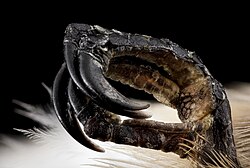
Their feet are specialized for gripping rather than walking. They possess three toes pointing forward and one backward, known as the hallux. These claw-like toes have ridged inner surfaces that help them cling to flower stems or petals. Because of this anatomy, ruby-throated hummingbirds cannot walk; they can only shuffle along branches.
Sexual Dimorphism
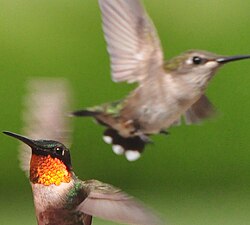
Males are most distinguished by their vibrant red gorget (throat patch), which they display during courtship. Females lack this brilliant red throat, making them more camouflaged during nesting.
Flight and Physiology
The flight of the ruby-throated hummingbird is unique among birds. Their wings connect to the body only at the shoulder joint, allowing them to rotate nearly 180°. This enables them to hover in mid-air and fly backward, a capability similar to that of insects.
To support this energy-intensive movement, their flight muscles comprise 25–30% of their total body weight. They generate lift on both the downstroke and the upstroke (in a 75%:25% ratio) by inverting their cambered wings. During hovering, their wings can beat up to 80 times per second.
This physical exertion is fueled by one of the highest metabolic rates in the animal kingdom. At rest, they breathe approximately 250 times per minute. During flight, their oxygen consumption per gram of muscle tissue is roughly 10 times higher than that of elite human athletes.
Distribution and Migration
The ruby-throated hummingbird has the largest breeding range of any hummingbird in the United States, spanning most of the Eastern U.S. and south-central and southeastern Canada. They prefer deciduous and pine forests, orchards, and gardens.
Migration is a defining characteristic of the species. They winter in Florida, southern Mexico, Central America (as far south as western Panama), and the West Indies. One of the most impressive feats is the non-stop journey across the Gulf of Mexico, covering roughly 900 miles (approx. 1,450 km) from Mexico or Panama to the eastern U.S.
To survive this 20-hour crossing without food or water, the birds double their fat mass to create a caloric reserve. Research indicates that older birds are generally better prepared for this journey than first-year birds due to higher body weights and larger fuel loads.

Behavior and Ecology
Ruby-throated hummingbirds are solitary and highly aggressive. They fiercely defend feeding territories, often attacking other hummingbirds that enter their space. Social interaction is limited primarily to courtship and the care of offspring by the female.
Their diet consists of nectar for energy and insects for protein, the latter being essential for the growth of young birds. While they are generally solitary, they are known for their rapid, squeaky chirps used primarily as threat vocalizations to warn rivals.

Breeding and Life Cycle
The species is primarily polygynous, meaning males mate with multiple females. Males arrive at breeding grounds first to establish territories and attract females through elaborate "dive displays," where they rise and fall rapidly in the air.
The female is solely responsible for nest construction and parental care. She builds a small, camouflaged nest using bud scales, lichen, and spider silk, often lining it with plant down or animal hair. These nests are typically placed on downward-sloping limbs of deciduous trees like oak or birch, though they have been known to use man-made materials like extension cords.
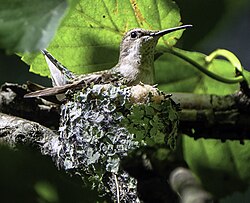
Females typically lay two white eggs and produce one to two broods per summer. The chicks are brooded for 12 to 14 days and are fed via regurgitation by the hovering mother. The young leave the nest and take their first flight between 18 and 22 days of age.

Longevity and Population Status
The oldest recorded banded ruby-throated hummingbird lived to be 9 years and 1 month old. Interestingly, females tend to live longer; males rarely survive past 5 years. This disparity is attributed to the high energetic costs males face while defending territories and migrating.
While the species is currently listed as Least Concern by the IUCN, recent data shows a decline. Between 1970 and 2021, the population grew substantially, but a 17% decline was reported in the 2021 census.

| Feature | Detail |
|---|---|
| Average Weight | Male: 3.4 g | Female: 3.8 g |
| Wingspan | 8 to 11 cm (3.1 to 4.3 in) |
| Max Heart Rate | 1,260 beats per minute |
| Breeding Range | Eastern North America (East of 100th meridian) |
| Wintering Range | Florida, Mexico, Central America, West Indies |
| Clutch Size | 1 to 3 eggs (usually 2) |
Frequently Asked Questions
Can ruby-throated hummingbirds walk?
No, they cannot walk in the traditional sense. Their feet are designed for gripping stems and petals; they can only shuffle their feet to move along a branch.
How do they survive the long flight across the Gulf of Mexico?
They prepare by doubling their fat mass, which provides the necessary caloric energy to sustain a non-stop 20-hour flight without food or water.
Why do females live longer than males?
Males face higher mortality rates, likely due to the extreme energetic demands of defending breeding territories and the subsequent stress of migration.
What do baby hummingbirds eat?
While adults rely heavily on nectar, young birds are fed insects by their mothers to provide the protein necessary for growth.
What makes their flight different from other birds?
Unlike other birds, their wings rotate almost 180° at the shoulder, allowing them to hover and fly backward, creating lift on both the upstroke and downstroke.