Roughton: A Historic Norfolk Village with a Global Connection
Nestled in the heart of the English county of Norfolk, Roughton is a charming village and civil parish that blends rural tranquility with a surprising historical legacy. Its name, meaning 'Rough farm/settlement', reflects the rugged character of the local terrain. Strategically located between the coastal town of Cromer and the city of Norwich, Roughton serves as a quiet sanctuary with deep roots in English heritage.
Key Facts
- Location: North Norfolk, England, situated between Cromer and Norwich.
- Population: 934 residents (as of the 2011 census).
- Notable Landmark: St Mary's Church, featuring a rare Saxon-origin round tower.
- Famous Resident: Albert Einstein sought refuge here in 1933.
- Transport: Served by the Bittern Line railway and the A140 road.
Village Life and Local Amenities
Roughton maintains the quintessential atmosphere of a Norfolk village, offering a variety of facilities for its residents and visitors. The community is supported by a primary school, a village hall, and a local garage. For leisure and dining, the village features a fish and chip shop, a play area, a fishing lake, and a traditional windmill.
One of the village's most striking architectural features is St Mary's Church. It is one of only 124 existing round-tower churches in Norfolk. While much of the main building dates back to the Victorian era, the tower is believed to be of Saxon origin, marking it as a significant piece of early English ecclesiastical architecture.
The Einstein Connection
Despite its small size, Roughton played a brief but pivotal role in 20th-century history. In September 1933, the world-renowned physicist Albert Einstein arrived in the village after fleeing Nazi Germany. He was provided refuge by Commander Oliver Locker-Lampson MP, who arranged for Einstein to live in a small hut on Roughton Heath before his eventual departure for the United States.
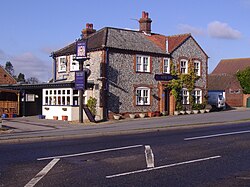
During his stay, Einstein was sculpted by the artist Jacob Epstein. His time in Norfolk is commemorated today by a blue plaque located at the entrance of the New Inn public house. On October 7, 1933, Einstein set sail from Southampton, beginning a new life in America and never returning to Europe.
This extraordinary chapter of history has inspired various creative works, including Mark Burgess's radio play Einstein in Cromer, the book Saving Einstein: When Norfolk Hid a Genius the Double Life of Oliver Locker-Lampson, and a Netflix docudrama titled Einstein and the Bomb.
Local History and Mysteries
The village is also remembered for a tragic unsolved mystery. On April 8, 1969, a schoolgirl named April Fabb disappeared without a trace while cycling from nearby Metton to visit her sister in Roughton.
Transport and Accessibility
Roughton is well-connected to the wider region. The village straddles the A140, the primary road linking Cromer and Norwich, as well as the B1463. For those using public transport, the nearest railway station is Roughton Road, a stop on the Bittern Line (connecting Sheringham, Cromer, and Norwich) operated by Greater Anglia.
Additionally, Sanders Coaches provides regular bus services to Holt, Cromer, Sheringham, and Norwich, while Norwich International Airport serves as the nearest air travel hub.
| Category | Details |
|---|---|
| Area | 7.23 km² (2.79 sq mi) |
| Population Density | 129/km² (330/sq mi) |
| District | North Norfolk |
| Postcode District | NR11 |
| Distance to London | 134 miles (216 km) |
Frequently Asked Questions
What is the significance of St Mary's Church in Roughton?
St Mary's Church is notable for its round tower, which is believed to be of Saxon origin. It is one of only 124 such round-tower churches found across Norfolk.
Why did Albert Einstein stay in Roughton?
Einstein stayed in a hut on Roughton Heath in 1933 as a refuge provided by Commander Oliver Locker-Lampson MP after Einstein fled Nazi Germany and before he emigrated to the United States.
How can visitors find the memorial to Albert Einstein?
A blue plaque commemorating Einstein's stay in the village is located at the entrance of the New Inn public house.
What are the best ways to travel to Roughton?
Visitors can reach Roughton via the A140 road, by bus through Sanders Coaches, or by train using the Roughton Road station on the Bittern Line.
What does the name 'Roughton' mean?
The name Roughton means 'Rough farm' or 'Rough settlement', which refers to the natural character of the ground in the area.