Rosario Oeste: The History and Legacy of a Former Argentine Railway Hub
Located in the western reaches of Rosario, Santa Fe, the Rosario Oeste station stands as a testament to Argentina's complex railway evolution. Once a vital node in the national transport network, this station served as a strategic gateway for long-distance travel, designed to streamline movement by avoiding the congested city center.
Today, while the station no longer welcomes passengers, its site remains a point of interest for historians and urban planners alike, representing the rise and fall of the passenger rail era in the region.
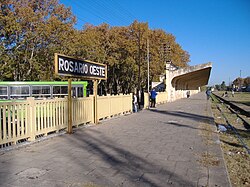
Key Facts
- Location: Intersection of Paraná and 9 de Julio streets, Rosario, Argentina.
- Network: Part of the Belgrano Railway (meter gauge).
- Operational Lifespan: Opened in 1917 and closed in 1993.
- Architectural Style: Modern rationalist design.
- Current Status: Abandoned, though the line is still used for freight by Trenes Argentinos Cargas.
The Evolution of Rosario Oeste
From Kilómetro 302 to a Regional Hub
The station began its life in 1917 as a simple stop known as Kilómetro 302, named for its distance from Buenos Aires. At the time, it was operated by the Córdoba Central Railway as part of the line heading west toward Córdoba. By 1939, the State Railway Administration officially renamed the site "Rosario Oeste."
Architectural Modernization
In the mid-1940s, the station underwent a significant transformation. The original wooden structure was demolished to make way for a new building designed in the rationalist style—a modern architectural approach that diverged from the British and French models common in other Argentine stations. This facility became the primary stop for all meter gauge (narrow track) long-distance trains, eliminating the need for trains to perform complex backing maneuvers at the Rosario Central Córdoba Station.
Nationalization and the Belgrano Railway
Following the nationalization of the railways under the government of Juan Perón in 1949, the Córdoba Central Railway was merged into the General Manuel Belgrano Railway. This consolidation centralized passenger services at Rosario Oeste, leading to the closure of several other termini in the area.
Conflict, Decline, and Abandonment
The station's history is also marked by social unrest. In September 1969, during the popular uprising known as the Rosariazo, the station was looted and set on fire. Despite the extensive damage, Rosario Oeste was the only station from that period to be subsequently rebuilt.
However, the broader decline of the Argentine railway system eventually caught up with the facility. Most passenger services were cancelled by 1977, and the subsequent privatization and downsizing of cargo services in the 1990s left the station abandoned. It officially closed its doors in 1993.
Future Prospects and Urban Planning
Because of its peripheral location and low urban impact, Rosario Oeste is frequently mentioned in discussions regarding the revival of the railway system. In 2006, the municipality suggested the site as a potential terminus for a projected high-speed railway connecting Buenos Aires, Rosario, and Córdoba.
Despite this, the official Urban Plan for 2007–2017 shifted the proposed site to Patio Parada, a railway maneuver area located closer to the city center, west of the Rosario Norte Station.
| Feature | Details |
|---|---|
| Coordinates | 32°56′31.92″S 60°41′34.26″W |
| Primary Line | Belgrano Railway |
| Operators | Córdoba Central Railway (1917–1948), Ferrocarriles Argentinos (1948–1993) |
| Ownership | Government of Argentina |
| Current Line Use | Freight only (Trenes Argentinos Cargas) |
Frequently Asked Questions
Why was Rosario Oeste built on the periphery of the city?
It was designed as a convenient stop for long-distance trains to avoid the logistical complications of entering the central part of the city and the need to back up at the Rosario Central Córdoba Station.
What is the significance of the "rationalist style" mentioned in its architecture?
The rationalist style represented a shift toward modernism, moving away from the traditional British and French architectural influences that characterized most other railway stations in Argentina at the time.
What happened to the station during the Rosariazo?
During the 1969 uprising, the station was looted and set on fire, though it was later rebuilt.
Does the railway line still see any activity?
Yes, while the Rosario Oeste station itself is closed, the state-owned company Trenes Argentinos Cargas continues to operate freight trains to the north of Argentina on that line.
Was the high-speed rail project ever built at Rosario Oeste?
No. Although the municipality considered it a likely alternative in 2006, the 2007–2017 Urban Plan shifted the projected site to the Patio Parada area.