Rosario – Islas Malvinas International Airport
Located 13 km (8.1 mi) west-northwest of the city center, the Rosario – Islas Malvinas International Airport (IATA: ROS, ICAO: SAAR) serves as the primary aviation hub for the Greater Rosario area in the Santa Fe Province of Argentina. Spanning 550 hectares (1,400 acres), this public facility is operated by the Province of Santa Fe and plays a critical role in connecting the region to domestic and international destinations.
Formerly known as Fisherton International Airport, the facility underwent a significant transformation between 2003 and 2004 with the construction of a new terminal. This expansion effectively elevated the site to international status, allowing it to handle a broader range of global traffic.
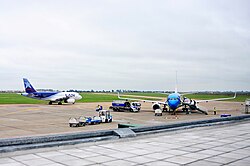
Key Facts
- Location: 13 km west-northwest of Rosario, Santa Fe, Argentina.
- Elevation: 85 ft (26 m) above mean sea level (AMSL).
- Runway: A single concrete runway measuring 3,000 m (9,843 ft) in length.
- Operator: Province of Santa Fe.
- Naming: The name reflects Argentina's sovereignty claims over the Falkland Islands (Islas Malvinas).
Infrastructure and Operations
The airport is designed to handle both commercial and private aviation. Its primary infrastructure consists of a concrete runway (02/20) that measures 3,000 meters by 60 meters. The facility sits at a relatively low elevation of 26 meters (85 ft), providing stable conditions for most aircraft types.
Historically, the airport experienced a period of decline in the early 21st century. By 2005, flight volumes had dropped by approximately 75% compared to the year 2000, with only 1,807 flights recorded. However, since 2013, the airport has seen a steady recovery, experiencing consistent growth in both passenger traffic and connectivity.
| Feature | Detail |
|---|---|
| IATA / ICAO Codes | ROS / SAAR |
| Total Area | 550 ha (1,400 acres) |
| Runway Surface | Concrete |
| Runway Dimensions | 3,000 m x 60 m |
| 2016 Passenger Volume | 510,056 |
Airlines and Destinations
Rosario is served by a variety of domestic and international carriers, offering a mix of year-round and seasonal services.
Domestic Connectivity
Aerolíneas Argentinas provides extensive coverage within Argentina, connecting Rosario to major cities including Buenos Aires (Aeroparque), Córdoba, Salta, Puerto Iguazú, San Carlos de Bariloche, and Mendoza. Other domestic services include LADE flights to Reconquista.
International Reach
The airport connects passengers to several key international hubs:
- Panama: Served by Copa Airlines via Panama City–Tocumen.
- Brazil: Flights to Rio de Janeiro (Galeão) and São Paulo (Guarulhos) via Gol Linhas Aéreas and LATAM Brasil, with seasonal options for Florianópolis.
- Dominican Republic: Services to Punta Cana provided by Aerolíneas Argentinas and Arajet.
- Peru: Connectivity to Lima via LATAM Peru.
- Spain: World2Fly is scheduled to begin service to Madrid on October 1, 2026.
Frequently Asked Questions
What is the IATA code for Rosario Airport?
The IATA code for Rosario – Islas Malvinas International Airport is ROS.
Who operates the airport?
The airport is operated by the Province of Santa Fe.
What is the significance of the airport's name?
The name "Islas Malvinas" reflects Argentina's claims of sovereignty over the Falkland Islands.
Does the airport offer international flights?
Yes, the airport offers international services to destinations such as Panama City, Rio de Janeiro, São Paulo, Lima, and Punta Cana, with a planned route to Madrid starting in late 2026.
How long is the runway at ROS?
The concrete runway is 3,000 meters (9,843 feet) long.