Greater Rosario: Argentina's Third Largest Metropolitan Area
Located in the province of Santa Fe, Greater Rosario (the Rosario Metropolitan Area) serves as a vital urban and economic hub in Argentina. As the country's third most populated urban settlement—trailing only Buenos Aires and Córdoba—this metropolis blends a dense urban core with a sprawling network of satellite towns and industrial zones.
The region is defined by its geography, expanding in all directions except to the east, where it is bounded by the massive Paraná River. This natural border not only shapes the city's growth but also fuels its economy through critical maritime trade.
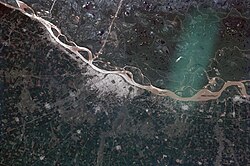
Key Facts
- Population: 1,455,668 inhabitants (2022 INDEC census).
- Total Area: 589 km² (227 sq mi).
- Population Density: 2,471.4 people per km².
- Core City: Rosario, with a population of approximately 910,000.
- Economic Engine: Home to the Cordón Industrial (Industrial Corridor) and major agricultural export ports.
Regional Composition and Geography
Greater Rosario consists of the central city of Rosario and several surrounding municipalities. To the south lies Villa Gobernador Gálvez, located roughly 10 km from the city center with a population of about 75,000. To the west and southwest, the metropolis incorporates towns such as Funes, Roldán, Pérez, and Soldini. These areas have grown significantly due to their proximity to major roads, leading many residents to commute daily into Rosario.
The northern expansion follows the coastline of the Paraná River. This stretch includes a series of merging towns: Granadero Baigorria, Capitán Bermúdez, Fray Luis Beltrán, San Lorenzo (which has a population exceeding 40,000), and Puerto General San Martín, the latter situated 35 km from the city center.
The Cordón Industrial
The northern sector is known as the Cordón Industrial (Industrial Corridor), a region historically characterized by heavy industrial production. While the economic crisis of the 1990s dismantled much of the infrastructure and impacted agricultural exports, a national economic recovery began around 2006. Despite this revitalization, the region still faces social challenges, with official surveys indicating a poverty rate of 27.4%.
Transportation and Connectivity
Greater Rosario functions as a critical node for national and international transit. Local mobility is supported by a fluid short-distance system where urban bus lines extend from Rosario into neighboring towns under a common fee structure. For interurban travel, the Bus Terminal and the Plaza Sarmiento transport node serve as primary hubs.
Road and Rail Networks
The Avenida de Circunvalación, a city-encircling avenue, connects the metropolis to several major arteries:
- National Route 11: Heads north toward the provincial capital, Santa Fe.
- General Estanislao López Highway: Provides a high-speed alternative to the north.
- National Route 9: Connects the region south toward San Nicolás de los Arroyos in Buenos Aires province, and west toward Córdoba.
- Rosario-Victoria Bridge: Opened in 2003, this bridge links the metropolis to Entre Ríos, providing a gateway to Uruguay and Brazil.
Rail travel is managed by Trenes Argentinos via the General Bartolomé Mitre Railway. A daily service connects Rosario Norte and Rosario Sur stations to Retiro Mitre Station in Buenos Aires, covering 315 km in approximately six and a half hours.
Air and Maritime Logistics
The region is a powerhouse for agricultural exports. Much of northern Argentina's produce is shipped overseas via the Paraná River, specifically through the Port of Rosario and Puerto General San Martín. Air travel is facilitated by the Rosario International Airport (IATA: ROS), located 13 km from the center, partially within the lands of Funes.
Metropolitan Summary
| Category | Detail |
|---|---|
| Total Population | 1,455,668 |
| Core City Population | ~910,000 |
| Land Area | 589 km² |
| Key Infrastructure | Rosario-Victoria Bridge, Rosario International Airport |
| Primary River | Paraná River |
Frequently Asked Questions
What is the population of Greater Rosario?
According to the 2022 INDEC census, the metropolitan area has a population of 1,455,668 inhabitants.
Which cities make up the Greater Rosario area?
In addition to Rosario, the area includes Villa Gobernador Gálvez, Funes, Roldán, Pérez, Soldini, Granadero Baigorria, Capitán Bermúdez, Fray Luis Beltrán, San Lorenzo, and Puerto General San Martín.
What is the Cordón Industrial?
The Cordón Industrial is a heavily industrialized productive region located in the northern part of Greater Rosario along the river coast.
How can one travel from Buenos Aires to Rosario by train?
Trenes Argentinos operates a daily service along the General Bartolomé Mitre Railway between Retiro Mitre Station in Buenos Aires and Rosario Norte/Sur stations, taking about 6.5 hours.
How does Greater Rosario connect to other countries?
The metropolis connects to Entre Ríos via the Rosario-Victoria Bridge, which serves as a route toward Uruguay and Brazil. Additionally, its ports on the Paraná River facilitate international maritime trade.