Rosario Central Station: From Railway Hub to Municipal Center
Located at the junction of Corrientes Street and Wheelwright Avenue in the heart of Rosario, Argentina, Rosario Central is a landmark of architectural and transport history. Situated near the banks of the Paraná River, this former railway station once served as a vital artery for the nation's connectivity before evolving into a modern center for civic administration and education.
Key Facts
- Opened: 1868 (Construction completed in 1870).
- Closed: 1977.
- Architectural Style: Neo-gothic Italian.
- Historical Significance: The first railway line to connect two Argentine provinces.
- Current Use: Seat of the "Antonio Berni" Center Municipal District and "La Isla de los Inventos".
The Golden Age of the Central Argentine Railway
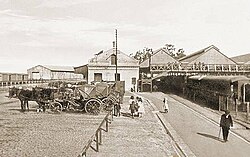
Construction of the station began in 1868 and was completed in 1870. Funded by British capital, the station was designed in the neo-gothic Italian style, featuring a distinctive clock tower that became a city landmark. At the time of its inception, it was one of Argentina's most significant stations due to its massive scale, the high level of investment, and the volume of traffic it handled.
The station served as the terminus for the Central Argentine Railway, linking Rosario to the city of Córdoba, located 396 km to the west. This was a pioneering achievement, marking the first of eight lines to operate in Rosario and the first ever to join two different provinces.
Operational Evolution
In 1908, the Central Argentine and the Buenos Aires and Rosario Railway companies merged. This led to a strategic reorganization of the city's rail traffic: Rosario Norte was designated for long-distance and express services, while Rosario Central focused on short- and mid-distance passenger travel. Between 1935 and 1940, the station was a hive of activity, managing seventy daily services and transporting an average of 438,000 passengers annually.
Decline and Closure
The decline of the station began in 1977 when most local and mid-distance services were cancelled, leading to the station's closure and subsequent abandonment. The physical infrastructure began to disappear in 1987 when rails connecting the station to the port were removed to make way for the Avenida Ribereña Central (Central Riverside Avenue).
Despite a brief attempt in November 1989 to launch an experimental passenger service, the effort failed within a month. Further demolition occurred in 1993, when workshops and stores north of the main building were cleared. By 1997, the remaining rails leading to the station were removed, effectively ending its life as a railway terminus.
Restoration and Modern Purpose
In 1999, control of the site was transferred from ENABieF (the state organization managing former railway assets) to the Municipality of Rosario. As part of a decentralization program, the city decided to restore the building while preserving its historic exterior.
In 2005, the building reopened as the Center Municipal District, named "Antonio Berni" in honor of the famous local painter. This administrative hub serves a population of 261,047 people across an area of 20.37 km². The restoration was a collaborative effort between local architect Luis Grossman and Colombian architect Laureano Forero Ochoa.
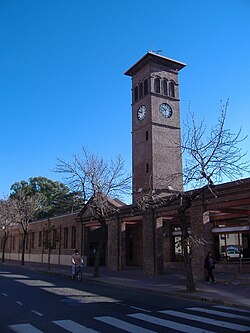
Beyond the municipal offices, a section of the former station—separated by a short bridge over a road tunnel—was transformed into La Isla de los Inventos ("Invention Island"), an educational and entertainment center dedicated to children. Today, the station is officially recognized as a site of patrimonial value by the municipality of Rosario (item 010180000).
Station Summary
| Feature | Details |
|---|---|
| Location | Av. Wheelwright and Corrientes, Rosario, Argentina |
| Railway Line | Mitre |
| Primary Operators | Central Argentine Railway (1870–1912), Ferrocarriles Argentinos (1948–1977) |
| Current Owner | Municipality of Rosario (since 1999) |
| Key Facilities | Antonio Berni District Center, La Isla de los Inventos |
Frequently Asked Questions
When did Rosario Central Station stop operating as a railway?
The station officially closed in 1977 after most local and mid-distance train services were cancelled.
What is the architectural style of the station?
The station was built using British capital in the neo-gothic Italian style, which was popular at the time of its construction in the late 1860s.
What is the "Antonio Berni" Center Municipal District?
It is the current use of the restored station building, serving as a decentralized municipal administrative office for a population of over 261,000 residents.
What is "La Isla de los Inventos"?
It is an educational and entertainment center for children located in a part of the former station complex, separated from the main building by a bridge.
Which cities did the railway from Rosario Central originally connect?
The line connected the city of Rosario to Córdoba, covering a distance of 396 km to the west.