Buenos Aires and Rosario Railway
The Buenos Aires and Rosario Railway (BA&R), known locally as the Ferrocarril Buenos Aires y Rosario, was a pivotal British-owned rail network that transformed transportation in late 19th-century Argentina. Utilizing a 5 ft 6 in (1,676 mm) broad gauge, the company expanded from a modest regional line into a massive infrastructure project connecting the capital to the provinces of Santa Fe, Santiago del Estero, and Tucumán.
Key Facts
- Operational Period: 1876 to 1908.
- Track Gauge: 5 ft 6 in (1,676 mm) broad gauge.
- Major Termini: Buenos Aires (Central and Retiro) and Rosario Norte.
- Acquisition: Merged into the Central Argentine Railway in 1908.
- Legacy: Parts of the network remain active today as the Ferrocarril Mitre.
Origins and Preliminary Planning
In the 1870s, travelers from the Littoral zone reaching Buenos Aires faced significant delays. They typically navigated the Sarmiento River to Tigre before transferring to the Buenos Aires Northern Railway. However, low water levels frequently halted river traffic, leaving passengers stranded.
To solve this, Guillermo Matti proposed a railway connecting Buenos Aires to Campana, allowing passengers to board boats to Rosario and other Littoral cities more efficiently. After evaluating three potential paths—an eastern route, a direct line, and a southern route—the government granted a concession on September 10, 1870, for a line running from the Port of Campana to Moreno station. This was later modified by provincial law in 1871 to join the Western Railway in Recoleta.
Construction and Early Operations
The project was formalized in London in 1873 with the establishment of the "Buenos Aires and Campana Railway Company Limited." Construction began on October 11, 1872, working simultaneously from both termini. The route faced significant geographical challenges, including 40 km of wetlands and several river crossings, necessitating the construction of multiple bridges and viaducts over the Luján and Las Conchas rivers.
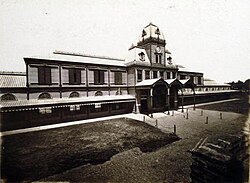
The line officially opened on January 13, 1876, running from the Central Station to Campana. Initial service consisted of four daily trains, with each journey averaging three hours.
Expansion to the North and West
Following the success of the Campana line, the company rebranded as the Buenos Aires and Rosario Railway and extended its tracks. The line reached Zárate, then Baradero in 1885, and finally Rosario by the end of 1885, terminating at Rosario Norte Station. The first service to Rosario commenced on February 1, 1886.
The BA&R then entered a period of rapid growth, extending its reach to:
- Santa Fe Province: Gálvez (1886), Rafaela (1887), and Sunchales (1887).
- Other Provinces: La Banda (1890) and Tucumán (1891).
- Branch Lines: Connections to Puerto San Martín, Puerto Cerana, San Francisco, and Santiago del Estero.
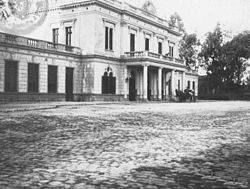
By the mid-1890s, the BA&R had become the second-largest British-owned railway in Argentina, effectively challenging the monopoly of the Central Argentine Railway in the northwest. In 1900, it further expanded by acquiring the 490 km metre gauge network of the Santa Fe and Córdoba Great Southern Railway, eventually reaching Río Cuarto in 1902.
The Belgrano and Tigre Branch
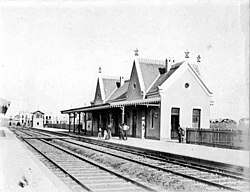
In 1887, a concession was granted to Emilio Noguier y Cía to build a line from Belgrano to Las Conchas (Tigre). After Noguier's company faced financial difficulties, the BA&R acquired the 22 km line. This led to the creation of the Tren del Bajo, a branch constructed between 1891 and 1896 starting from Coghlan station, named after Irish engineer John Coghlan.
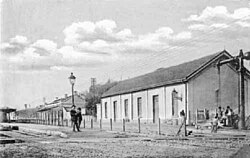
Because this line ran parallel to the Central Argentine Railway, stations with the same names were distinguished by suffixes: the Central Argentine used "C" and the BA&R used "R".
The Fate of the Tigre Branch
Following the nationalization of railways in 1961, the Retiro-Tigre R branch was closed due to low demand. However, in 1995, the abandoned section was reconverted into a light rail service known as the Tren de la Costa, featuring new stations such as Avenida Maipú and Delta.
Merger with Central Argentine Railway
The fierce competition between the BA&R and the Central Argentine Railway (CAR) eventually led to a merger in 1908 to protect mutual interests. While the BA&R took over services, the leadership remained with CAR. For a brief period, locomotives bore both "BAR" and "FCCA" markings before the company was officially named the Ferrocarril Central Argentino in 1909.
This merger added 2,000 km of rail to the Central Argentine network. It was decided that Rosario Central would handle short and medium distances, while Rosario Norte remained the long-distance terminus.
Technical Specifications and Rolling Stock
The BA&R relied on high-quality British engineering. Its rolling stock included 25 steam locomotives produced by Beyer, Peacock & Company, designed by engineer Hermann Lange. These were delivered in two batches: ten units between 1885 and 1886, and fifteen units in 1888.
| Feature | Detail |
|---|---|
| Native Name | Ferrocarril Buenos Aires y Rosario |
| Track Gauge | 5 ft 6 in (1,676 mm) |
| Key Termini | Buenos Aires, Rosario Norte, Tucumán |
| Major Merger | Central Argentine Railway (1908) |
| Locomotive Supplier | Beyer, Peacock & Company |
Frequently Asked Questions
Why was the Buenos Aires and Rosario Railway originally created?
It was conceived by Guillermo Matti to provide a reliable land connection between Buenos Aires and Campana, bypassing the unpredictable water levels of the Sarmiento River that often delayed passengers traveling to the Littoral zone.
What happened to the BA&R's terminus in Buenos Aires?
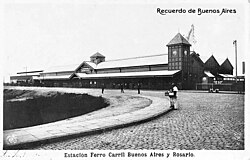
The original Central Station was destroyed by fire in 1897. The company then used the Retiro station owned by the Buenos Aires Northern Railway until 1901, when it opened its own building. This building was later demolished after the Central Argentine Railway opened a larger terminal in 1915.
How did the BA&R distinguish its stations from the Central Argentine Railway?
Because the two companies operated parallel lines through the same towns, they added letters to station names to avoid confusion: the BA&R used an "R" (e.g., Belgrano R), while the Central Argentine used a "C".
What is the modern legacy of the Tigre branch?
After being closed in 1961, the abandoned section of the Tigre branch was repurposed in 1995 as the Tren de la Costa, a light rail tourist and commuter service.
Who manufactured the locomotives for the BA&R?
The locomotives were produced by the British firm Beyer, Peacock & Company and were designed by the company's co-manager, engineer Hermann Lange.