Rosario and Puerto Belgrano Railway
The Rosario and Puerto Belgrano Railway (Spanish: Ferrocarril Rosario y Puerto Belgrano) was a significant French-owned rail operation that carved a north-south path through the heart of Argentina. Designed to challenge the dominance of British rail companies, this broad gauge line connected the vital hubs of Rosario in Santa Fe Province and Puerto Belgrano in Buenos Aires Province.
Unlike many contemporary lines that radiated from Buenos Aires, this railway was strategically designed to link cities that were closer to Rosario or Bahía Blanca than to the capital. By doing so, the company aimed to divert traffic away from the British-owned BA Great Southern and BA Western railways.
Key Facts
- Operator: Compagnie du Chemin de Fer de Rosario à Puerto Belgrano (1910–1948).
- Track Gauge: 1,676 mm (5 ft 6 in) broad gauge, single track.
- Route Length: Approximately 800 km.
- Termini: Rosario (Santa Fe) and Puerto Belgrano (Buenos Aires).
- Nationalization: Integrated into the Mitre and Roca Railways in 1948.
- Infrastructure: Included 36 bridges and a specialized dock at Puerto Belgrano.
History and Development
Origins and Concessions
The project began with a construction concession granted to Diego de Alvear under Law N° 4.279 in 1903. By December 1906, this concession was transferred to the French-owned Sociedad Anónima Compañía del Ferrocarril Rosario a Puerto Belgrano. As part of the agreement, the company was required to construct a dock at the line's southern terminus in Puerto Belgrano.
Engineering Challenges
Because the line was built after many east-to-west tracks were already established, engineers had to construct numerous bridges to cross existing lines. While the terrain was generally level, the route was punctuated by short, sharp gradients that dictated the specific types of locomotives required for operation. Notable engineering feats included seven iron bridges crossing the Sauce Grande River near Bahía Blanca.
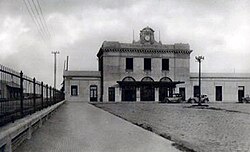
The total infrastructure included 36 bridges spanning 857 meters. At the southern end, the company built a 250-meter dock capable of accommodating four 125-meter ships simultaneously, equipped with 12 electric and 4 hydraulic cranes.
Operational Growth
Construction took place between 1906 and 1910, with full passenger and freight services inaugurated by 1912. The military port of Bahía Blanca served as the primary entry point for construction materials, including rails, steam locomotives, coaches, and even prefabricated homes for staff.
The company established its headquarters in Villa Diego (Rosario) in 1909, creating the "Coronel Aguirre" station, which featured workshops, a locomotive warehouse, and a switchyard. These buildings are now part of the Ciudad Universitaria de Rosario.
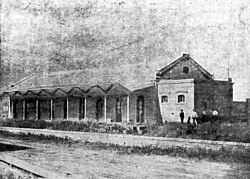
To further stimulate traffic, a 27-km branch line from Punta Alta to Bahía Blanca was constructed under the direction of Swiss Engineer Armin Reimman and later Lucien Capelle. This expansion culminated in the opening of a new terminus on Colón Avenue in 1921, and the first full inaugural trip from Rosario to Bahía Blanca took place on March 2, 1922.
Economic Struggles and Decline
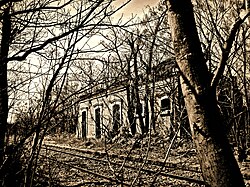
Despite its ambitious design, the railway suffered from a chronic deficit. The company struggled to compete with the more aggressive pricing of British railways and found itself traversing less developed agricultural regions compared to the fertile lands controlled by its British rivals.
Nationalization and Privatization
In 1948, the administration of Juan Perón nationalized the Argentine railway network. The Rosario and Puerto Belgrano line was split: the northern section (Rosario to Ingeniero Beaugey) joined the Mitre Railway, while the southern section (Beaugey to Puerto Belgrano) became part of the Roca Railway.
Further declines occurred in 1977 when the section between Bajo Hondo and Coronel Pringles was closed, and passenger services in Rosario were shifted and eventually terminated. By the early 1990s, under President Carlos Menem, the line was privatized and granted to the freight company Ferroexpreso Pampeano. The final passenger service, running between Bahía Blanca and Punta Alta, ended in February 1990.
Railway Summary
| Feature | Details |
|---|---|
| Native Name | Ferrocarril Rosario y Puerto Belgrano |
| Ownership | French (until 1948) |
| Gauge | 1,676 mm (Broad Gauge) |
| Primary Route | Rosario ↔ Puerto Belgrano |
| Key Infrastructure | 36 bridges, Puerto Belgrano dock |
| Current Status | Defunct as a company; lines privatized/closed |
Frequently Asked Questions
Why was the Rosario and Puerto Belgrano Railway built?
It was designed to connect cities closer to Rosario and Bahía Blanca than to Buenos Aires, specifically to compete for merchandise traffic against British-owned railway companies.
What happened to the Puerto Belgrano dock?
After its completion, the 250-meter dock was acquired by the Government of Argentina in 1914 and incorporated into the Argentine Navy.
How did the railway's geography affect its profitability?
The line crossed less developed agricultural areas compared to the more fertile regions served by British companies, contributing to a chronic financial deficit.
When did passenger services officially end on the line?
The final passenger service, which operated between Bahía Blanca and Punta Alta, was discontinued in February 1990.
Which railway lines absorbed the RPBR after nationalization?
The northern section became part of the Mitre Railway, and the southern section was integrated into the Roca Railway in 1948.