Argentine Railway Nationalization: The 1948 Transition to State Ownership
On March 1, 1948, Argentina marked a pivotal shift in its economic sovereignty. Under the first term of President Juan Perón, the Argentine government purchased seven British-owned and three French-owned railway companies, bringing the vast majority of the nation's rail transport network under state control. This move was not merely a commercial transaction but a symbolic act of economic nationalism, aimed at reducing foreign influence over the country's infrastructure.
Key Facts
- Date of Nationalization: March 1, 1948.
- Scope: Purchase of 7 British and 3 French railway companies.
- Network Size: Approximately 24,458 km (15,197 mi) of British-owned lines, representing 57% of the total network.
- Financial Terms: Cancellation of US$ 500 million in debt to the Central Bank of Argentina plus a US$ 100 million cash payment.
- Outcome: Creation of Ferrocarriles Argentinos, organized into six regional divisions.
The Era of Foreign Investment
During the latter half of the 19th century, British and French investors played a critical role in Argentina's development. Between 1856 and 1914, the railway network expanded to become the largest in Latin America. This investment helped transform Argentina from a rural, underdeveloped nation with isolated communities into a prosperous global exporter of agricultural products.
However, the design of these networks reflected the priorities of the foreign owners. Most lines radiated inland from the major ports of Buenos Aires and Rosario, designed specifically to accelerate the transport of goods to European markets. Because these radial lines lacked interlinking, the internal integration of the Argentine interior progressed more slowly than if domestic needs had been the primary focus.
The Path to Nationalization
Several factors converged to make nationalization inevitable by the late 1940s. During World War II, restrictions on importing materials and equipment led to a severe lack of maintenance. By 1948, locomotives, rolling stock, and tracks were in desperate need of renewal. Simultaneously, the rise of an improved national road network increased competition from road transport.
Politically, the climate had shifted toward economic nationalism. Many Argentines viewed the foreign-owned rails as symbols of external control. President Perón incorporated the nationalization of the railways, the telephone system, the docks, and the central bank into his first Five-Year Plan, announced in October 1946, as a means of achieving economic independence.
The Transfer and Restructuring
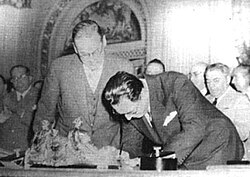
The transition occurred in stages. Between 1936 and 1939, the state had already nationalized the metre gauge Córdoba Central, Transandine, and Central Chubut railways. The main event took place on March 1, 1948, with the acquisition of the remaining British companies, including the broad gauge BA Great Southern and Central Argentine, and the standard gauge Entre Ríos and Argentine North Eastern.
The transfer was celebrated with mass demonstrations, most notably at the Plaza Británica in front of the Retiro railway terminus in Buenos Aires. Later in 1948, the government also nationalized three French-owned companies, including the Rosario & Puerto Belgrano. These were all consolidated into Ferrocarriles Argentinos, a state-owned holding company.
The Six Railway Divisions
To manage the network, the government grouped the lines by track gauge (the distance between the rails) and locality, naming the divisions after national heroes and former presidents:
| Railway Division | Key Former Companies Included | Primary Provinces Covered |
|---|---|---|
| Belgrano | Central Northern, Córdoba Central, Midland | Tucumán, Salta, Jujuy, Córdoba, Chaco |
| Mitre | Central Argentine, Buenos Aires Central | Buenos Aires, Santa Fe, Córdoba, Tucumán |
| Roca | BA Great Southern, Patagónicos, Rosario & Pto. Belgrano | Buenos Aires, La Pampa, Río Negro, Neuquén |
| Sarmiento | BA Western | Buenos Aires, La Pampa, Córdoba, San Luis, Mendoza |
| San Martín | BA & Pacific | Buenos Aires, Santa Fe, Córdoba, Mendoza, San Luis |
| Urquiza | Argentine North Eastern, Económico Correntino | Entre Ríos, Corrientes, Misiones |
Economic Aftermath and Legacy
While the nationalization was initially hailed as a victory over foreign imperialism, the long-term economic results were complex. The state-owned enterprises eventually contributed to significant government budget deficits. To cover these losses, the Central Bank often resorted to printing money, which fueled inflation.
Ferrocarriles Argentinos became one of the most loss-making state entities. By the 1960s, the railway system was generating daily losses of approximately one million US dollars, a figure that climbed to two million US dollars per day by the 1980s.
Frequently Asked Questions
Why did Argentina nationalize its railways in 1948?
The nationalization was driven by a desire for economic independence and nationalism under President Juan Perón. Additionally, the railways had suffered from a lack of maintenance during World War II and faced increasing competition from road transport.
How were the British shareholders compensated?
The British shareholders were compensated through the cancellation of a US$ 500 million debt owed to the Central Bank of Argentina, along with a controversial cash payment of US$ 100 million, which Perón stated was paid for "sentimental reasons."
What was Ferrocarriles Argentinos?
Ferrocarriles Argentinos was the state-owned holding company created to manage the entire national railway network after the British and French companies were nationalized and grouped into six regional divisions.
Did the nationalization help the Argentine economy?
While it was seen as a political victory for economic sovereignty, it later contributed to financial instability. The railways became heavily loss-making, contributing to budget deficits and inflation from the 1950s through the 1980s.
Who were the six railway divisions named after?
The divisions were named after distinguished Argentine presidents and national heroes: José de San Martín, Manuel Belgrano, Domingo Sarmiento, Justo José de Urquiza, Bartolomé Mitre, and Julio A. Roca.