Ronnie Montrose: The Legacy of a Hard Rock Guitar Pioneer
Ronnie Montrose was a formidable force in the world of hard rock, known for his searing guitar work and his ability to shape the sound of multiple influential bands. Born in San Francisco, California, Montrose spent his early childhood in Colorado before returning to the San Francisco Bay Area, where he would eventually establish his professional musical footprint.
His journey began in earnest at age 16 when he left home to pursue music. By late 1968, he was playing with the band Sawbuck, signed to Fillmore Records—a label co-owned by the legendary promoter Bill Graham and producer David Rubinson. While Sawbuck toured with major acts and recorded their sole studio album, Montrose's talent quickly caught the attention of industry heavyweights.
Key Facts
- Early Career: Started with Sawbuck before joining Van Morrison for the album Tupelo Honey.
- Major Collaborations: Played with the Edgar Winter Group, contributing to hits like "Frankenstein" and "Free Ride".
- Band Leadership: Founded the band Montrose in 1973, featuring vocalist Sammy Hagar.
- Musical Evolution: Formed the progressive rock band Gamma in 1979.
- Versatility: Recorded everything from hard rock and progressive rock to an all-instrumental solo album.
The Rise of the Montrose Band
In 1973, Ronnie formed his eponymous band, Montrose, with Sammy Hagar on vocals. This partnership produced two seminal albums under Warner Bros. Records: Montrose (1973) and Paper Money (1974). The group helped define the hard rock sound of the era before Hagar departed for a solo career.
Following Hagar's exit, Montrose continued the band's momentum with vocalist Bob James and keyboardist Jim Alcivar, releasing Warner Bros. Presents Montrose! (1975) and Jump on It (1976). Seeking a change in creative direction, he released an all-instrumental solo project titled Open Fire in 1978, produced by his former collaborator Edgar Winter.
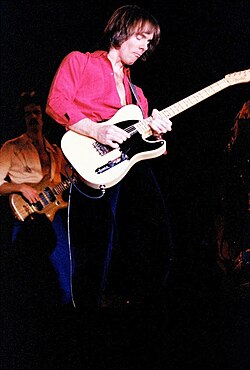
Expanding Horizons: Gamma and Beyond
In 1979, Montrose transitioned toward a more progressive rock sound by forming Gamma. Recommended by James Dewar, vocalist Davey Pattison joined the lineup, which also included Jim Alcivar and Alan Fitzgerald. Gamma evolved through several iterations, eventually incorporating drummer Denny Carmassi and bassist Glenn Letsch in Gamma 2, and Mitchell Froom on keyboards for Gamma 3.
Montrose's versatility extended beyond the studio and stage. In 1980, he composed and performed the soundtrack for the Canadian skiing comedy Powderheads. He also contributed lead guitar to Paul Kantner's 1983 track "(She Is a Telepath)" and spent a brief period in the mid-1980s with the Seattle-based band Rail.
Later Career and Final Works
Throughout the 1980s and 1990s, Montrose remained prolific. He released solo albums such as The Speed of Sound (1988), Music from Here (1994), and Bearings (2000), alongside later projects like Mean (1987) and Gamma 4 (2000). A notable highlight from 1986 was his interpretation of the Beatles' "Love You To" on the album Territory, which featured a rare vocal performance by Montrose himself.
In his final years, Montrose enjoyed reunions with original bandmates. He appeared on Sammy Hagar's 1997 album Marching to Mars and performed as a special guest at Hagar's concerts in 2004 and 2005. His final professional chapter was the Ronnie Montrose Band, featuring Randy Scoles, Dan McNay, and Steve Brown, whose performances were captured on the DVD Ronnie Montrose: Live at the Uptown.
Career Summary Table
| Period/Year | Project/Band | Key Contribution/Role |
|---|---|---|
| 1968–1971 | Sawbuck | Guitarist; signed to Fillmore Records |
| 1971–1972 | Van Morrison | Guitarist for Tupelo Honey sessions |
| 1972 | Edgar Winter Group | Guitar, mandolin, and 12-string acoustic |
| 1973–1976 | Montrose | Band leader and lead guitarist |
| 1979–2000 | Gamma | Founder; shifted to progressive rock |
| 2011–2012 | Ronnie Montrose Band | Final touring ensemble |
Frequently Asked Questions
Did Ronnie Montrose ever play with Mott the Hoople?
No. Although the liner notes for the CD edition of Paper Money suggested he was invited to join as lead guitarist, Ronnie Montrose stated that this was merely a rumor and never actually happened.
What was the musical difference between Montrose and Gamma?
While the Montrose band focused on a hard rock/vocal format, Gamma had a more progressive rock edge.
Which famous hit songs did he record with the Edgar Winter Group?
During his time with the Edgar Winter Group, he recorded the hit singles "Frankenstein" and "Free Ride" for the album They Only Come Out at Night.
When did Ronnie Montrose pass away?
Ronnie Montrose passed away in 2012, having continued to tour even after revealing in 2009 that he had successfully fought prostate cancer.