Roman Republic: The Rise and Fall of a Mediterranean Superpower
The Roman Republic (c. 509 – 27 BC) represents one of the most transformative eras of classical antiquity. Transitioning from a monarchy to a complex consular republic, Rome evolved from a small city-state in Latium into the dominant power of the Mediterranean basin. This period was defined by a unique constitutional balance, relentless military expansion, and internal social struggles that eventually paved the way for the Roman Empire.
At its heart, the Republic was governed by the principle of Res publica (the "public thing"), where power was shared among elected magistrates, the Senate, and various legislative assemblies. This system sought to prevent the return of autocratic rule, though it was frequently tested by the ambitions of powerful generals and the needs of a rapidly growing population.
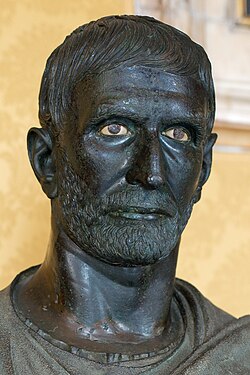
Key Facts
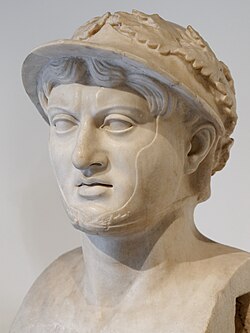
- Duration: Approximately 509 BC to 27 BC.
- Government: A consular republic featuring two annually elected consuls and a powerful Senate.
- Territorial Growth: Expanded from roughly 10,000 km² in 326 BC to 1,950,000 km² by 50 BC.
- Language: Latin was the official language.
- Key Transitions: Began with the overthrow of the monarchy and ended when Octavian was proclaimed Augustus.
The Early Republic and Italian Expansion
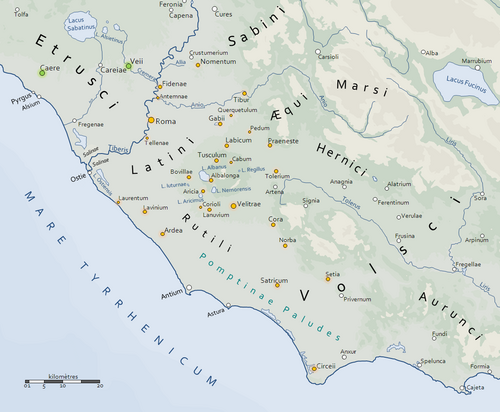
Securing Latium and the Etruscan Frontier
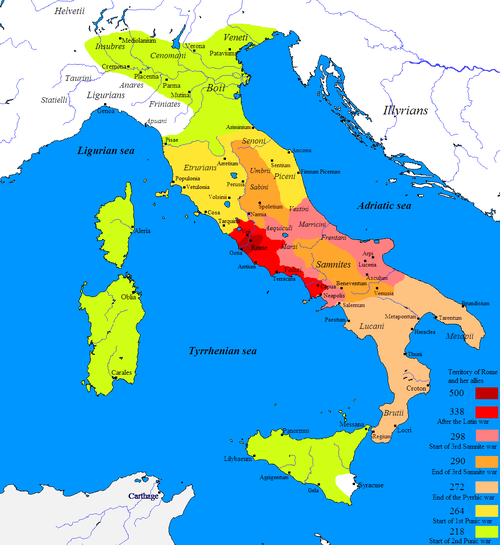
The early years of the Republic were characterized by wars of expansion against neighboring tribes and cities. Rome successfully defeated rival Latin cities in a series of battles, including Lake Regillus (496 BC) and Corbio (446 BC). While the Romans suffered a major setback at the Battle of the Cremera in 477 BC against the Etruscan city of Veii, they eventually avenged this defeat by destroying Veii in 396 BC.
The Gallic Threat and the Samnite Wars
Rome's growth was nearly halted around 390–387 BC when Gallic tribes invaded from the north. Following a rout at the Battle of Allia River, the city of Rome was sacked by the Senones. Although the destruction was largely superficial, the event served as a catalyst for further military fortification.
Between 343 and 290 BC, Rome engaged in three grueling conflicts known as the Samnite Wars. Despite early struggles and a rebellion in 298 BC, Rome eventually annexed most Samnite territory and established colonies, securing its dominance over the Italian peninsula.
Mediterranean Dominance and the Punic Wars
The Struggle with Carthage
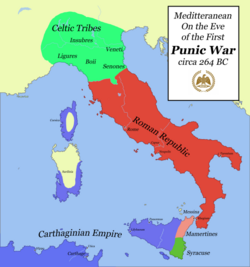
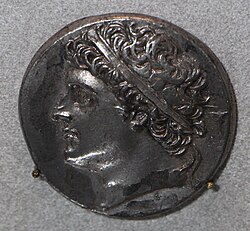
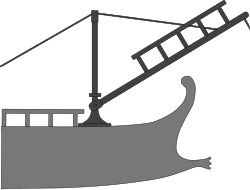
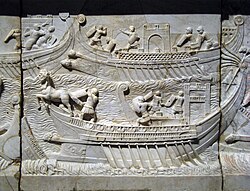
As Rome looked beyond Italy, it clashed with Carthage, the leading maritime power of the era. The First Punic War (264–241 BC) saw Rome develop its naval capabilities, utilizing inventions like the corvus (a boarding bridge) to turn sea battles into infantry fights.
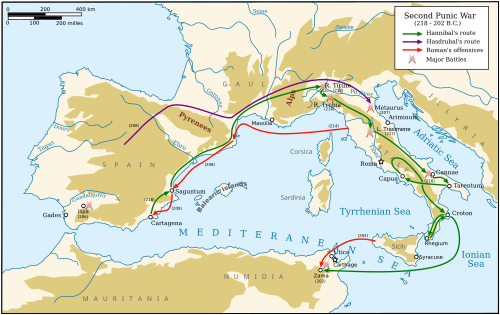
The Second Punic War is most famous for the invasion of Italy by the Carthaginian general Hannibal, who utilized war elephants to cross the Alps. Despite Hannibal's tactical brilliance, Rome's resilience and the eventual offensives by Scipio Africanus led to a Roman victory, establishing Rome as the supreme power in the Western Mediterranean.
![A Carthaginian quarter shekel, perhaps minted in Spain. The obverse may depict Hannibal with the traits of a young Melqart. The reverse features a war elephant, which were included in Hannibal's army during the Second Punic War.[73]](/images/d5/e9/d5e90b43f93b9758f38e6fe76e27f7743df8020caba0e97e8d976431166624ca.jpg)
Expansion into the Greek East
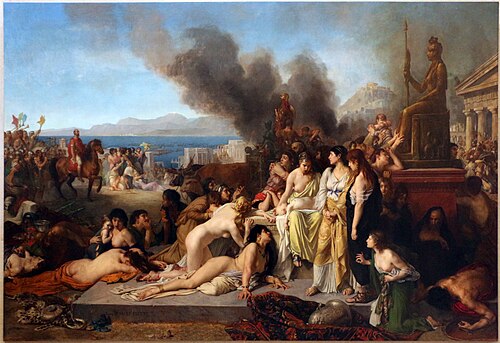
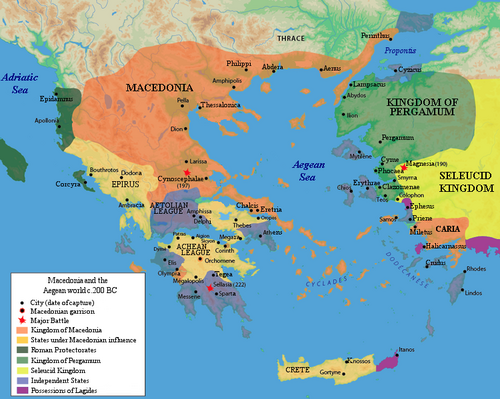
Following the defeat of Carthage, Rome turned its attention to the Hellenistic kingdoms. Through the Macedonian Wars and the eventual destruction of Corinth in 146 BC, Rome brought Greece and much of Asia under its influence, integrating Greek culture and art into the Roman way of life.
Society, Economy, and Military Power
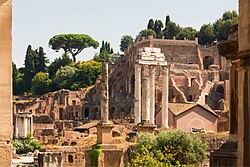
![Temple of Janus as seen in the present church of San Nicola in Carcere, in the Forum Holitorium of Rome, Italy, dedicated by Gaius Duilius after his naval victory at the Battle of Mylae in 260 BC[56]](/images/55/6c/556c4c38a80f4321e25760532843b1f5e1d5f264fe997a4d5b51d68f7021e7cc.jpg)
The Roman Military Machine
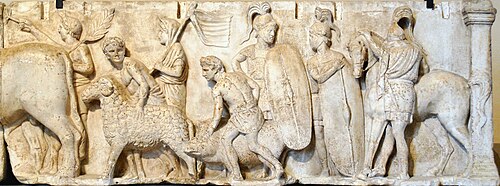
The Republic's success relied on its military organization. Initially utilizing hoplite-style armies, Rome transitioned to the manipular legion, a more flexible tactical unit. By the start of the Second Punic War, Rome could mobilize an immense force; Polybius estimates the available manpower at 770,000 men, with 700,000 infantry and 70,000 cavalry.
Demographics and Urban Life
The population of Italy is a subject of historical debate. "Low count" estimates suggest a population of around four million by the end of the Republic, while "high count" theories suggest between seven and twelve million. By 57 BC, the city of Rome itself may have reached a population of one million people.
The economy was primarily agricultural, but trade and finance flourished. The state provided a frumentatio (grain ration) of up to 33 kg of unmilled wheat monthly to as many as 200,000 citizens starting in 123 BC to ensure social stability.
The Crisis and Fall of the Republic
![Denarius of Gaius Caecilius Metellus Caprarius, 125 BC. The reverse depicts the triumph of his great-grandfather Lucius, with the elephants he had captured at Panormos. The elephant had thence become the emblem of the powerful Caecilii Metelli.[59]](/images/be/67/be670af756b0d0ffcf510f9ea7022087e464b3f27b3f6b795a296d7d75595c96.jpg)
Internal Strife and the Rise of Dictators
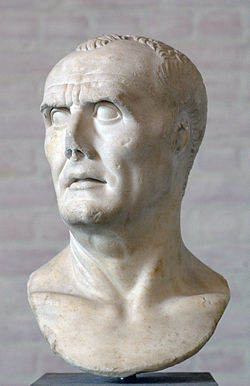
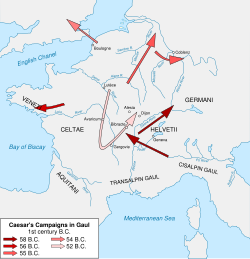
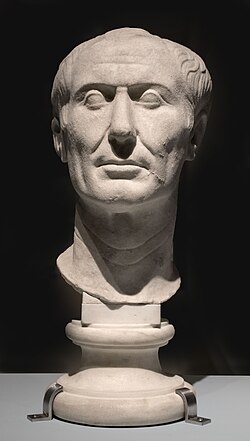
The late Republic was plagued by social unrest and civil wars. The rise of powerful individuals like Gaius Marius and Sulla shifted loyalty from the state to individual generals. This instability culminated in the First Triumvirate and the subsequent rise of Julius Caesar.
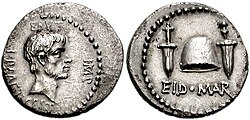
Caesar was named dictator for life in February 44 BC, a move that threatened the traditional republican system. This led to his assassination on the Ides of March (March 15, 44 BC) by a group of senators seeking to restore the Republic.
![Denarius of Caesar, minted just before his murder, in 44 BC. It was the first Roman coin bearing the portrait of a living person.[306]](/images/ee/0c/ee0c4fbdd8a2e0ba82bda74f7e83538e20de6a90db979a7245dfe7580924264f.jpg)
The Transition to Empire
The vacuum left by Caesar led to the Second Triumvirate and a final clash between Octavian and Mark Antony. Following the naval Battle of Actium on September 2, 31 BC, Octavian emerged victorious. In 16 January 27 BC, he was proclaimed Augustus, effectively ending the Republic and initiating the Roman Empire.
| Period/Event | Approximate Date | Key Outcome |
|---|---|---|
| Founding of Republic | c. 509 BC | Overthrow of the monarchy; establishment of consuls. |
| Latin War | 340–338 BC | Dissolution of the Latin League; Roman rule over Latins. |
| First Punic War | 264–241 BC | Rome becomes a naval power; gains Sicily. |
| Second Punic War | 218–201 BC | Defeat of Hannibal; dominance of Western Mediterranean. |
| Sack of Corinth | 146 BC | Consolidation of power over Greece. |
| Assassination of Caesar | 44 BC | End of the dictatorship for life; trigger for final civil wars. |
| Augustus Proclaimed | 27 BC | Formal transition from Republic to Empire. |
Frequently Asked Questions
![The Temple of Hercules Victor, Rome, built in the mid-2nd century BC, most likely by Lucius Mummius Achaicus, victor of the Achaean War[92]](/images/1a/ac/1aac80c3a92d398940a1a4e438b5cfb50fb3e8ae4c44ae709cdec9186f68ea9a.jpg)
![Denarius of Faustus Cornelius Sulla, 56 BC. It shows Diana on the obverse, while the reverse depicts Sulla being offered an olive branch by his ally Bocchus I. Jugurtha is shown captive on the right.[122]](/images/c7/87/c7878fcf50f8f06b9677b7fdd667a967b22f55c689cacf27e6664575e34da66e.jpg)
![A Roman naval bireme depicted in a relief from the Temple of Fortuna Primigenia in Praeneste,[225] c. 120 BC;[226] now in the Museo Pio-Clementino in the Vatican Museums](/images/37/6c/376c56f90680dd2b5e09835665159b50fcc201d07ad2fe15526c8e1f4c8117f7.png)
![The Temple of Portunus, god of grain storage, keys, livestock and ports.[286] Rome, built between 120 and 80 BC](/images/69/78/6978af9c6ec96a9ffef5a12f7c84a244f256f0dc6ec2e44adc057016a27c24f6.jpg)
![Denarius of Lucius Caesius, 112–111 BC. On the obverse is Apollo, as written on the monogram behind his head, who also wears the attributes of Vejovis, an obscure deity. The obverse depicts a group of statues representing the Lares Praestites, which was described by Ovid.[296][297]](/images/c9/b7/c9b7d9b8e4d10cbfe79cfec6787e078c8cc4ae699413ae121b0d01a55b710c8d.jpg)
![Inside the "Temple of Mercury" at Baiae, a swimming pool for a Roman bath, built during the late Roman Republic,[303] and containing one of the largest domes in the world before the building of the Pantheon](/images/26/3e/263e5f47199a0fbef80c557d0c12e69cf1e5240d11d1f5d603ee143fcefa67bd.jpg)
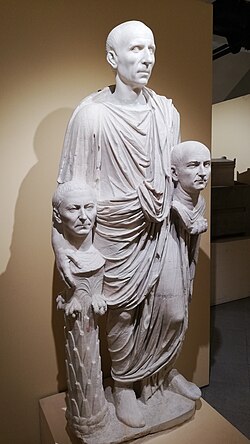
![The Orator, c. 100 BC, an Etrusco-Roman statue of a Republican senator, wearing toga praetexta and senatorial shoes; compared to the voluminous, costly, impractical togas of the Imperial era, the Republican-era type is frugal and "skimpy" (exigua).[311]](/images/82/64/82647da5581a83946b059f490725d68dde60d54aeb4f6ed740dc8fa3a091d870.jpg)
Who were the first consuls of the Roman Republic?
The first consuls, elected around 509 BC after the overthrow of the monarchy, were Lucius Junius Brutus and Lucius Tarquinius Collatinus.
What was the corvus and why was it important?
The corvus was a boarding bridge used by the Roman navy during the First Punic War. It allowed Roman soldiers to board enemy ships, effectively turning a naval engagement into a land-style battle, which played to Rome's strength in infantry combat.
How did the Roman military change during the Republic?
Rome transitioned from using traditional hoplite armies to the manipular legion, which offered greater flexibility on the battlefield. Additionally, the army relied heavily on the Socii (Italian allies), who provided roughly half of the manpower.
What was the frumentatio?
The frumentatio was a state-sponsored grain ration, consisting of up to 33 kg of unmilled wheat, distributed monthly to as many as 200,000 people starting in 123 BC.
Why did the Roman Republic eventually collapse?
The collapse was driven by a combination of social inequality, the rise of military commanders whose soldiers were more loyal to them than to the state, and a series of civil wars that culminated in the rise of Octavian (Augustus).